
At Silverstone on 13 May 1950, the first World Championship Grand Prix started without a single Ferrari on the grid. Enzo Ferrari had fallen out with the organisers over starting money and kept his cars at home. It is the only championship race weekend in seventy-five years that Formula 1's most permanent institution has voluntarily skipped — and by the following month, at Monaco, the red cars were back. Almost every other manufacturer in this story eventually did the opposite: arrived with fanfare, spent enormous sums, and left.
Formula 1's history is often told through drivers. Told through manufacturers, it becomes a very different narrative — a repeating cycle of marketing ambition colliding with the sport's genuine, humiliating difficulty, followed by a recession, a boardroom review, and a press release full of the phrase "changing priorities."
The only constant: Ferrari
Ferrari is the sole entrant to have contested every season since the championship began. It has done so as a fully independent constructor building its own chassis and its own engines, a combination that almost no one else has sustained for more than a decade at a time.
That continuity is not the product of superior management. Ferrari has endured droughts of extraordinary length — no drivers' title between 1979 and 2000, and a constructors' championship gap after 2008 that stretched well past a decade. What it has instead is an identity that makes withdrawal unthinkable. Fiat's stake from 1969 onwards, and later Ferrari's separation into a standalone listed company, changed the ownership repeatedly without ever putting the racing programme genuinely in doubt.
Every other manufacturer in Formula 1 has to justify the expenditure against alternative marketing spend. Ferrari has to justify not racing. That single asymmetry explains more about the sport's history than any technical regulation.
Alfa Romeo won the first championship with a pre-war car
The 1950 title went to Giuseppe "Nino" Farina in an Alfa Romeo 158 — a supercharged straight-eight designed in the late 1930s, before the war interrupted everything. Alfa's cars were so dominant that the "Three Fs" — Farina, Fangio and Luigi Fagioli — simply divided the wins among themselves.
Juan Manuel Fangio took the 1951 title in the developed 159, but by then the 158/159 lineage was straining. The engine was reputedly drinking fuel at a rate approaching a gallon or two per handful of miles, and Ferrari's naturally aspirated 4.5-litre cars had caught up. Alfa Romeo asked the Italian government for development money, was refused, and withdrew at the end of 1951 with a perfect record: two seasons, two championships.
The withdrawal had immediate consequences. With Alfa gone and Formula 1 short of competitive cars, the 1952 and 1953 championships were run to Formula 2 regulations. Alberto Ascari won both for Ferrari, taking nine consecutive Grands Prix across the two seasons.
Alfa Romeo would return as a constructor between 1979 and 1985, having first supplied flat-12 engines to Brabham, and never came close to that early success. Decades later the name reappeared again as a badge on Sauber's cars from 2019 to 2023 — a branding exercise rather than an engineering programme, and a useful illustration of how manufacturer "participation" has come to mean several very different things.
Maserati and the customer car that beat the factories
Maserati's contribution was subtler and arguably more influential. The 250F, introduced in 1954, was a beautifully balanced front-engined car that Maserati was happy to sell to anyone with the money — which meant that for several seasons a large slice of the grid was privateer 250Fs.
Fangio won the 1954 championship having started the season in a 250F before Mercedes-Benz was ready, and returned to Maserati to take the 1957 title, a campaign that included his celebrated pursuit of the Ferraris at the Nürburgring. Maserati withdrew as a works team at the end of that year after financial trouble, though 250Fs kept racing in private hands.
The company came back as an engine supplier in the mid-1960s, building V12s for Cooper; John Surtees won the 1966 Mexican Grand Prix with one. It was Maserati's last meaningful moment in the sport.
Mercedes-Benz: two seasons, two titles, and Le Mans
Mercedes-Benz returned to Grand Prix racing at the French Grand Prix at Reims in 1954 with the W196 — initially in streamlined all-enveloping bodywork that looked like nothing else on the grid — and finished first and second on debut with Fangio and Karl Kling.
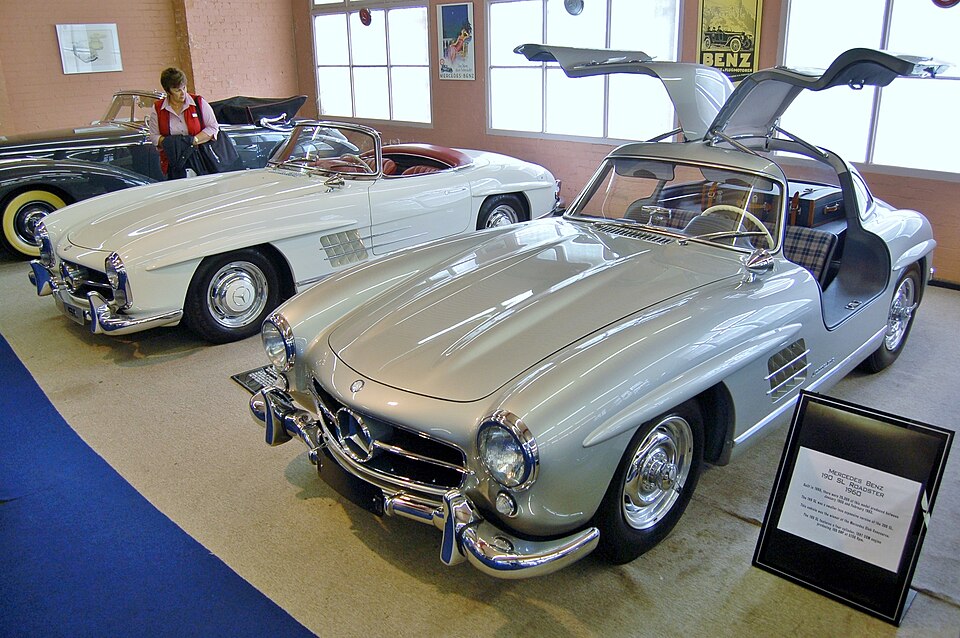
The W196 was a serious engineering statement: desmodromic valve actuation, direct fuel injection derived from aviation work, and an inclined straight-eight. Fangio won the title in 1954 and again in 1955, when Stirling Moss finished second in the standings and the team's superiority became close to absolute.
Then, at Le Mans in June 1955, Pierre Levegh's Mercedes 300 SLR launched into the crowd. More than eighty spectators died along with the driver. It remains the worst disaster in motorsport history. Mercedes completed the season, won everything in sight, and then withdrew from motor racing entirely at the end of 1955.
The company stayed away from Formula 1 for close to four decades. When it came back, it did so cautiously and indirectly — which turned out to be the smartest re-entry strategy any manufacturer has ever executed.
Vanwall and BRM: Britain's first serious attempts
Tony Vandervell made bearings — Vandervell Products supplied "Thinwall" bearings to much of the British motor industry — and he wanted to beat the Italians. Vanwall's cars combined an engine drawing on Norton motorcycle cylinder head practice with a chassis influenced by Colin Chapman and aerodynamic bodywork by Frank Costin.
In 1958 Vanwall won the first ever Constructors' Championship, with Moss and Tony Brooks taking six victories between them. Mike Hawthorn won the drivers' title for Ferrari by a single point. Vandervell's health failed shortly afterwards and the team effectively stopped — a manufacturer that quit immediately after winning, which is rarer than quitting after losing but not unheard of.
British Racing Motors was the other national project, and its early years were a cautionary tale. The BRM V16, a 1.5-litre supercharged sixteen-cylinder screaming to extraordinary revs, was a magnificent noise and a competitive disaster. BRM spent the 1950s being embarrassed and the early 1960s finally getting it right: Graham Hill won the 1962 drivers' championship and BRM the constructors' title with a compact V8. The later H16 engine was another ambitious dead end, and BRM faded out during the 1970s.
The garagistes and the mid-engined revolution
Enzo Ferrari dismissed the small British specialist teams as garagistes — assemblers who bought engines and gearboxes rather than making them. He was factually correct and strategically wrong. The garagistes rewrote Formula 1.
Cooper started it. Charles and John Cooper had been building small rear-engined racers in Surbiton, and putting the engine behind the driver turned out to be transformative: better weight distribution, smaller frontal area, no propshaft running under the driver. Stirling Moss won at Monaco in a privately entered Cooper in 1958, and Jack Brabham took the drivers' and constructors' titles in 1959 and 1960 with Coventry Climax power. Within a few seasons every front-engined car on the grid was obsolete, Ferrari's included.
Colin Chapman's Lotus took the idea further and faster. The Lotus 25 of 1962 introduced the stressed-skin monocoque to Formula 1, cutting weight and multiplying torsional stiffness; Jim Clark won titles in 1963 and 1965. The Lotus 49 of 1967 was designed around a new Ford-funded engine used as a fully stressed chassis member. The wedge-shaped Lotus 72 took Jochen Rindt to a posthumous title in 1970 and Emerson Fittipaldi to another in 1972. The Lotus 78 and 79 then discovered ground effect, and Mario Andretti won the 1978 championship in a car that generated downforce from the shape of its underbody rather than its wings.
Jack Brabham left Cooper to build his own cars and in 1966 became — and remains — the only man to win the world championship in a car bearing his own name, using an Australian-developed Repco V8. Denny Hulme won again for Brabham in 1967. Bernie Ecclestone bought the team in the early 1970s, which set in motion the commercial restructuring of the entire sport.
Bruce McLaren, a Cooper driver, founded his own team in 1963 and it entered Formula 1 in 1966. Bruce was killed testing a Can-Am car at Goodwood in 1970, and the team he left behind became one of the two most successful in the sport's history.
Frank Williams spent years running other people's cars on almost no money before partnering with the engineer Patrick Head. Ken Tyrrell ran Jackie Stewart to the 1969 title in a Matra, then built his own cars and won again in 1971 and 1973 — and, in 1976, entered the six-wheeled P34, which actually won a Grand Prix in Sweden.
None of these were car manufacturers. All of them beat car manufacturers, consistently, for decades. That is the central tension of Formula 1's history: the specialists are usually better at it than the industrial giants.
The Ford Cosworth DFV democratised the grid
The single most consequential decision any manufacturer ever made in Formula 1 was Ford's, and it cost roughly £100,000.
When the 3-litre formula arrived in 1966, Chapman needed an engine. Walter Hayes, a Ford of Britain executive with an unusually good instinct for public relations, persuaded the company to fund Keith Duckworth at Cosworth to design one. The result was the Double Four Valve — the DFV — a compact 90-degree V8 that debuted at Zandvoort in 1967 in the back of a Lotus 49 and won first time out with Jim Clark.
Ford's genius was in what happened next. After a season of Lotus exclusivity, the DFV was sold to anyone who wanted one. A small team could buy a competitive engine, bolt it to a Hewland gearbox and a self-built tub, and win Grands Prix. Tyrrell did. Matra did. McLaren, Williams, Brabham, Lotus, March, Wolf and Hesketh all built championship-capable or race-winning cars around it.
The DFV won over 150 Grands Prix and remained a race-winning proposition into the early 1980s, by which time turbochargers had finally overwhelmed it. No engine before or since has so thoroughly flattened the barrier to entry — and Ford did it on a budget a modern manufacturer would spend on hospitality.
Honda's first adventure, and its abrupt end
Honda entered Formula 1 in 1964 as a complete constructor — chassis and engine — barely more than a decade after building its first motorcycle. It was an audacious statement of intent from a company still very small by global standards.
Richie Ginther won the 1965 Mexican Grand Prix in the RA272, giving Honda its first victory and Goodyear its first in Formula 1. John Surtees won at Monza in 1967 in the RA300, a car built in Britain around a Honda V12 in a hurry.
Then the RA302, an air-cooled magnesium-bodied car Surtees considered unready, was entered at Rouen in 1968. Jo Schlesser crashed on the second lap and was killed in the ensuing fire. Honda withdrew from Formula 1 at the end of that season and did not return as a constructor for decades. It is the first clear instance of a pattern: a manufacturer arrives to prove something, achieves part of it, meets tragedy or difficulty, and leaves.
Renault lights the turbo fuse
The regulations had permitted 1.5-litre forced-induction engines alongside 3-litre naturally aspirated ones since 1966, and everybody ignored the clause. Renault did not.
The turbocharged Renault RS01 appeared at Silverstone in 1977 and spent two seasons being nicknamed the "yellow teapot" for its habit of stopping in a cloud of steam. Then, at Dijon in 1979, Jean-Pierre Jabouille won the French Grand Prix — the first Formula 1 victory for a turbocharged car, on home soil, on French Michelin tyres. The race is remembered mostly for the wheel-banging duel behind him between René Arnoux and Gilles Villeneuve.
Within five years the entire grid was turbocharged, qualifying engines were producing power figures north of 1,000 horsepower in short bursts, and the naturally aspirated era was over. Renault, having proved the concept, never won a championship with its own works team, and withdrew it at the end of 1985 while continuing to supply engines.
That is a specifically Renault kind of story, and it repeats. The company's engines went on to win a remarkable number of titles in other people's cars.
The turbo rush: BMW, Porsche and Honda again
BMW built a 1.5-litre four-cylinder turbo — the M12/13, based on a production-derived iron block, some of them reputedly aged by being run in road cars first — and supplied it to Brabham. Nelson Piquet won the 1983 drivers' championship with it, making BMW the first manufacturer to power a turbo world champion.
Porsche built the TAG-badged V6 that McLaren used from 1983 to 1987, funded by Techniques d'Avant Garde and designed to John Barnard's packaging requirements rather than Porsche's preferences. It won three consecutive drivers' titles: Niki Lauda by half a point in 1984, then Alain Prost in 1985 and 1986.
Porsche's own direct history is thinner than its reputation suggests. It ran a works team in 1961 and 1962, and Dan Gurney's win in the flat-eight 804 at Rouen in 1962 remains Porsche's only Grand Prix victory as a constructor. A 1991 return with a heavy, underpowered V12 for Footwork was abandoned mid-season and is best forgotten.
Honda came back in 1983 as an engine supplier, first with the tiny Spirit team, then with Williams. The Williams-Honda FW11 won the constructors' championship in 1986 and Piquet took the drivers' title in 1987.
McLaren-Honda and the most dominant season ever
Honda switched its primary effort to McLaren for 1988, and the result was the MP4/4 — a low-slung Steve Nichols and Gordon Murray design with Ayrton Senna and Alain Prost driving. It won fifteen of the season's sixteen races. The only loss came at Monza, where Senna collided with a backmarker while leading, weeks after Enzo Ferrari's death, handing Ferrari a one-two that the tifosi have never stopped talking about.
McLaren-Honda took four consecutive drivers' and constructors' championships from 1988 to 1991, across the switch from turbo to 3.5-litre naturally aspirated V10s and V12s. Honda then withdrew again, at the end of 1992, as Japan's asset price bubble collapsed.
Note the timing. Honda left in 1992, in a recession. BMW would leave in 2009, in a recession. Toyota left in 2009. Honda left again in 2008. This is not coincidence — it is the mechanism.
The 1990s: expensive lessons for Peugeot and Lamborghini
The 1990s saw a scattering of manufacturer engine programmes that produced almost nothing.
Peugeot supplied McLaren in 1994 — a single unhappy season notable for engine failures — then Jordan from 1995 to 1997 and Prost from 1998 to 2000, before selling the programme off. Peugeot never won a Grand Prix in Formula 1, despite being one of the most successful rally and sportscar manufacturers of the era.
Lamborghini, then under Chrysler ownership, built a V12 that appeared in Larrousse, Lotus, Ligier and Minardi cars between 1989 and 1993. It was famously tested by McLaren in late 1993, and Senna reportedly liked it, but the deal never happened. Lamborghini never won a Formula 1 race either.
Yamaha, Subaru (via a disastrous Motori Moderni flat-12), Ilmor, Judd and Hart all had their turns. The lesson repeatedly delivered was that building a Formula 1 engine is not the hard part. Building one that is light, reliable, packageable and powerful — all four, simultaneously, against people who have been doing it for thirty years — is the hard part.
Mercedes came back through the side door
Mercedes-Benz's return in 1994 was, in retrospect, a masterclass. Rather than building a works team, it took a stake in Ilmor Engineering — the British firm founded by Mario Illien and Paul Morgan — and had Ilmor's engines badged as Mercedes, first with Sauber, then from 1995 with McLaren.
McLaren-Mercedes won drivers' titles with Mika Häkkinen in 1998 and 1999 and with Lewis Hamilton in 2008. Mercedes acquired Ilmor's Formula 1 operation outright, giving it a genuinely world-class engine facility at Brixworth that it had not had to build from scratch.
Only in 2010 did Mercedes take the final step, buying the Brawn team — itself the reconstituted Honda operation — and returning as a works constructor for the first time since 1955. It took four seasons to become competitive. Then it took over the sport.
The millennial wave: Jaguar, Toyota, BMW, Renault and Honda
The early 2000s brought the largest manufacturer influx in the sport's history. At its peak, works or semi-works efforts from Ferrari, Mercedes, Renault, Honda, Toyota, BMW and Ford's Jaguar were all on the grid at once.
Ford bought Stewart Grand Prix and rebranded it Jaguar for 2000. It was a well-funded, badly run programme with constant management churn — five years, two podiums, no wins. Ford sold it to Red Bull at the end of 2004 for a nominal sum, and Red Bull promptly built the most successful team of the following two decades on the same factory site at Milton Keynes.
Renault bought Benetton in 2000 and ran as a full works constructor from 2002. It worked: Fernando Alonso won the 2005 and 2006 drivers' championships and Renault took both constructors' titles. Then Renault scaled back, sold down its stake, and reverted to engine supply — powering Red Bull to four consecutive doubles from 2010 to 2013 with Sebastian Vettel.
Honda bought BAR outright for 2006, won a single race with Jenson Button in Hungary that year, and then produced two poor seasons. In December 2008, with the global financial crisis in full swing, Honda announced its withdrawal with almost no notice. Ross Brawn led a management buyout, fitted Mercedes engines, and won both championships in 2009 with a car Honda had paid for. That is the single most painful data point in the entire manufacturer story.
Case study: Toyota, eight seasons, no wins
Toyota's Formula 1 project is the definitive example of money failing to buy competence.
The team was built from scratch at Toyota Motorsport's Cologne facility, which already had deep rallying experience, and entered in 2002. For most of its existence it was believed to have the largest budget on the grid — larger than Ferrari's. It had a full-scale wind tunnel, a dedicated engine operation, and access to essentially unlimited corporate resources.
Across eight seasons it scored a small number of poles and a respectable tally of podiums, but never won a Grand Prix. It came close a few times, most notably in the strong early stages of 2009, and never converted.
The diagnosis is consistent among people who worked there: decisions requiring speed went through a corporate hierarchy built for consensus, technical leadership rotated, and the operation was in Germany while the sport's talent pool and supply chain were concentrated in a corridor of southern England. It optimised for process in a sport that rewards a single stubborn engineer overruling everyone.
Toyota withdrew in November 2009. Its engines had also powered Williams and the Jordan/Midland lineage, and those disappeared with it.
Case study: BMW, and leaving right after winning
BMW's second era was shorter and stranger. Having supplied Williams with V10s from 2000 to 2005 — a partnership that produced wins and a genuine title challenge in 2003 but ended in mutual frustration — BMW bought the Sauber team and ran BMW Sauber from 2006.
It improved fast. In 2007 it was the clear third force. In 2008, Robert Kubica won the Canadian Grand Prix and led the drivers' championship in mid-season. The team then made the defensible decision to switch development to the radically different 2009 regulations, and the 2009 car was a failure.
In July 2009 BMW announced its withdrawal at the end of the year, citing sustainability and shifting strategic priorities. Peter Sauber bought his team back. Fewer than twelve months separated leading the world championship from leaving the sport.
The BMW case is instructive because the racing operation was not incompetent. It was killed by the parent company's calculation that the marketing return no longer justified a nine-figure annual outlay during a collapse in car sales. That calculation is made in every recession, in every manufacturer boardroom, and it almost always produces the same answer.
The hybrid era and eight years of Mercedes
The 1.6-litre turbo-hybrid V6 power units introduced in 2014 were the most complex engines the sport had ever seen, combining a turbocharged internal combustion engine with energy recovery from both braking and exhaust gases, and demanding thermal efficiency figures no road engine approaches.
Mercedes had prepared better than anyone. The split-turbo layout — compressor at the front of the engine, turbine at the rear, joined by a shaft through the vee — gave packaging and cooling advantages that took rivals years to replicate. Mercedes won eight consecutive constructors' championships from 2014 to 2021, with Lewis Hamilton taking six drivers' titles in that span and Nico Rosberg one in 2016.
Ferrari and Renault took several seasons to close the gap, and Honda's 2015 return with McLaren was a catastrophe. The "size zero" concept — a radically compact power unit designed to McLaren's aerodynamic requirements — was underpowered and unreliable, and the partnership collapsed acrimoniously in 2017.
Red Bull and Honda: the manufacturer that stayed by leaving
Honda then did something unexpected. Instead of quitting, it took the humbler route: supplying Toro Rosso in 2018, learning without pressure, then Red Bull in 2019.
The results were extraordinary. Max Verstappen won the 2021 title, and Red Bull-Honda power went on to dominate the following seasons. Honda had formally announced its withdrawal at the end of 2021 for carbon-neutrality reasons, then continued supplying and supporting the engines under a Red Bull Powertrains badge anyway — a manufacturer publicly leaving and privately staying, which may be the most modern arrangement of all.
From 2026, Honda returns as a full works supplier — to Aston Martin.
2026: Audi, Cadillac, Ford and Aston Martin
The 2026 regulations — power units split roughly evenly between combustion and electrical power, running fully sustainable fuel, with the MGU-H removed — were written explicitly to attract manufacturers. They worked.
Audi has taken over the Sauber operation at Hinwil and entered as a full works team, with power units built at Neuburg an der Donau. It is the Volkswagen Group's first Formula 1 entry, and it arrives with a target of championship contention within several seasons rather than immediately — a notably more realistic public posture than Toyota's.
Porsche, Audi's sister brand, spent 2022 negotiating an equity stake in Red Bull and walked away when Red Bull declined to cede control. Porsche then confirmed it would not enter. The near-miss is a useful reminder of how contingent these decisions are.
Cadillac joined as the eleventh team, backed by General Motors and TWG Motorsports, initially running customer power units while GM develops its own — the first genuinely new American manufacturer presence in Formula 1 in a very long time.
Ford returned as Red Bull's power unit partner, contributing to the electrical side of Red Bull Powertrains rather than building a complete engine — a deliberately capital-light structure that reflects everything Ford learned from Jaguar.
Aston Martin completed a long journey back. Its first attempt, the front-engined DBR4 of 1959, was obsolete before it raced and scored almost nothing. The name returned as Red Bull's title sponsor in the late 2010s, then in 2021 Lawrence Stroll rebranded the Racing Point team — the descendant of Jordan, Midland, Spyker and Force India — as a works Aston Martin entry, built a new factory at Silverstone, hired Adrian Newey, and secured Honda's works engines for 2026.
Alpine, meanwhile, moved the other way: Renault ended its own power unit programme, and the works Renault-badged team now runs customer Mercedes engines. After forty-eight years of building Formula 1 engines at Viry-Châtillon, France's most successful engine manufacturer stopped.
The manufacturer scoreboard
| Manufacturer | Peak involvement | Titles as constructor | How it ended |
|---|---|---|---|
| Ferrari | 1950–present | Many, in every era | Never left |
| Alfa Romeo | 1950–51, 1979–85, badge 2019–23 | 1950, 1951 (drivers') | Funding refused; later a badge |
| Maserati | 1954–57 works, engines to 1967 | 1957 (drivers') | Financial collapse |
| Mercedes-Benz | 1954–55, 1994– engines, 2010– works | 1954, 1955; 2014–21 | Withdrew after Le Mans; returned |
| Vanwall | 1956–58 | 1958 constructors' | Stopped after winning |
| BRM | 1950s–1970s | 1962 | Slow decline |
| Ford (Cosworth) | 1967–2004 engines | Powered many champions | Costs outgrew the model |
| Honda | 1964–68, 1983–92, 2000–08, 2015– | Powered 1986–91, 2021– | Left three times, back again |
| Renault | 1977–85, 2002–09 works, engines throughout | 2005, 2006 | Engine programme ended |
| BMW | 1982–87, 2000–09 | 1983 (drivers', with Brabham) | Withdrew in the crisis |
| Toyota | 2002–09 | None | Withdrew, winless |
| Jaguar | 2000–04 | None | Sold to Red Bull |
| Peugeot | 1994–2000 engines | None | Sold the programme |
| Porsche | 1961–62, TAG 1983–87, 1991 | 1984–86 as TAG engine | Never re-entered |
| Lamborghini | 1989–93 engines | None | Quietly stopped |
| Audi | 2026– | — | — |
| Cadillac | 2026– | — | — |
Why the cycle repeats
Strip away the individual stories and the same sequence appears again and again.
A manufacturer enters when its business is healthy and its marketing department wants global reach. Formula 1 offers an audience measured in hundreds of millions, in markets where the manufacturer wants to grow, with a halo of technical credibility no advertising campaign can buy.
It then underestimates the difficulty. Executives who run factories building millions of cars a year assume that a racing team of a few hundred people is a manageable subsidiary. It is not. Formula 1 is a compressed development race in which a decision made on Tuesday shows up on the car by Friday, and the organisational instincts that make a car company successful — consensus, risk aversion, documented process — are actively harmful.
Then the results fail to arrive on schedule. A three-year plan becomes a five-year plan. The budget grows because the only visible lever is spending. Internal critics start asking what the return actually is, and nobody can answer with a number.
Then a recession arrives — 1992, 2008–09, or any of the smaller shocks — and the answer becomes obvious. Motorsport budgets are among the easiest cuts to justify to shareholders because they are large, discretionary, and visible.
The specialists survive these cycles because racing is not a line item for them; it is the entire company. McLaren, Williams and Red Bull have no alternative use for their factories. Ferrari sells road cars because it races, not the other way round.
The 2026 rules and the budget cap have altered the arithmetic somewhat. A cost ceiling makes the downside knowable, and rising team valuations mean a manufacturer that exits can now sell rather than simply write off the loss. Whether that is enough to break a seventy-five-year pattern is the open question of the current era.
Watch the entry, and then watch the third year
If you want to predict which of the current manufacturers will still be here in a decade, ignore the launch events. Look instead at what happens in year three, when the car is midfield, the technical director has been replaced once, and the parent company's sales are soft.
The teams that survive that moment are the ones where somebody senior has decided that leaving is not an available option. Ferrari made that decision in 1950 and has never revisited it. Audi and Cadillac are about to find out whether they made it too.
Next time you see a manufacturer badge on a Formula 1 car, it is worth asking a simple question: is the company racing, or is it advertising? The answer usually tells you how long it will stay.


