
In June 1923, a 25-year-old racing driver won a minor event on the Savio circuit near Ravenna and was introduced to an elderly count in the paddock. The count's son had been Italy's leading fighter ace of the First World War, shot down over the Montello five years earlier. Some time later the ace's mother told the young driver to paint her son's personal emblem on his cars: it would bring him luck. The driver was Enzo Ferrari. The emblem was a black horse rearing on its hind legs.
That is the most famous animal transplant in automotive history, but it is far from the only one. Look along any row of parked cars and you are looking at a small, silent zoo: a bull, a lion, a leaping cat, a griffin, a serpent eating a man, a scorpion, a ram, a bulldog. Almost none of these creatures were chosen by a marketing department. They arrived from battlefields, medieval coats of arms, saw-blade catalogues, bullfighting rings and the astrological birth signs of stubborn founders — and then, because badges outlive the people who commission them, they stayed.
Why animals ended up on radiator grilles in the first place
The car badge inherited its grammar from heraldry, which had spent seven centuries solving exactly the problem early automakers faced. A knight in a closed helm needed to be identifiable from a distance, at speed, by people who could not read. So did a car.
Heraldry had already ranked its animals. The lion meant courage and sovereignty. The eagle meant dominion and altitude. The griffin — lion's body, eagle's head and wings — meant both at once, and was reserved for guardians of treasure. The serpent meant cunning and, in the Milanese reading, dynastic power. A manufacturer who put one of these on a radiator was not inventing a symbol; it was borrowing an old one with its meanings pre-installed.
There were practical reasons too. Trademark offices reward distinctiveness, and a rearing horse is far easier to defend than a name in a nice typeface. An animal survives translation — a bull is a bull in every market you sell into. And crucially, an animal implies a vector. Horses gallop, snakes strike, cats pounce. A badge that implies motion is doing free advertising every time the car stands still.
Ferrari's prancing horse: an inheritance from a dead pilot
Francesco Baracca flew SPAD fighters for the Italian air corps and was credited with 34 aerial victories before he was killed in June 1918, at 30. He painted a black rearing horse on the fuselage of his aircraft — a cavalryman's emblem, since he had come to flying from the Piemonte Reale Cavalleria.
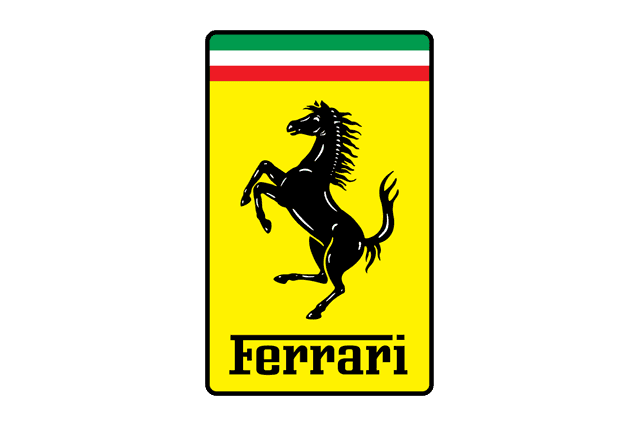
Enzo Ferrari met Baracca's father, Count Enrico, at Ravenna in 1923, and later his mother, Countess Paolina. Her instruction was simple: use my son's horse, it will bring you fortune. Ferrari added his own contribution — a canary-yellow shield behind it, yellow being the civic colour of his native Modena — and topped it with the green, white and red of the Italian flag.
The horse did not appear on a car for nearly a decade. Ferrari was still running Scuderia Ferrari as Alfa Romeo's racing arm, and the cavallino rampante made its competition debut on Alfas at the Spa 24 Hours in July 1932. The Scuderia badge of that era was a rectangular shield, not the later oval, and it is the shape you still see on the front wings of road cars today.
One detail rewards attention. In Baracca's version the horse's tail hangs downward; Ferrari's tail sweeps up. It is a small change with a large effect — the raised tail turns a static cavalry crest into something coiled and about to move.
Porsche's horse came from a stud farm, and the antlers came from a duchy
Sixty kilometres of autobahn from nowhere in particular, a second black horse rears on a second yellow field — and it has nothing to do with Baracca.
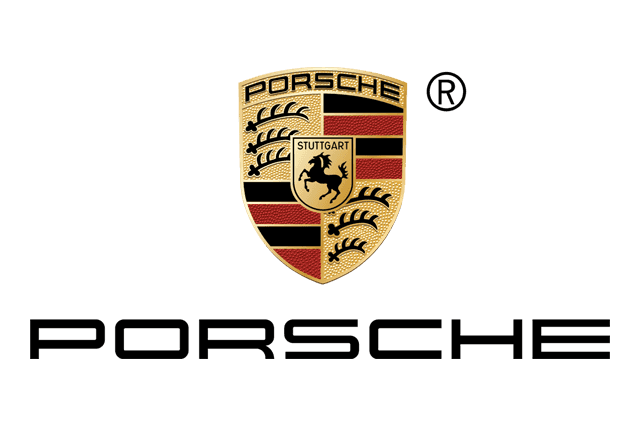
Stuttgart's name is a worn-down form of Stuotgarten, "stud garden": a horse-breeding estate established in the tenth century, traditionally credited to Duke Liudolf of Swabia. The city took a rearing horse as its arms and has kept it ever since. Porsche, headquartered in Stuttgart-Zuffenhausen, simply used its home city's coat of arms.
The surrounding crest is the other half of the story. The stylised antlers and the red-and-black stripes come from the arms of Württemberg — after 1945 the state of Württemberg-Hohenzollern, then Baden-Württemberg — so the badge is really a coat of arms inside a coat of arms: the city sitting within the region.
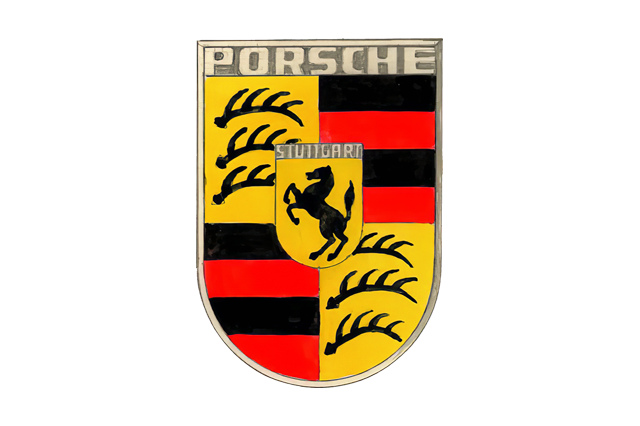
The crest arrived in the early 1950s, at a moment when Porsche was discovering America. The design work is generally credited to Franz Xaver Reimspiess, an engineer who had also worked on the Volkswagen emblem, and the crest first reached customers on 356 steering-wheel hubs before it migrated to the nose. Note what Porsche did not do: it never claimed the horse meant horsepower. The horse is municipal paperwork that happened to be perfect.
| Ferrari | Porsche | |
|---|---|---|
| Source | Personal emblem of a WWI fighter ace | Coat of arms of the city of Stuttgart |
| Yellow field means | Modena, Enzo's home city | Stuttgart's civic gold |
| Direction | Rearing left, tail raised | Rearing left within a quartered shield |
| Added elements | Italian tricolour, S F monogram | Württemberg antlers and stripes |
The Mustang's pony gallops, and it gallops the other way
Ford's own badge is a script in a blue oval — no animal anywhere. But the company owns one of the most recognisable horses in the world, and it belongs to a single model line.
The Mustang launched at the New York World's Fair in April 1964, and the running horse in its grille corral came out of the design studio rather than a coat of arms. Sketches by Phil Clark are the ones usually credited with fixing the pony's form. Where the name came from is still argued: designer John Najjar always said he had the P-51 Mustang fighter in mind, while market researcher Robert Eggert pushed the wild horse of the American West after reading a book about them.
Two things distinguish it from the European horses. First, it runs — legs extended, all four feet off the ground — rather than rearing. Rearing is a display of dominance; galloping is simply speed, which is the American argument. Second, it runs to the viewer's left, against the direction most heraldic beasts face, and Ford has cheerfully encouraged the folklore that this is because a wild mustang answers to nobody.
The horse has been through decades of restyling, but the corral has proved almost impossible to abandon. When Ford has tried to modernise it, buyers have pushed back, which tells you something about what a good animal badge is worth.
Lamborghini's raging bull began as a birth sign and became a naming convention
Ferruccio Lamborghini was born in April 1916, which makes him a Taurus, and he was superstitious enough about it to build a company identity around a bull.
The interest was not purely astrological. In 1962 Lamborghini visited the Seville ranch of Don Eduardo Miura, breeder of some of Spain's most notoriously dangerous fighting bulls. The gold bull on a black shield, adopted for the new car company in 1963, was drawn to be as aggressive as the Ferrari horse was elegant — head down, shoulders loaded, one hoof scraping.
What makes Lamborghini unusual is that the badge became a rule. Almost every model since has been named after a bull, a bullfighting term, or a place associated with the ring.
| Model | Where the name comes from |
|---|---|
| Miura | Don Eduardo Miura's fighting-bull breeding line |
| Islero | The Miura bull that killed the matador Manolete in 1947 |
| Espada | Spanish for "sword" — also slang for the matador |
| Jarama | A bullfighting region north of Madrid |
| Urraco, Jalpa, Gallardo | Named fighting-bull breeds |
| Diablo | A famously ferocious nineteenth-century bull |
| Murciélago | A bull that survived a punishing fight and was spared, then bred |
| Aventador, Huracán, Revuelto | Individual bulls remembered from the ring |
| Urus | The aurochs, the extinct wild ancestor of cattle |
The exception proves how strong the rule is. The Countach is not a bull at all — the name is a Piedmontese exclamation, roughly an astonished profanity, reportedly blurted out by someone seeing the prototype. It is the one Lamborghini that broke the convention and, inevitably, the one everybody remembers.
Peugeot's lion has been redrawn for more than 170 years — and it started on saw blades
Peugeot's lion is the oldest continuously used animal mark in the car industry, and it predates the car by roughly four decades.
The Peugeot family were millers who moved into steel in the early nineteenth century, making saw blades, coffee grinders, crinoline hoops and umbrella frames long before anything with wheels. The lion was registered as a trademark in 1858, drawn by a goldsmith from Montbéliard named Justin Blazer, and the brief was oddly literal: the lion was meant to advertise three qualities of a Peugeot saw blade — teeth as hard as a lion's, a spine as flexible as the animal's back, and a cut as fast as its pounce.
The lion is also regional. It is the heraldic beast of Franche-Comté and of Belfort, the nearby city whose colossal stone lion commemorates a siege — a local emblem that a local family would naturally reach for.
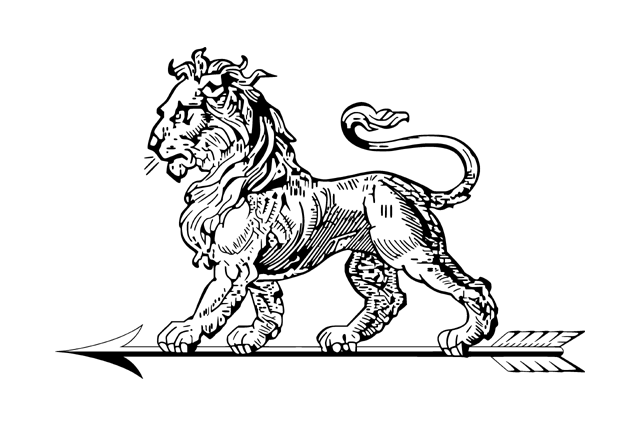
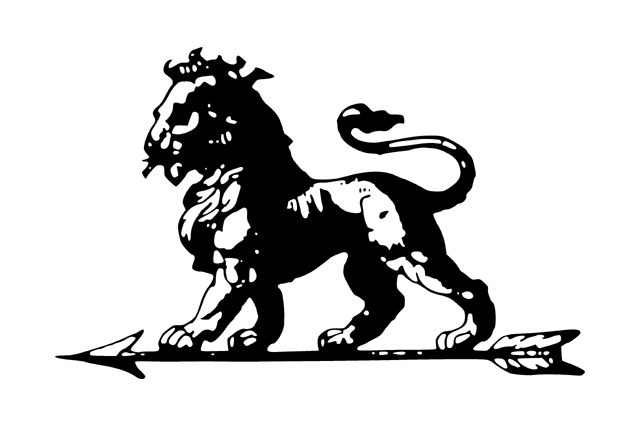
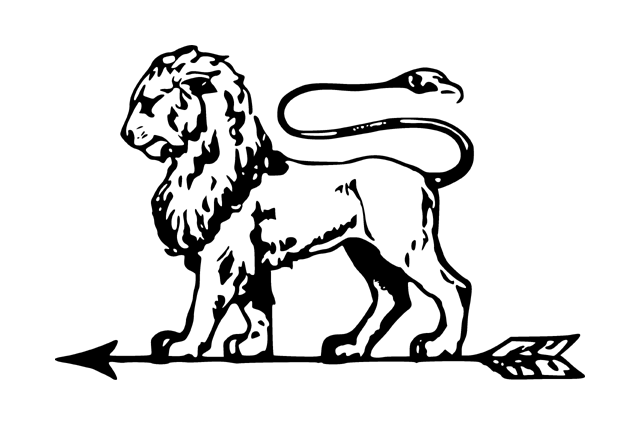
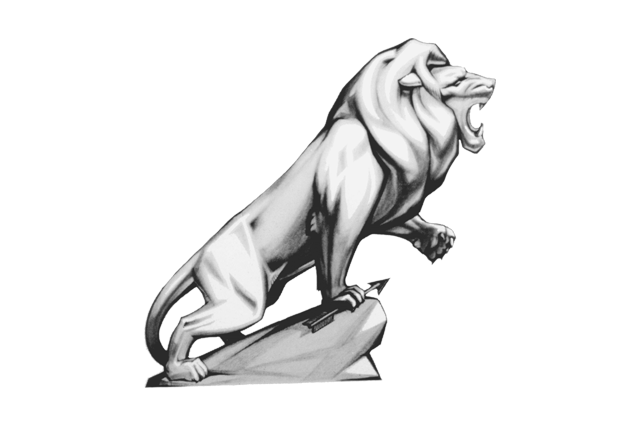
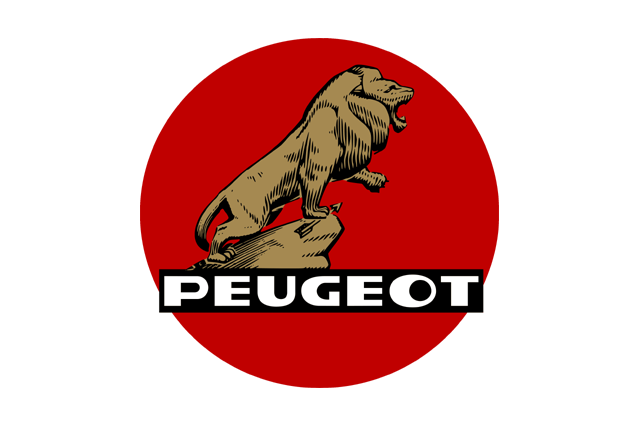
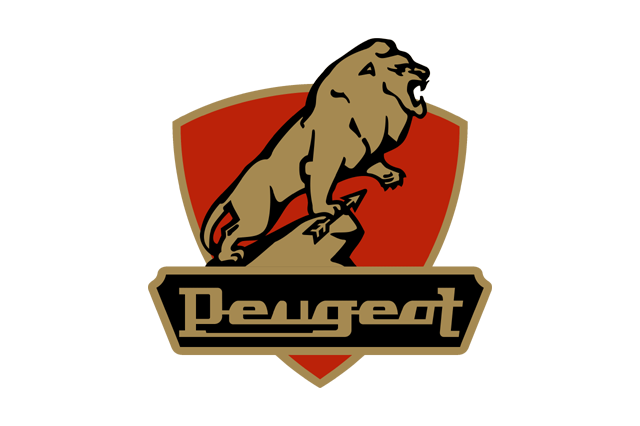
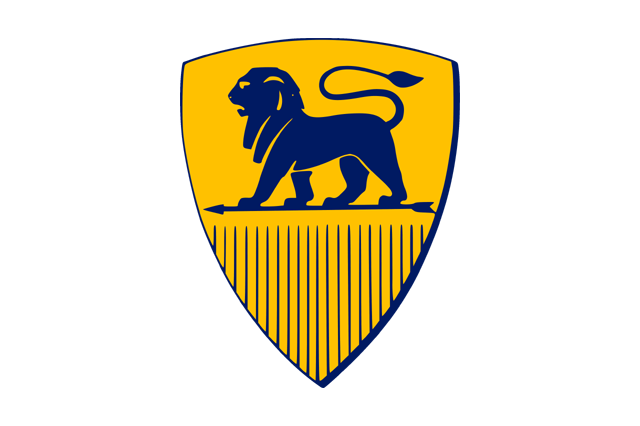

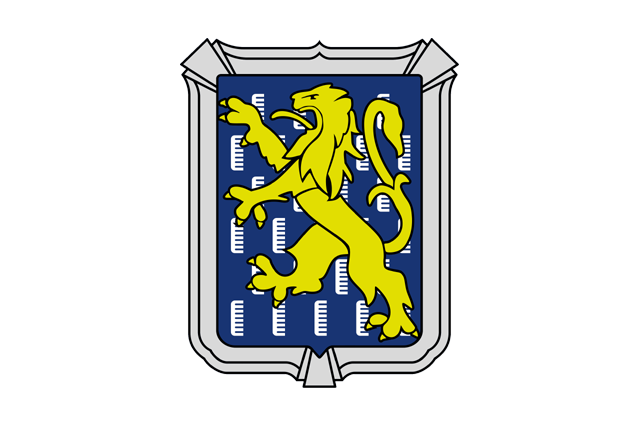
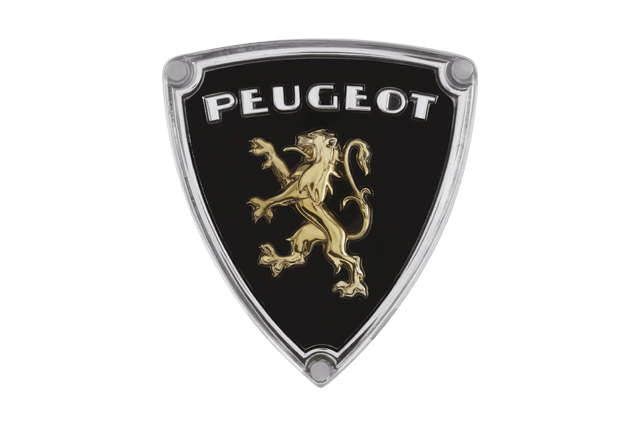
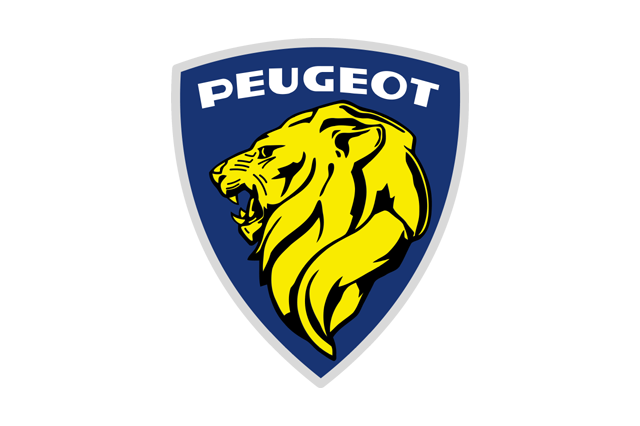
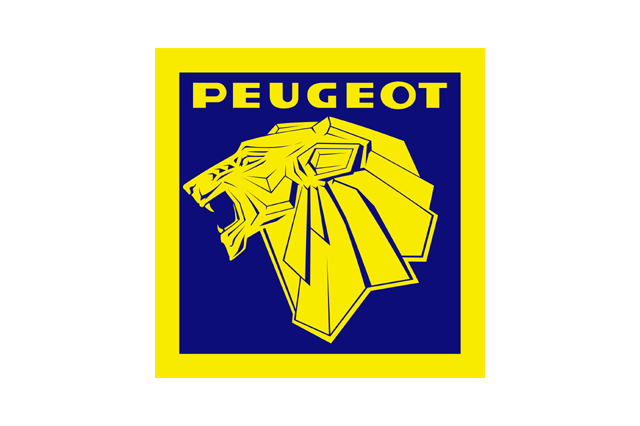

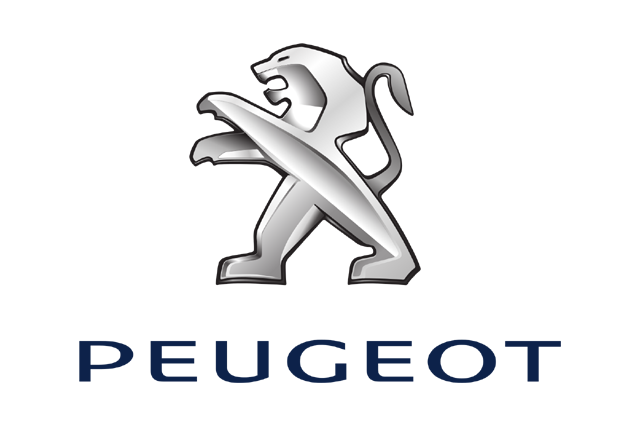
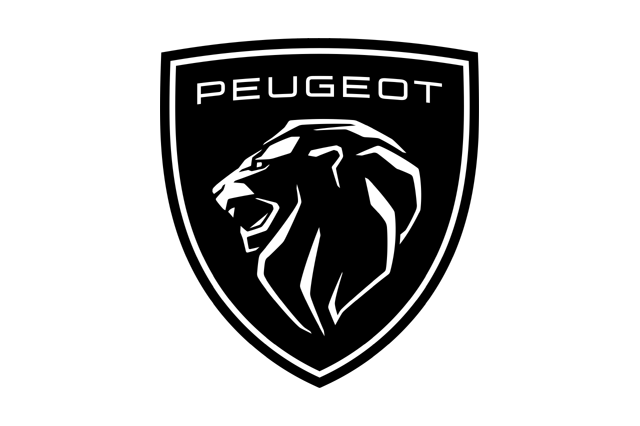
Track it through the decades and you can read industrial design history off a single animal. The early-twentieth-century lion walks along an arrow. The interwar versions become heraldic and static. In 1948 a full rampant lion appears, standing on its hind legs in profile. By 1960 the whole body has been discarded and only the head remains, flattened into something that could be stamped cheaply into chrome.
The 1970s outline lion is pure minimalism — a few unbroken strokes, no interior detail. The late 1990s brought a more muscular, sculptural cat, the 2010s a glossy three-dimensional chrome one, and then in 2021 Peugeot did something clever: it went back to a lion's head inside a shield, a deliberate echo of the 1960s mark, redrawn as flat vector artwork that reads perfectly on a phone screen.
That round trip — body, to head, to outline, to chrome, back to head — is the whole industry's badge story compressed into one animal.
Griffins: Vauxhall, Scania and Saab all guard the same treasure
The griffin is heraldry's hybrid: eagle's head, wings and talons on a lion's body, understood since antiquity as a guardian. Three vehicle makers use it, and their reasons are entirely separate.

Vauxhall's comes from a thirteenth-century Norman mercenary, Falkes de Bréauté, who acquired a manor house in London through marriage. The place became known as Fulk's Hall, which slurred over centuries into Vauxhall — the district that gave its name to the Vauxhall Iron Works, founded there in 1857. The griffin was on de Bréauté's arms, so the ironworks took it, and it survived the move to Luton in 1905 and the General Motors takeover in 1925. For much of the twentieth century the griffin held a flag bearing a V.

Scania's griffin head is civic rather than feudal. Skåne — Scania in Latin — is Sweden's southernmost province, and its coat of arms is a crowned griffin head. The truck maker took the region's emblem along with its name.
Saab's griffin is inherited from Scania by corporate marriage: the aircraft maker and Scania-Vabis merged in 1969, and the griffin head came with the deal. Saab's use of it was intermittent afterwards — the two businesses separated in the 1990s, ownership of the mark had to be negotiated, and the griffin appeared and vanished from Saab's nose across the General Motors years. Few badges have been so directly hostage to the corporate structure behind them.
Holden's lion invented the wheel
Australia's national marque wore a lion, but not a heraldic one. The emblem, adopted around 1928 and attributed to the sculptor Rayner Hoff, shows a lion with a paw on a rolling stone.
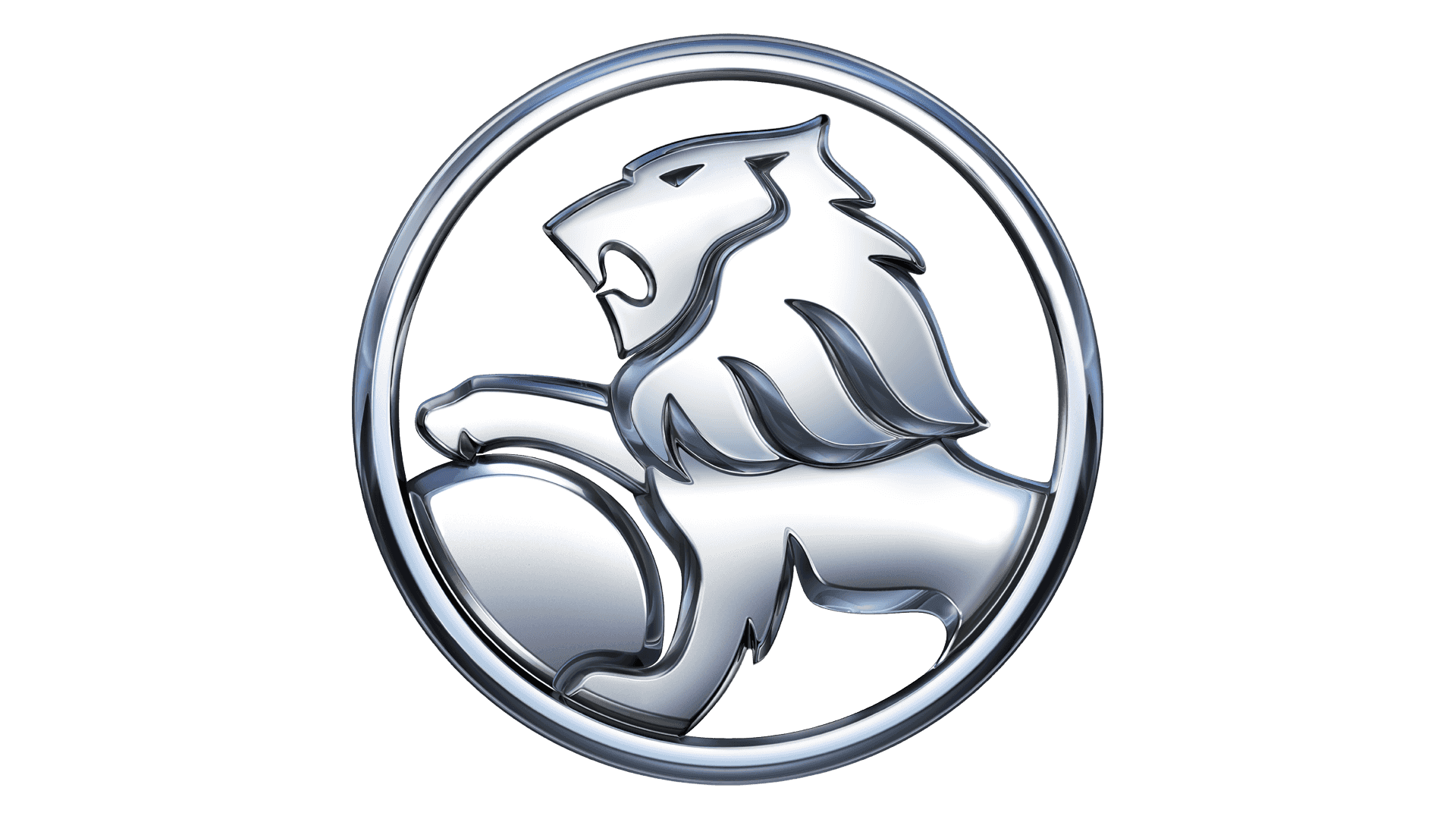
The reference is a fable — that early humans got the idea of the wheel from watching lions roll stones. It is a myth with no archaeological basis whatsoever, and it is exactly the right story for a company that began in 1856 as a saddlery in Adelaide, moved into carriage trimming, then car bodies, then complete cars. Holden's lion is about invention rather than aggression, which makes it the odd one out in this menagerie. It was retired along with the brand at the start of the 2020s.
Alfa Romeo's serpent is eating a man, and has been since 1910
No badge in the industry is stranger than Alfa Romeo's. On one half, the red cross of Milan on white. On the other, a crowned serpent with a human figure in its jaws.
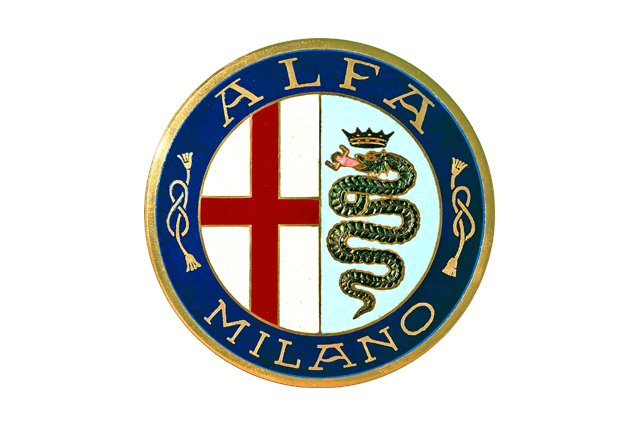
The company's account of the design is that a young draughtsman, Romano Cattaneo, was waiting for a tram at Piazza Castello in Milan in 1910 when he looked up at the Filarete tower of the Sforza Castle and saw the biscione — the crowned grass snake of the Visconti, the dynasty that ruled Milan for close to two centuries. He put it beside the city's crusader cross, and A.L.F.A. had a badge before it had a reputation.
What the snake is doing has never been settled. One reading is a Saracen being devoured, tied to a crusading legend about Ottone Visconti. Another, gentler reading is that the figure is a child emerging renewed, a symbol of rebirth. Alfa itself has generally declined to pick a side, and modern versions of the badge are drawn ambiguously enough that you can believe whichever you prefer.
The surrounding details are a political timeline. Savoy dynastic knots flanked the badge in the monarchy years and were removed after Italy became a republic in 1946. The word MILANO sat under the emblem until the early 1970s, when it was dropped — the Alfasud was being built at Pomigliano d'Arco near Naples, and claiming Milan had become awkward. The 2015 redesign flattened everything into a single colour and a clean circle, and in doing so quietly softened the man in the snake's mouth.
America's snakes: a dream and a V10
The United States contributed the two most literal serpents in the business, and both are performance halo cars rather than corporate marks.

Carroll Shelby's Cobra was born from a very specific piece of arithmetic in 1962: take the lightweight British AC Ace chassis, drop in a small-block Ford V8, and sell the result. Shelby's long-repeated account of the name is that it came to him in a dream and he wrote it down in the middle of the night. The coiled cobra became his personal mark and outlived the car by decades.
The Viper is the odder case, because Dodge's own animal was already a ram. The Viper appeared as a show car in 1989 and reached production in 1992 with an 8.0-litre V10 derived from a truck engine, its aluminium block developed with help from Lamborghini, then under Chrysler ownership. The car got its own fanged snake's-head badge rather than the divisional ram — an admission that the corporate animal was not venomous enough for the job.
Jaguar's leaper, the growler, and a cat that has now been let go
The company that became Jaguar started in 1922 building motorcycle sidecars, then became SS Cars. By 1945 those two letters had acquired associations no British manufacturer could survive, and the name of one of its models — Jaguar — was promoted to the name of the company.
The badge then split into two animals that do different jobs. The leaper is a full-body cat stretched in mid-pounce, derived from a mascot designed in the late 1930s by the illustrator Frederick Gordon Crosby. The growler is a head-on roaring face used as a flat badge on grilles and steering wheels.
The leaper's decline was regulatory before it was aesthetic. European pedestrian-impact rules made a rigid metal animal projecting from a bonnet indefensible, and the standing mascot disappeared from new cars. Then in the mid-2020s Jaguar's rebrand, ahead of its move to electric cars, retired the leaper from the badge altogether in favour of a monogram and a redrawn wordmark — one of the clearest signals yet that the animal era is closing.
Abarth's scorpion is another founder's birth sign
Carlo Abarth was born in Vienna in November 1908, which puts him under Scorpio, and like Ferruccio Lamborghini he built his company's identity straight out of the horoscope column.
Abarth & C. was founded in 1949, and the scorpion has been on everything it made since: exhaust systems that made ordinary Fiats sound and breathe like racing cars, the tiny giant-killing 500- and 600-based specials, and a long career of record-breaking runs at Monza. The badge pairs the scorpion with the red and yellow of Turin, the city that became Abarth's home and Fiat's.
The choice is smarter than it looks. A scorpion is small, which is exactly what an Abarth is; it is also disproportionately dangerous, which is exactly the promise. No other animal in the industry expresses "this thing is far quicker than its size suggests" so economically. Fiat absorbed Abarth in 1971 and let the name go quiet, then revived it in 2007 to badge the hot versions of the new 500 — and the scorpion came back untouched, because there was nothing to fix.
Ram, bulldog, elephant, eagle: the animals that promise endurance instead of speed
Not every creature on a vehicle is selling velocity. A second family of badges sells the opposite: stubbornness, load-bearing, refusal to break.
Dodge's ram arrived as a hood ornament in the early 1930s, sculpted by Avard Fairbanks, on the logic that a ram is the animal that owns the mountain trail and gets out of nobody's way. It became the name of the pickup line in 1981, and in 2010 Chrysler took the extraordinary step of spinning the trucks off into a separate marque called Ram — a case of an animal badge growing so strong that it consumed the brand that carried it.
Mack's bulldog has a war behind it. British troops in the First World War reportedly nicknamed the blunt-nosed Mack AC the "Bulldog Mack" for the way it kept pulling. The company adopted the nickname, and in the early 1930s the chief engineer, Alfred Fellows Masury, carved the first bulldog hood ornament and patented the design. It remains the only animal on the road that customers routinely order in solid gold.
Metzeler's elephant belongs to a Munich rubber company founded in the 1860s, decades before it made motorcycle tyres. Rubber's selling point was toughness, and no animal says thick-skinned and unstoppable more efficiently. Moto Guzzi's eagle is a memorial rather than a boast: the founders had served in the Italian air corps with a pilot, Giovanni Ravelli, who was killed in a crash shortly after the war, and the eagle honours him. Spain's Pegaso — the state truck maker of the post-war years — took the winged horse Pegasus, a rare mythological animal in a field of real ones.
Škoda's winged arrow is a bird that nobody will confirm is a bird
Škoda's emblem is the most contested item in this whole category, because the company has never definitively explained it.
The winged arrow appeared in the mid-1920s: a circle enclosing an arrow with three feathers and a small circular eye near the head. The official reading is functional — the wing means speed and the reach of the company's exports, the arrow means progress and precision manufacturing, the eye means accuracy and range of vision.

The folklore is more colourful. One long-circulated story holds that the emblem was inspired by a Native American figure in a feathered headdress, either an employee's design or a decorative piece owned by the family, and the badge was widely nicknamed the "Indian head" for decades. Škoda has never endorsed the story, and the wing is arguably just a wing. Either way it belongs here: it is a bird reduced to its single most useful attribute.
The near-misses and the one-model animals
Some animals never made it to a corporate badge but ran wild on individual cars. Bugatti's Type 41 Royale carried a rearing elephant on its radiator cap — a sculpture by Rembrandt Bugatti, Ettore's brother, an accomplished animalier who died in 1916, making the Royale a memorial as much as a car. Lincoln used a greyhound mascot in the 1930s, because the greyhound was the accepted shorthand for streamlined speed before wind tunnels existed. Chevrolet's Impala carried a leaping antelope on its flanks for generations while the division itself wore a bowtie.
Elsewhere the animals are still working. Wiesmann, the German coachbuilt sports car maker, uses a gecko on the argument that its cars stick to the road the way a gecko sticks to a wall — probably the most honest animal metaphor anyone has attempted. Proton spent years with a stylised tiger's head. SsangYong's name literally means "twin dragons". Chrysler's short-lived Eagle division in the late 1980s wore, predictably, an eagle's head.
Why animals worked so well — and why almost nobody starts with one now
Reduced to mechanics, an animal badge does four things at once. It is instantly recognisable at low resolution, because animal silhouettes are among the shapes human vision is best tuned to. It carries a claim without making a sentence — venom, power, endurance — which keeps regulators and translators out of the argument. It borrows authority from heraldry, implying a lineage the company may not actually have. And it is legally distinctive in a way a geometric mark rarely is.
So why has essentially no significant new brand adopted one this century?
The first reason is the screen. A modern badge has to work as an app icon, a loading animation, a 24-pixel favicon and a glowing element on a closed EV nose panel. Fur, muscle definition and a snake swallowing a man do not survive that compression. Every legacy animal has therefore been flattened — Alfa's in 2015, Jaguar's in 2012 and then abandoned entirely, Peugeot's returned to a head-only silhouette in 2021.
The second is the death of the grille. Electric cars do not need a large opening at the front, which removes the frame that animal badges were composed for. A crest was designed to sit inside a radiator shell; on a smooth sealed nose it becomes a sticker.
The third is tone. Aggression has gone out of fashion in a segment selling efficiency and calm. It is difficult to imagine a new electric brand launching in the 2020s behind a charging bull. The new marques — the Chinese EV makers, the Californian start-ups, the premium sub-brands — have gone almost uniformly to wordmarks, monograms and abstract geometry, which are cheap to animate, safe in every market, and say nothing that could later be embarrassing.
And the fourth is that the good animals are taken. Lions, horses, bulls, eagles and big cats are spoken for by companies with a century of trademark enforcement behind them. What is left is either weak or absurd.
Go and look at the badge on your own car
The next time you walk up to any vehicle, ask three questions of whatever is on its nose. Is the animal real or mythical? Is it standing still, or caught mid-movement? And is it facing you, or facing where the car is going?
Those three answers will usually tell you what decade the badge was designed in and what the company thought it was selling. A rearing beast on a quartered shield is pre-war heraldry. A creature caught in mid-stride with no frame around it is post-war optimism. A flat head in a plain circle is the 2020s, drawn by someone whose first consideration was how it would look on a phone.
And if the badge is just letters — that is the newest answer of all, and it means the company decided that no animal alive could say anything it wanted to be held to.


