
In the summer of 1888, a woman and her two teenage sons pushed a three-wheeled machine out of a workshop in Mannheim before dawn, without telling the man who had built it. By nightfall they had covered around 106 kilometres to Pforzheim, buying fuel from a pharmacy, unblocking a fuel line with a hat pin, and having a cobbler nail leather onto the brake blocks when they wore through. Bertha Benz had just completed the first long-distance journey by automobile, and she had done it to prove a point to her husband: the thing worked, and people would buy it.
That mixture — obsessive engineering on one side, and someone with nerve willing to shove it into the real world — is the whole story of Mercedes-Benz in miniature. The company holds a claim no other carmaker can make: it did not enter the automobile industry, it started it. What follows is the long arc, from a patent filed in January 1886 to an electric saloon that slips through the air more cleanly than almost anything ever sold.
Two workshops, one invention, no contact
In the mid-1880s, two independent efforts in south-west Germany arrived at the petrol-driven automobile at almost the same moment, roughly a hundred kilometres apart. Karl Benz was in Mannheim. Gottlieb Daimler and Wilhelm Maybach were in Bad Cannstatt, near Stuttgart. There is no evidence the two camps ever met, and they spent the following four decades as competitors before their companies fused into one.
Benz was the theorist and the systems thinker. He was not trying to motorise a horse carriage; he was designing a vehicle as an integrated whole, with the engine, drivetrain, chassis and controls conceived together. Daimler and Maybach were engine men first. Their goal was a compact, fast-running petrol engine that could be dropped into anything at all — a carriage, a boat, a rail trolley, an airship.
Both approaches were correct, and the industry that followed took something from each: Benz's idea of the car as a designed object, and Daimler's idea of the engine as a universal power source.
The Patent-Motorwagen, January 1886
Karl Benz had founded Benz & Cie. in Mannheim in 1883, building stationary gas engines to pay the bills while he pursued the vehicle. On 29 January 1886 he filed German patent DRP 37435 for a "vehicle powered by a gas engine." That document is as close as anything gets to the birth certificate of the automobile.
The Patent-Motorwagen was a tubular steel tricycle with a single-cylinder, horizontally mounted four-stroke engine of a little under one litre, water-cooled by evaporation, mounted behind the driver's bench and turning a large horizontal flywheel. Output was somewhere under a single horsepower at a leisurely few hundred rpm, good for a walking-to-jogging pace on level ground. Drive went by belt to a countershaft and then by chains to the two rear wheels, with a differential — a component Benz understood he needed and engineered accordingly.
Two details show how completely Benz had thought it through. He used a single steerable front wheel because he had not yet solved steering geometry for two front wheels that must trace different arcs; a rigid front axle would have fought itself in every corner. And he built his own electric ignition with a trembler coil and spark plug, because nothing suitable existed to buy.
The vehicle was demonstrated publicly in Mannheim during 1886 to a response best described as bemused. Benz refined it steadily — the Model III gained a proper gearing arrangement and was the version offered commercially — but sales were close to nonexistent. He was, by the accounts of the time, close to giving up on it.
Bertha Benz makes the case
Bertha Benz had funded her husband's work with her dowry and had a clearer read on the commercial problem than he did: the machine needed to be seen doing something useful, at distance, in public.
In August 1888 she and her sons Eugen and Richard set out from Mannheim for Pforzheim, where her mother lived, without Karl's prior knowledge. There were no filling stations, so she topped up with ligroin — a petroleum solvent sold as a cleaning agent — at the Stadt-Apotheke in Wiesloch, which is why that pharmacy is now routinely described as the world's first fuel stop.
The trip became a rolling field test. A blocked fuel line was cleared with her hat pin. A shorting ignition wire was insulated with a garter. Worn brake blocks were re-faced with leather by a village cobbler — arguably the invention of the brake lining. On the hills, the boys had to get out and push, and Bertha's post-trip feedback to Karl included the recommendation that the car needed a lower gear.
The press noticed. Orders followed. By the 1890s Benz & Cie. was building the Victoria and then the four-wheeled Velo, which is generally regarded as the first series-produced automobile in the world, with production running into the low thousands — an industrial scale nobody else had reached. The Bertha Benz Memorial Route now traces her original journey, signposted, as a piece of official German heritage.
Cannstatt: the engine that would go anywhere
While Benz was selling Velos, Gottlieb Daimler and Wilhelm Maybach were working in a converted greenhouse in the garden of Daimler's villa in Bad Cannstatt, with such secrecy that neighbours reportedly suspected counterfeiting.
Their 1885 single-cylinder engine, nicknamed the Standuhr or "grandfather clock" for its shape, ran far faster than the industrial gas engines of the day and was small enough to be portable. They bolted it to a wooden two-wheeler — the Reitwagen, effectively the first motorcycle — then to a carriage in 1886, then to a boat, then to a rail car, then, later, to airships. Daimler-Motoren-Gesellschaft was founded in 1890.
Maybach's contribution is easy to undervalue. He was the more gifted detail engineer of the pair, and the spray-nozzle carburettor he developed in the early 1890s is the direct ancestor of every carburettor that followed. He also gave the industry the honeycomb radiator, which finally made high-output engines coolable in a compact package. Their 1889 steel-wheeled Stahlradwagen, shown in Paris, dispensed with carriage architecture entirely and used a V-twin — the first of a configuration that never went away.
Daimler died in 1900. Maybach left the company a few years later, which turned out to matter for the story twice over.
Emil Jellinek and a ten-year-old girl
The brand name did not come from a founder. It came from a customer.
Emil Jellinek was an Austrian businessman and consular official based in Nice, wealthy, restless, and an enthusiastic racer of Daimler cars. He entered events under the pseudonym "Mercédès" — the name of his daughter, born in 1889 — because a gentleman of his standing did not race under his own.
Jellinek was also a demanding client. He believed the tall, short-wheelbase Daimler Phoenix racers were dangerous, a view brutally confirmed when DMG works driver Wilhelm Bauer was killed in one at the La Turbie hillclimb in 1900. Jellinek went to Daimler-Motoren-Gesellschaft with a proposal: he would buy a substantial batch of cars — reported at the time as three dozen — and take on sales rights for several territories, provided they built him something fundamentally new. And it would carry his daughter's name.
Wilhelm Maybach delivered. The Mercedes 35 hp, which appeared at Nice Week in March 1901, is the car historians point to as the first recognisably modern automobile: long wheelbase, low centre of gravity, a light pressed-steel frame, honeycomb radiator, gate-change gearbox, and a mechanically inlet-valved four-cylinder that pulled cleanly. It did not look like a carriage. It looked like a car, and every car built afterwards looked more like it than like anything that came before.
The name was registered as a trademark in 1902.

Jellinek, never modest, formally changed his own surname to Jellinek-Mercedes in 1903, remarking — in the version that has come down to us — that it was probably the first time a father had taken his daughter's name.
Wreath and star: the 1926 merger
Benz and Daimler spent the next two decades as rivals. Benz built the Blitzen-Benz, a 21.5-litre monster of around 200 hp that set a land speed record on Daytona Beach in 1911 at roughly 228 km/h — faster, at that moment, than any aircraft. Daimler built Mercedes tourers and racers, and won the 1914 French Grand Prix in a one-two-three.
Then came the war, the collapse of the German economy and the hyperinflation of 1923. Domestic car demand evaporated. In 1924 the two firms signed an agreement of mutual interest, standardising and coordinating production while remaining separate; in June 1926 they merged outright as Daimler-Benz AG, with the cars badged Mercedes-Benz.
The logo tells the story cleanly. Daimler had registered the three-pointed star in 1909 — a family emblem Gottlieb Daimler had used on a postcard to mark his house, later given the meaning of motorisation on land, on water and in the air. Benz used a laurel wreath.

The merged company put the star inside the wreath, and over the following decades stripped it back to a star in a plain ring.
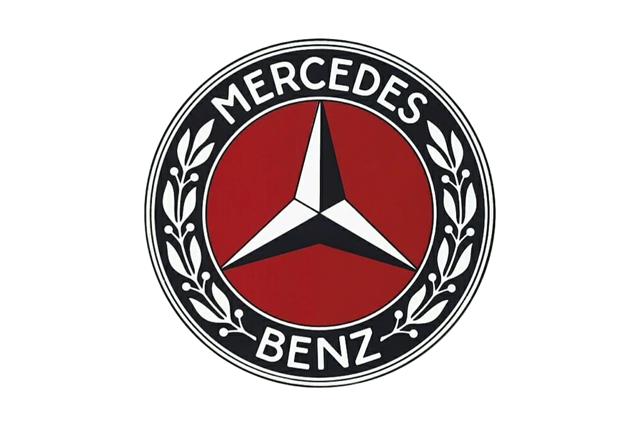
The full sequence, from Jellinek's word-mark to the flat star used on cars today, reads as a steady exercise in subtraction.


The 1930s: Grosser Mercedes and Silver Arrows
The merged company went immediately upmarket. Ferdinand Porsche, technical director in the 1920s before founding his own consultancy, left behind the supercharged S, SS, SSK and SSKL sports cars, with their exposed exhaust pipes and the shriek of a Roots blower engaging at full throttle.
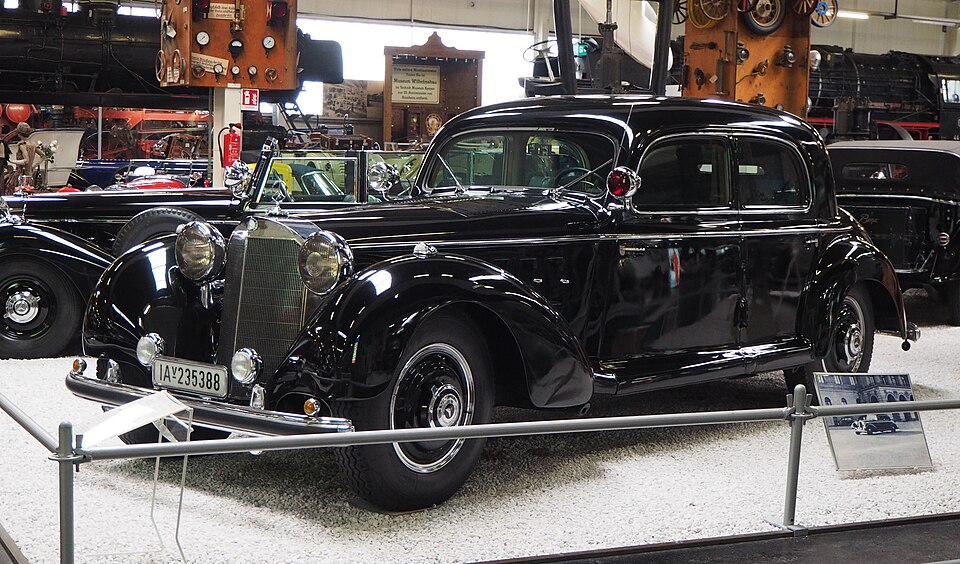
Above them sat the 770 "Grosser Mercedes" of 1930, a 7.7-litre supercharged straight-eight built for heads of state, popes, emperors and — unavoidably and to the company's lasting discomfort — the Nazi leadership, which used the later armoured W150 version as its parade car. Daimler-Benz has since documented that period, including its use of forced labour, rather than letting it sit unmentioned.
On track, the Silberpfeile rewrote what a racing car could be. The W25 arrived for the 1934 Grand Prix formula, followed by the W125 of 1937 — supercharged, roughly 600 hp, a figure Formula One would not routinely match again for half a century — and the elegant 3-litre V12 W154 of 1938. Rudolf Caracciola, Manfred von Brauchitsch and Hermann Lang became national figures.
The origin myth of the silver colour, in which white paint was scraped off overnight to make the 750 kg weight limit, is a lovely story that historians have long treated with scepticism; the cars were unpainted aluminium, and the reasons were probably more mundane. The dominance was not in dispute. When the Italians created a 1.5-litre class at Tripoli in 1939 partly to escape German cars, Mercedes designed the W165 for it in a matter of months and finished first and second.
Zero, and the rebuild
In 1945 the company's plants were largely rubble. The board's own assessment that year concluded, in effect, that Daimler-Benz had ceased to exist as an industrial concern.
Recovery started at the bottom. The pre-war 170 V went back into production for ambulances, vans and taxis. In 1949 came the first diesel passenger cars for private buyers, a segment Mercedes would own for the next fifty years. By 1951 the company could show two genuinely new cars at Frankfurt: the 220 and the six-cylinder 300, a stately saloon so closely associated with Chancellor Konrad Adenauer that it has been called the "Adenauer Mercedes" ever since. The 300's chassis and engine became the platform for something considerably less stately.
The 300 SL: a race car with a door problem
Racing manager Alfred Neubauer and engineer Rudolf Uhlenhaut needed a competitive sports car in 1952 without a competitive budget, so they took the 300's carried-over 3.0-litre straight-six and built around it a welded tubular spaceframe of extraordinary lightness — the whole structure weighed less than a hundred kilograms.
The catch was that the frame's triangulation ran high along the flanks. There was no room for a conventional door aperture without cutting the structure and losing its stiffness. The solution was to hinge small doors at the roof. The W194 racer duly won Le Mans in 1952 and the brutal Carrera Panamericana in Mexico the same year.
Max Hoffman, the New York importer with an unmatched instinct for what Americans would buy, told the board there was a market for a road version and reportedly backed it with a firm order. The production 300 SL (W198) was launched in New York in February 1954, and it arrived with a genuine world first: Bosch mechanical direct fuel injection on a production car, lifting the canted-over six to around 215 hp and the car to a top speed that made it the fastest production car available.
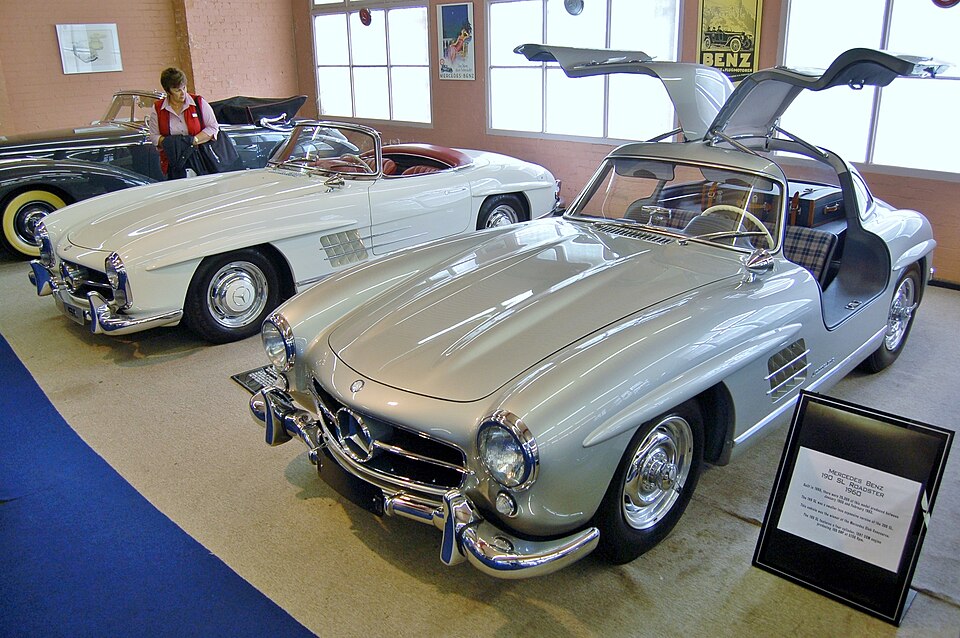
Roughly 1,400 coupés were built before the roadster replaced them in 1957. The gullwing doors, which existed purely because of a structural constraint, became the single most recognisable automotive silhouette of the decade.
The racing story of the era ended abruptly. Juan Manuel Fangio took the 1954 and 1955 world championships in the W196, and Stirling Moss with journalist Denis Jenkinson won the 1955 Mille Miglia in a 300 SLR in a shade over ten hours, still one of motorsport's great performances. But at Le Mans in June 1955, Pierre Levegh's 300 SLR launched into the crowd, killing him and more than eighty spectators — the worst disaster in the history of the sport. Mercedes withdrew its remaining cars from that race and, at the end of the season, withdrew from top-level racing altogether. It would be more than three decades before the company returned in earnest.
Béla Barényi and the idea that a car should be destroyed
The most consequential Mercedes engineer of the twentieth century designed no engine anyone remembers.
Béla Barényi, a Hungarian-Austrian who joined the company in 1939, spent his career on the proposition that a strong car is a dangerous car. His insight was that the passenger cell should be rigid while the structure ahead of and behind it should be deliberately weak, collapsing in a controlled way to absorb crash energy over distance and time. He patented the concept in the early 1950s.
It reached production on the W111 "Fintail" in 1959: a rigid safety cell with defined crumple zones front and rear, the first production car in the world designed that way. Barényi also worked on the safety steering column and on separating occupants from intruding structures. He accumulated well over two thousand patents, and essentially every car on the road today is built to his central idea.
The company kept adding to the list, and unusually, it kept the patents open rather than fighting to monopolise them.
| Year | Innovation | First fitted to |
|---|---|---|
| 1959 | Crumple zones and rigid safety cell | W111 saloon |
| 1978 | Anti-lock braking (ABS), with Bosch | W116 S-Class |
| 1981 | Driver airbag and belt tensioner | W126 S-Class |
| 1995 | Electronic Stability Program (ESP), with Bosch | C140 S-Class coupé |
| 1996 | Brake Assist | S-Class |
| 2002 | Pre-Safe anticipatory occupant protection | W220 S-Class |
The 600: the car for people who had everything
If the 300 SL was the halo, the 600 (W100) of 1963 was the statement of absolute capability. Under the bonnet sat the M100, a 6.3-litre V8 producing around 250 hp — the company's first V8 for a road car, built to a standard closer to aerospace than automotive.
Its defining feature was a high-pressure hydraulic system, running at well over a hundred bar, that operated the doors, windows, seats, sunroof and boot lid. Doors closed themselves with a soft, irresistible pull. The suspension was air, front and rear. Long-wheelbase Pullman versions offered six doors, and the Landaulet with its folding rear roof section became the default vehicle for waving at crowds.
Around 2,700 were built over an eighteen-year run ending in 1981, for a client list running from heads of state to John Lennon and Elvis Presley. The same year the 600 appeared, the company also introduced the W113 SL, nicknamed the "Pagoda" for the concave roof of Paul Bracq's hardtop — a shape that was structurally sound and visually unlike anything else. That pairing, one imperious and one delicate, defined the range for a decade.
Under Bracq and later Bruno Sacco, Mercedes design settled into a doctrine of vertical affinity and horizontal homogeneity: a new model should not make its predecessor look obsolete, and every car in the range should look like part of one family. It is why a 1980s Mercedes still reads as dignified rather than dated.
The W123 and the reputation for indestructibility
In January 1976 Mercedes replaced the mid-range saloon with the W123, and accidentally created the most durable reputation in the industry.
Nothing about it was radical. It was a conservative, thoroughly over-engineered car with double-wishbone front suspension, a semi-trailing-arm rear, and a range of petrol and diesel engines — including the OM617 five-cylinder diesel — that were built with enormous margins and asked to work for decades.
Demand outran supply so badly in Germany that waiting lists stretched past a year and used examples changed hands for more than the list price of a new one. It was the first Mercedes offered as a factory estate, the T-model, launched in 1978 and instantly making the wagon respectable. Nearly 2.7 million were built before production ended in 1986.
The W123's afterlife is the real story. Enormous numbers ended up in West Africa, the Middle East and South Asia, where 300D taxis have run for a million kilometres and more on a diet of indifferent fuel and improvised parts. That is where the phrase "they don't build them like that any more" attached itself to a specific three-pointed star.
The engineering peak: W126 and W124
The 1979 W126 S-Class was, by broad consensus, the point at which Mercedes was doing everything better than anyone. Sacco's body was genuinely aerodynamic rather than decoratively so, it used lighter alloys and high-strength steels to lose weight over its predecessor, and it introduced the driver's airbag as an option in 1981, paired with a pyrotechnic belt tensioner. Close to 900,000 were built across a twelve-year run, which for a car in that class was extraordinary.
Beneath it, the compact W201 190 of 1982 — the "Baby Benz" — was developed at ruinous cost, most of it disappearing into a new five-link rear suspension that gave a small car the composure of a big one.
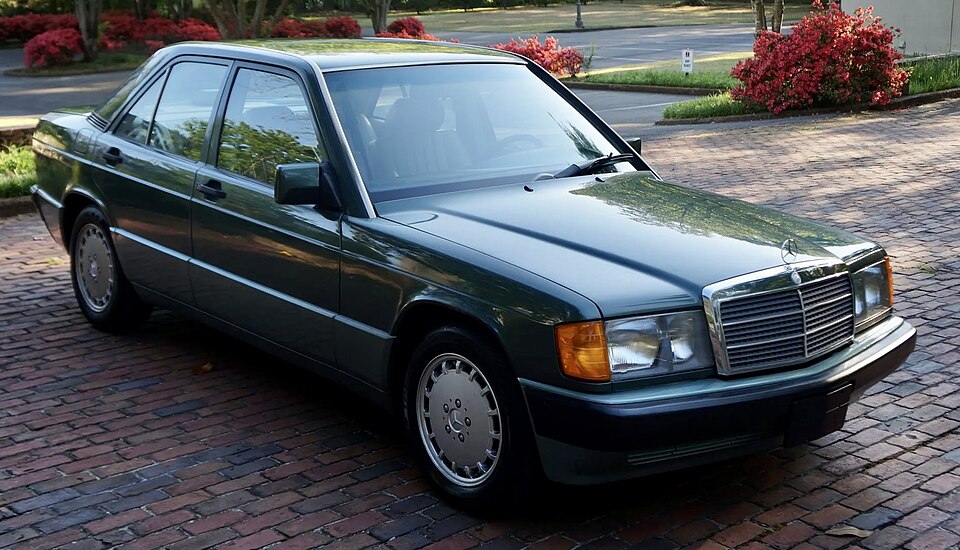
Then, in late 1984, the W124.
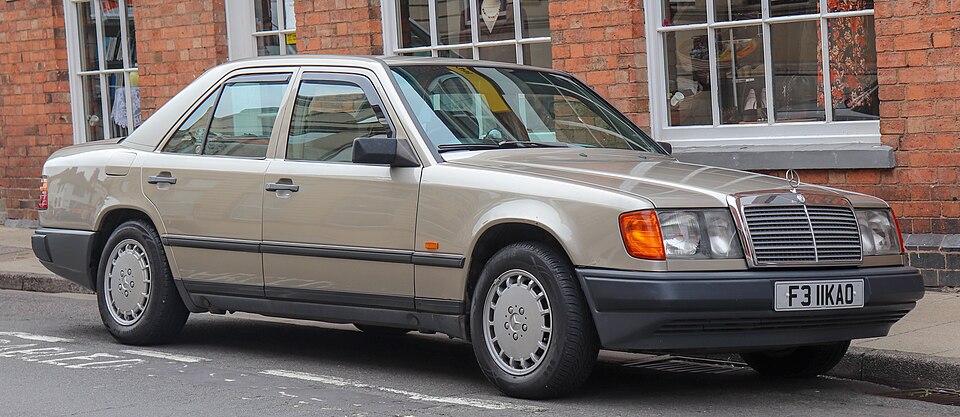
The W124 is the car enthusiasts point to when arguing that Mercedes peaked. Its drag coefficient was class-leading, achieved partly through Sacco's ribbed side cladding, which broke up airflow and kept the flanks clean of road grime. Its structure was intricate to the point of extravagance. It offered a single-arm windscreen wiper with an eccentric mechanism that swept a larger area than the geometry should have allowed — the sort of problem nobody else would have spent money solving.
It also produced one of the great sleepers. The 500 E, developed with Porsche and hand-assembled at Zuffenhausen from 1990, put the 5.0-litre V8 into the W124 body with flared arches and a lowered stance, and looked to the untrained eye like a taxi. When the range was renamed in 1993, the W124 became the first E-Class.
The moose test
By the mid-1990s Mercedes was pushing into new segments — the A-Class, the M-Class SUV, the Smart city car — under real cost pressure. The A-Class (W168), launched in 1997, was the boldest: a tall, short, front-drive hatchback with a sandwich floor designed so that in a frontal impact the engine would slide underneath the cabin rather than into it. Clever, safe, and very un-Mercedes.
In October 1997 the Swedish magazine Teknikens Värld ran its standard evasive-manoeuvre test — the älgtest, or moose test, simulating a swerve around an animal in the road. The A-Class rolled over. The photographs went around the world within days.
The initial response was defensive and made things worse. Then the company reversed hard: it stopped deliveries, halted production, and spent roughly three months re-engineering the car with revised suspension geometry, wider track, a lower ride height and — crucially — ESP fitted as standard, on a small hatchback, in 1997. The bill has been credibly reported at hundreds of millions of marks, and the recall covered cars already sold.
The decision had a consequence far beyond one model. Mercedes made ESP standard across its entire range by 1999, which pressured competitors to follow, which eventually made stability control a legal requirement in most major markets. A public humiliation over a hatchback probably saved a very large number of lives.
AMG: from a Swabian back room to a sub-brand
In 1967 two former Daimler-Benz engineers, Hans Werner Aufrecht and Erhard Melcher, set up a racing-engine business in Burgstall an der Murr. The name was an initialism: Aufrecht, Melcher, and Großaspach, the village where Aufrecht was born.
Their reputation was made in 1971 at the Spa 24 Hours, where an enlarged 300 SEL — a full-sized luxury saloon, nicknamed the Rote Sau or "Red Pig" — took a class win and finished second overall, humiliating purpose-built race cars. AMG moved to Affalterbach in 1976 and spent the 1980s as the tuner of choice for people who wanted a Mercedes that behaved badly.
The relationship formalised in stages: a cooperation agreement in 1990, the first jointly developed car in the C 36 AMG of 1993, a majority stake taken by the parent company in 1999, and full ownership by 2005. Affalterbach has stayed the home of the operation, and the "one man, one engine" principle — a single technician assembling a complete engine and signing a plaque on it — survived industrialisation.
The engines defined eras. The naturally aspirated M156 6.2-litre V8 of 2006 was AMG's first entirely in-house engine and made a noise that sold cars on its own. The 4.0-litre twin-turbo V8 that followed put its turbochargers inside the vee of the block for packaging and response. The SLS AMG of 2009 revived the gullwing door as a deliberate quotation of 1954, and the AMG GT that followed in 2014 gave the sub-brand its own sports car rather than a modified saloon.
Alongside it, Mercedes rebuilt a racing record. Group C sports cars in the late 1980s, a return to Formula One as an engine supplier with Ilmor from 1994, the long McLaren-Mercedes partnership that produced the road-going SLR, and then the purchase of the Brawn team in 2009. The works Mercedes team's run of eight consecutive constructors' championships from 2014 is the most dominant sustained period any manufacturer has had in the sport.
Maybach, twice
Wilhelm Maybach's son Karl founded an engine works in 1909 that built Zeppelin powerplants and, between the wars, some of the most exotic luxury cars in Europe, including the twelve-cylinder Zeppelin models. The firm eventually ended up inside the Daimler-Benz group, its name dormant for decades.
It came back in 2002 as a standalone ultra-luxury marque, with the Maybach 57 and 62 — the numbers indicating overall length in decimetres. They were technically formidable and lavishly appointed, but they were built on S-Class architecture, priced against Rolls-Royce and Bentley, and never escaped the perception that they were expensive Mercedes. Sales stayed low and the marque was wound down in 2012.
The second attempt worked because it inverted the logic. Instead of pretending not to be a Mercedes, Mercedes-Maybach launched in 2014 as an explicit top rung of the S-Class: longer wheelbase, different rear cabin, its own badging, no separate showroom. Doing less made it credible, and it has since extended to the GLS and to Mercedes-Maybach EQS variants.
The 1998 tie-up with Chrysler, sold at the time as a "merger of equals," went the other way. Cultural incompatibility, a collapsing US market position and disputed benefits led to the stake being offloaded in 2007, after which the company reverted to the name Daimler AG.
The EQ era and the EQS
Mercedes committed to electrification with the Generation EQ concept in 2016, and the first production result, the EQC of 2019, was an honest but unremarkable conversion of an existing GLC platform. The real answer came in 2021.
The EQS was built on a dedicated electric architecture, and it used that freedom for the thing Mercedes has always cared about: efficiency through air. With no engine to cool and no bonnet line to respect, the body became a single arc — the so-called one-bow design — and achieved a drag coefficient of 0.20, at the time the lowest of any production car in the world. Range figures ran beyond 700 km on the WLTP cycle in the longest-legged versions.
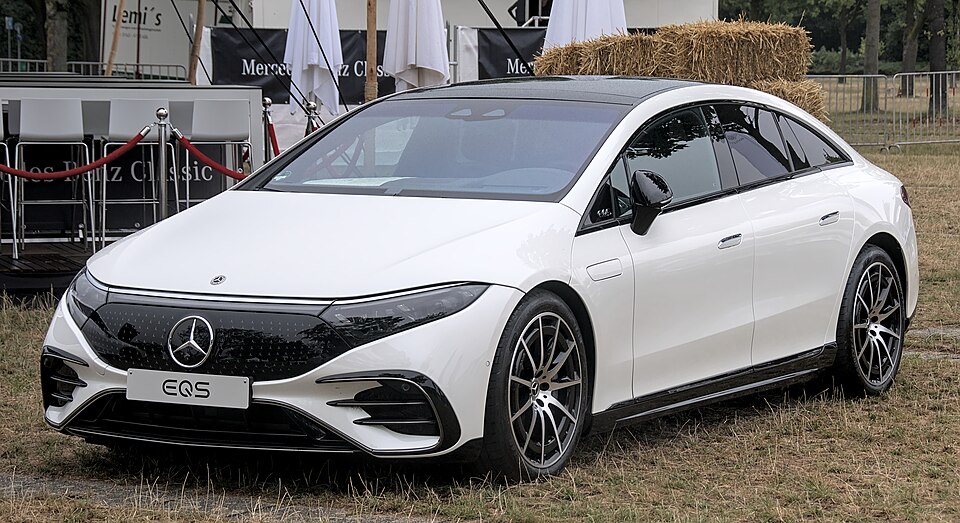
Inside, the optional MBUX Hyperscreen ran a single curved glass panel more than 140 centimetres wide across the whole dashboard. It divided opinion sharply, and the exterior did too: buyers who wanted a limousine found the EQS looked like a very large hatchback, and Mercedes has since moved its electric flagships back toward more formal three-box proportions.
The engineering statement came separately. The Vision EQXX research car drove from Sindelfingen to the south of France in 2022 — over a thousand kilometres — on a single charge of a battery no larger than a normal saloon's, at a real-world efficiency figure below 9 kWh per 100 km. That is not a styling exercise; it is the same instinct that produced the honeycomb radiator and the crumple zone, applied to a new constraint.
Corporately, the modern company is leaner than the conglomerate of the 2000s. Daimler Truck was spun off at the end of 2021, and the remaining car business renamed itself Mercedes-Benz Group AG in early 2022 — the first time in its history that the company and the brand carried the same name.
What to look for the next time you see the star
The three-pointed star has meant land, sea and air since 1909, but the more useful way to read a Mercedes is to look for the constraint that shaped it. The gullwing door exists because a spaceframe had nowhere to put a hinge. The W124's ribbed cladding exists because dirty flanks are an aerodynamic problem. The EQS looks the way it does because a battery floor and a 0.20 drag coefficient are not negotiable.
Find a W123 still working somewhere — and in much of the world you still can — and open the driver's door. Listen to the sound the latch makes, and the weight of the hinge. That noise was designed by people who assumed the car would still be running in forty years, and it was. Then ask whether anything you can buy today is being built to the same assumption, and what it would cost if it were.


