
The shed was about ten feet by fifteen, standing in the Davidson family's backyard on what is now Juneau Avenue in Milwaukee. Someone — the story says Arthur Davidson's father, a Scottish-born cabinetmaker — painted five words on the door: Harley-Davidson Motor Co. That was 1903, and the company inside it consisted of two young men in their early twenties who had spent months trying to make a bicycle go by itself. The shed is gone. The address is not: Harley-Davidson's head office has stood on that block for more than a century, which makes it one of the most stubbornly rooted industrial addresses in America.
What came out of that shed was not a technical revolution. Plenty of people were bolting engines into bicycle frames in 1903. What came out of it, eventually, was something rarer and far more durable: a trademark that people pay to wear, tattoo on their arms, and defend in bar arguments. The bar-and-shield is not just a logo. For long stretches of the company's history, it was the most valuable thing Harley-Davidson owned — worth more than the factories, and certainly worth more than the motorcycles it was stuck on.
The shed, the loop frame, and a carburettor made from a tomato can
William S. Harley was the engineer. He had been drafting since his teens, worked in a bicycle factory, and would later take a degree in mechanical engineering at the University of Wisconsin — an unusual credential for a motorcycle builder in that era, and one that shows in the company's early paperwork. Arthur Davidson was the pattern maker and, as it turned out, the salesman. His brothers Walter, a railway mechanic, and William A., a toolroom foreman for the Milwaukee Road railway, joined as the thing turned serious.
The first engine was tiny — a single cylinder of roughly ten cubic inches — and by all accounts it could not pull the machine up Milwaukee's hills without pedalling. The famous detail is the carburettor, said to have been fashioned from a tin can. What mattered more was what they did next: they threw the design out. The second engine was far larger, near 25 cubic inches, with a substantially heavier flywheel, and the frame was redesigned as a proper loop rather than a bicycle with an engine wedged into it. That decision — build a motorcycle, not a motorised bicycle — separated Harley-Davidson from dozens of contemporaries who never got past the wedge.
Production was measured in single digits for the first couple of years. A Chicago man named Carl Herman Lang became the first dealer in 1905 and reportedly sold a meaningful fraction of the total output himself. In 1906 the company built a modest factory on the Chestnut Street site, and in 1907 it incorporated, with Walter Davidson as president, William Harley as chief engineer, Arthur as sales manager and secretary, and William A. Davidson as works manager. Those four roles stayed remarkably stable for decades — a family firm in the most literal sense, and one that would not have an outside chief executive until well after the founders were gone.
The early singles were painted a subdued grey with pinstriping and fitted with an effective muffler, and Harley marketed them as the Silent Gray Fellow. It is a telling first slogan for a company later defined by noise.
1909: the V-twin, and why 45 degrees mattered
Harley showed a V-twin in its 1908 catalogue and put a production version on sale for 1909 — the Model 5-D, around 49.5 cubic inches, two cylinders set in a narrow 45-degree vee sharing a single crankpin. It was not a success. The engine used atmospheric inlet valves, which could not cope with the increased demand, and the leather drive belt slipped under the extra torque. Fewer than thirty were reportedly built and the twin vanished from the range for 1910.
It came back for 1911, properly engineered: mechanically operated inlet valves in an F-head layout, a belt tensioner, a stiffer frame. From that point the 45-degree V-twin was Harley-Davidson, and it has never seriously been anything else.
The angle deserves an explanation, because it is the single most consequential decision in the company's engineering history. A 45-degree included angle makes for a narrow, compact engine that drops neatly into a diamond frame between the rider's knees — good for packaging, good for cooling airflow to both cylinders, good for a low centre of gravity. The cost is that with both connecting rods on one crankpin, the firing intervals are uneven: the cylinders fire at roughly 315 and 405 degrees of crank rotation, then the engine coasts. That produces the loping, syncopated exhaust note that Harley riders describe as potato-potato and that engineers describe, less romantically, as a large primary imbalance.
A smoother configuration was always available. A 90-degree twin gives perfect primary balance — this is why Ducati builds its L-twins that way — and BMW's flat twin is smoother still. Harley chose to keep the vibration and the sound. By the 1980s the sound was not a by-product; it was the product. In 1994 the company went so far as to apply to trademark the exhaust note of its V-twin, an application contested by nearly every major rival and eventually withdrawn in 2000 without a registration ever issuing. The attempt tells you exactly how the company had come to understand itself: not as a manufacturer of vehicles, but as the proprietor of a set of sensations.
The bar and shield: a trademark before it was a brand
The bar-and-shield first appeared around 1910 — a horizontal bar carrying the name "Harley-Davidson" laid across a shield reading "Motor Cycles" — and was registered with the US Patent Office shortly afterwards. It has been redrawn many times: fattened, flattened, boxed, chromed, rendered in orange and black, in black and white, in metallic outline. But the underlying geometry has never been abandoned, which over more than a century has given it something almost no other vehicle mark possesses — an unbroken visual lineage recognisable at a glance across every decade.
Note what the mark is not. It contains no eagle, no wings, no flames, no skull — none of the imagery the company later attached to itself. It is a piece of Edwardian commercial signage: a nameplate on a shield, drawn to look like a badge of quality on a machine. The outlaw associations were bolted on by other people, decades later, and Harley spent an interesting half-century deciding how it felt about that.
The company also ran, at various times, a set of secondary marks — the number "1" in stars and stripes from the early 1970s, the winged-eagle graphics of the 1930s and 1990s, and the "Willie G. skull" that became ubiquitous on merchandise. These were free to fashion in a way the bar-and-shield never was. The core mark stayed conservative precisely because everything else was permitted to be loud.
Board tracks, hillclimbs, and the Wrecking Crew
Harley officially disdained racing in its early years. Arthur Davidson's advertising line was that the company built machines for reliable transport, not for stunts. This lasted exactly as long as it took Indian to start winning everything.
In 1913 the company hired William Ottaway away from the Thor factory and set him to work on the racing eight-valve and pocket-valve twins. By 1915 the Harley team was beating Indian outright, and in the years around the First World War the squad became known as the Wrecking Crew: Otto Walker, Ray Weishaar, Leslie "Red" Parkhurst, Jim Davis, Fred Ludlow, Ralph Hepburn. Walker is generally credited as the first rider to win a race at an average speed above 100 mph, at Fresno in 1921.
They rode on board tracks — vast circular saucers of pine planking, banked to angles that today read as insane, some of them approaching 60 degrees. The bikes had no brakes and no throttle in the modern sense; riders killed the engine with a kill button and controlled speed with an oil pump and spark advance. Splinters, oil, and tyre failures did what you would expect. After a series of crashes killed riders and spectators — the 1912 disaster at Newark, New Jersey, being the most notorious — the press renamed the motordromes murderdromes, and the sport's popularity collapsed under its own body count.
The hillclimb era that followed was gentler on spectators and just as good for dealer showrooms. Every county fair had a hill, and factory-supported riders on stripped, chain-wrapped twins clawed their way up it in front of crowds who could buy something similar on Monday. Harley formally withdrew factory racing support in 1921 during the post-war recession, but its dealer network had already learned the lesson that shaped the next hundred years: the motorcycle sells the scene, and the scene sells the motorcycle.
There is a small legend attached to Ray Weishaar, who kept a piglet as a team mascot and was photographed with it after victories. The story is that this is where "hog" comes from. It is a good story, and the company eventually built an entire membership organisation and a stock ticker symbol on it, though the word's actual origin is murkier than the official version allows.
Two world wars in olive drab
The military relationship began in earnest with the 1916 Punitive Expedition into Mexico and expanded enormously once America entered the First World War. Harley supplied something in the order of 15,000 to 20,000 machines to the US military, and by the Armistice a large share of the factory's output was going to the government rather than to dealers. The company's most cherished anecdote from the period concerns Corporal Roy Holtz, who — riding a Harley sidecar outfit and thoroughly lost — is said to have been the first American serviceman to enter Germany after the ceasefire.
The Second World War was larger by an order of magnitude. The WLA, a militarised version of the 45-cubic-inch flathead twin, was built in the tens of thousands — figures around 90,000 are commonly cited across the whole production run, including the Canadian WLC and substantial Lend-Lease shipments to the Soviet Union. It had blackout lighting, a scabbard for a Thompson submachine gun on some configurations, an oil-bath air cleaner for desert dust, and a crankcase breather designed for fording. The company took the Army-Navy "E" production award twice.
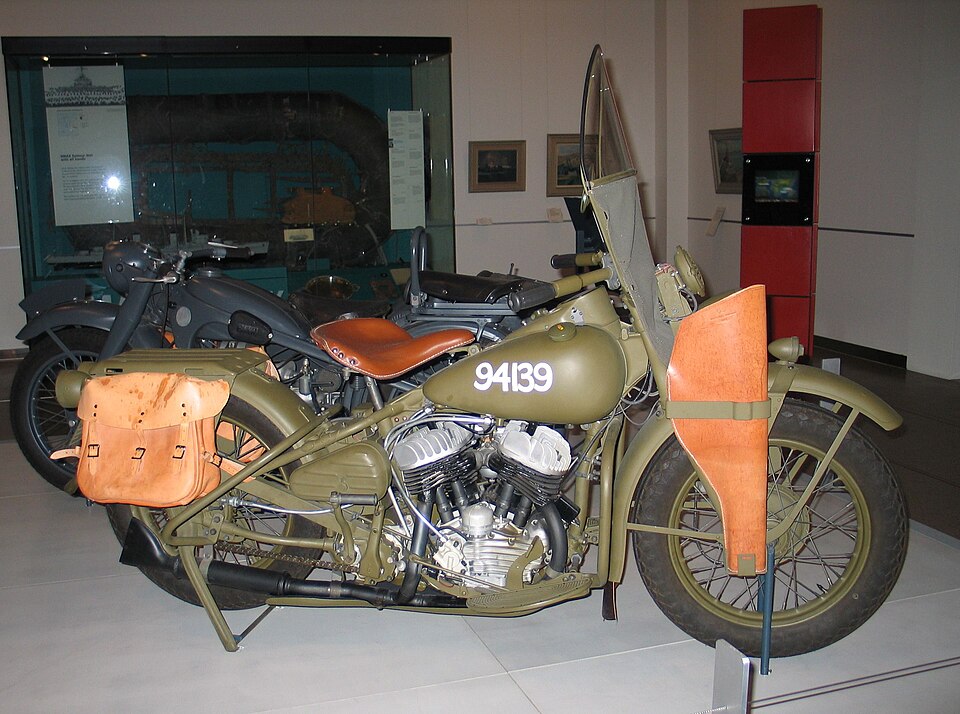
Harley also built the XA, a shaft-drive horizontally opposed twin that was, with no real attempt at concealment, a reverse-engineered BMW — commissioned because the Army wanted the German bike's desert performance. Roughly a thousand were made before the Jeep made the whole category redundant. It remains the only flat twin and the only shaft-drive machine Harley ever built.
The war left two legacies. First, an enormous surplus of cheap, tough, olive-drab twins hit the civilian market in 1946, giving a generation of returning servicemen a motorcycle they already knew how to fix. Second, it left those men with a fondness for riding in groups, wearing surplus uniform, and behaving in ways their towns had not previously had to accommodate.
Surviving the Depression as one of the last two standing
The American motorcycle industry of 1915 had dozens of manufacturers. By the mid-1930s it had two: Harley-Davidson and Indian.
The scale of the contraction is hard to overstate. Harley's output fell from something over 20,000 machines in 1929 to a figure often quoted at around 3,700 in 1933 — roughly an 80 per cent collapse in four years. The company survived on a combination of export sales, police contracts, the three-wheeled Servi-Car introduced in 1932 for garages and municipal fleets, and brutal cost control. Wages were cut, hours were cut, and the founders reportedly took the same medicine.
It also survived on styling, which is worth noticing. In 1933 Harley introduced bright Art Deco tank graphics — the famous eagle motif — for the simple reason that new paint cost far less than new engineering and might move a machine off a dealer floor. That is the earliest clear instance of the company's defining commercial instinct: when you cannot afford to change the product, change how it looks and what it means.
Then, in the depths of it, came the engineering that justified everything. The 1936 EL — the Knucklehead, named for the shape of its rocker boxes — brought overhead valves and a recirculating dry-sump oil system to a 61-cubic-inch V-twin producing meaningfully more power than anything Harley had sold before. It is the direct ancestor of every Big Twin since: Panhead in 1948, Shovelhead in 1966, Evolution in 1984, Twin Cam in 1999, Milwaukee-Eight in 2017. Every one of them is a 45-degree, air-cooled, pushrod V-twin, and every one of them is recognisably a descendant of the 1936 engine.
Indian, meanwhile, went through a series of owners and a disastrous post-war attempt at British-style vertical twins, and stopped building motorcycles in Springfield in 1953. From that year until the 1990s, Harley-Davidson was the American motorcycle industry, with no domestic competitor of any consequence.
Hollister, Brando, and a brand it did not ask for
Over the Fourth of July weekend in 1947, an American Motorcyclist Association gypsy tour descended on Hollister, California — a town of a few thousand — with several times its population in riders. There was drinking, street racing, and a number of arrests. There was also a Life magazine photograph of a dishevelled man slumped on a motorcycle amid a drift of beer bottles, which is widely believed to have been staged, and which did more to shape the public image of motorcycling than any event of the century.
The AMA is supposed to have responded that 99 per cent of motorcyclists are law-abiding citizens — a statement the association has always denied making, and which handed the remaining one per cent a name they wear on their vests to this day.
Then in 1953 came The Wild One, with Marlon Brando as Johnny Strabler in a Perfecto jacket and a peaked cap. The delicious detail, endlessly repeated in Harley circles, is that Brando rode a Triumph Thunderbird in the film; it was Lee Marvin's rival gang that rode Harleys. The imagery stuck to the American brand anyway, because the American brand was the only one available to stick to.
Harley-Davidson's official response for the next two decades was horror. Company advertising through the 1950s and 1960s pushed wholesome families, touring couples, and police service. It was the customers, not the corporation, who decided what a Harley meant — stripping the fenders, raking the forks, extending the springers, and inventing the chopper, an aesthetic that reached full cultural saturation with Easy Rider in 1969. The factory would spend the following thirty years catching up to what its own buyers had built in their garages.
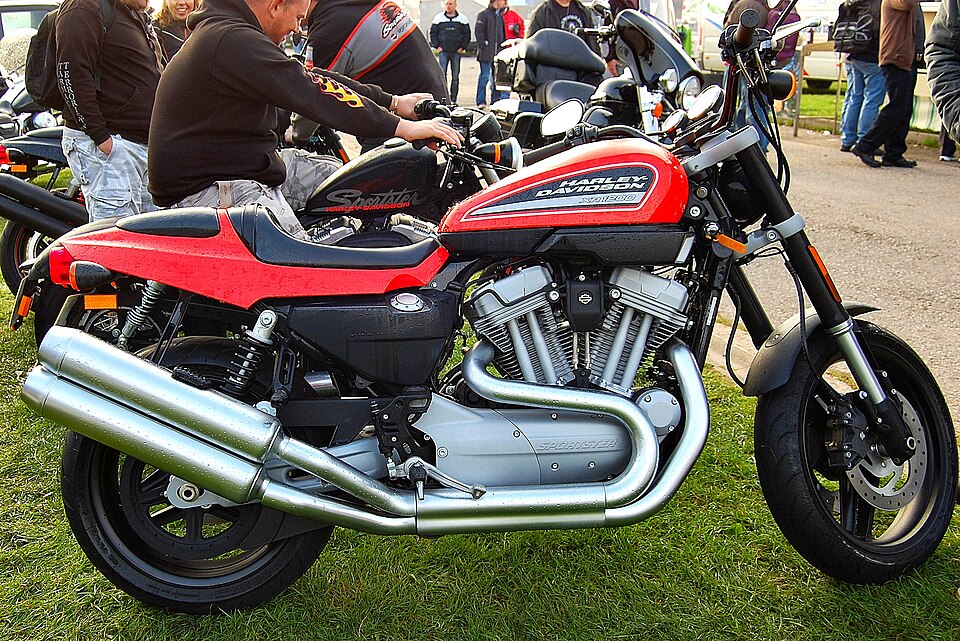
The bikes of this period are the ones that define the classic silhouette. The 1952 K model brought foot shift and hand clutch to the flathead middleweight; the 1957 XL Sportster put overhead valves on it and created a model line that would run, in recognisable form, for well over sixty years. The Hydra-Glide of 1949 introduced telescopic forks, the Duo-Glide of 1958 added rear suspension, and the 1965 Electra Glide added an electric starter and a name that has never left the catalogue.
The AMF years: growth, strikes, and rust
Harley-Davidson went public in 1965 and was acquired in 1969 by AMF, the American Machine and Foundry conglomerate best known for bowling equipment. The logic was straightforward: American leisure was booming, motorcycling was booming, and AMF had capital.
What followed is the most-litigated chapter in the company's history, and the caricature is only partly fair. AMF did invest. It expanded capacity dramatically, moving assembly to a large plant in York, Pennsylvania while keeping engine and transmission work in Milwaukee, and it pushed output to levels the family firm had never approached. It also kept the company alive at a moment when Honda, Kawasaki, Suzuki and Yamaha were flooding the American market with machines that were cheaper, faster, cleaner and vastly more reliable.
But the ramp-up outran the process control. Quality in the 1970s became genuinely poor: oil leaks accepted as normal, electrical faults, poor paint, machines that needed a dealer rebuild before they were fit to sell. Labour relations were bitter, culminating in a long strike in 1974. Buyers who cross-shopped a Harley against a Japanese bike found the comparison humiliating, and market share in the heavyweight segment fell hard.
AMF also owned Aermacchi, the Italian firm whose lightweights Harley had bought into in 1960 and taken over fully in the 1970s. The Aermacchi-built singles and two-strokes were sold as Harley-Davidsons — the Sprint, the SS and SX two-strokes, the RR250 road racer that actually won world championships in the mid-1970s under Walter Villa. Selling a small Italian two-stroke with a bar-and-shield on the tank confused everyone, and the Italian operation was sold off in 1978.
The one unambiguous triumph of the era came from the family. In 1971, Willie G. Davidson — grandson of William A., an art-school-trained designer who had joined the styling department in 1963 — took an Electra Glide chassis, fitted a Sportster front end, and produced the FX Super Glide. It was the first factory custom: a mass-produced motorcycle deliberately styled to look like something a customer had modified. That single idea has generated more profit for the motorcycle industry than any engineering advance of the last fifty years. The Low Rider of 1977 refined it; the Café Racer XLCR of the same year proved that Willie G. could also miss.
The buyout, the tariff, and the Evolution engine
In June 1981, thirteen executives led by Vaughn Beals and including Willie G. Davidson bought the company back from AMF in a leveraged transaction valued at roughly $80 million. They rode from York to Milwaukee under a banner reading The Eagle Soars Alone. Then interest rates spiked, the recession bit, the heavyweight market collapsed, and the new owners found themselves running a debt-loaded company with a reputation for building unreliable motorcycles.
Three things saved it.
The tariff. In 1983, following an International Trade Commission finding, the Reagan administration imposed a steep additional duty on imported motorcycles above 700cc — beginning at 45 per cent and stepping down over five years. It is the textbook case of temporary protection, and the reason it is a textbook case is what happened next: Harley asked for the tariff to be removed a year early, in 1987, having used the breathing space rather than merely enjoying it. Its rivals, meanwhile, responded with the famous 699cc engines built specifically to slip under the threshold.
The manufacturing overhaul. Beals and his colleagues went to Japan, toured Honda's American plant, and came back with just-in-time inventory — internally branded MAN, for Materials As Needed — statistical process control, and employee involvement programmes. Work-in-process inventory fell dramatically, defect rates fell dramatically, and warranty costs followed. It is one of the genuinely successful transplants of Japanese production methods into an American factory, and it is why the company's revival is taught in business schools rather than remembered as a fluke of trade policy.
The Evolution engine. Launched for 1984 after years of development, the V2 Evolution was a 1340cc air-cooled 45-degree V-twin with aluminium cylinders and heads, better sealing, and vastly improved oil control. It was not exotic. It simply did not leak, did not overheat in traffic, and did not require its owner to become an amateur mechanic. Fitted first to the FXST Softail — whose hidden-shock frame, giving the look of a rigid hardtail with actual rear suspension, came from an independent designer named Bill Davis — it turned the product line from a liability into an asset almost overnight.
The company returned to the public markets in the mid-1980s, and by the end of the decade it had recaptured the top of the American heavyweight segment. The 1990 Fat Boy, with its solid disc wheels and shotgun exhausts, became the defining silhouette of the decade and, thanks to a supporting role in Terminator 2, one of the most recognisable motorcycles ever built.
HOG: turning a customer list into a religion
The Harley Owners Group was founded in 1983, and it is arguably the most important product the company has ever launched.
The structure was clever. Membership came free with a new motorcycle for the first year. Local chapters were sponsored by dealers, which turned dealerships from transaction points into clubhouses. HOG organised rallies, ride-ins, and the enormous anniversary gatherings in Milwaukee every five years. It ran a magazine, a touring-mileage recognition programme, and a scheme letting members rent a Harley on holiday.
What this achieved, in marketing terms, is that Harley stopped selling motorcycles and started selling membership, with a motorcycle as the entry fee. Membership climbed into the hundreds of thousands and eventually past a million worldwide. It also produced something no rival could copy: a customer base that would buy a second, third and fourth machine from the same brand, and would buy branded clothing, badges, pins and rally patches in between.
The merchandise operation — MotorClothes and the general licensing programme — became a profit centre in its own right, with margins that would embarrass the motorcycle business. Harley-Davidson-branded goods flowed outward: leather jackets, boots, T-shirts, die-cast models, a chain of themed cafés opened in Manhattan and Las Vegas in the 1990s, and licensed products of increasing distance from motorcycling. There were Harley-Davidson cigarettes, licensed to a tobacco company in that decade. There were, notoriously, a Harley-Davidson fragrance and various homeware items that marketing courses now cite as the outer edge of what a brand can bear. The company pulled back from the worst of it, but the underlying discovery held: the bar-and-shield could be rented out, and renting it out cost almost nothing to produce.
It was not always enforceable. Harley pursued a New York business over the use of "hog", and the courts ultimately found that the word had become generic for large motorcycles before Harley adopted it — a rare loss for a company that otherwise defends its marks with exceptional energy. The V-twin sound application failed too. What the company did successfully own was the shape of the shield, the trade dress of the machines, and the model names, and it defended all of them relentlessly.
The 1990s boom, and the waiting-list problem
Through the 1990s Harley could not build motorcycles fast enough. Dealers held waiting lists running to a year or more, and used machines routinely sold above list price — an inversion of normal vehicle economics that persisted for the better part of a decade.
Management understood the danger: satisfy the demand too quickly and you destroy the scarcity that creates it. Capacity was added deliberately rather than explosively, with a new plant at Kansas City in the late 1990s and expansion in York and Wisconsin. Revenue and earnings grew for the better part of twenty consecutive years, an almost unheard-of run for a vehicle manufacturer.
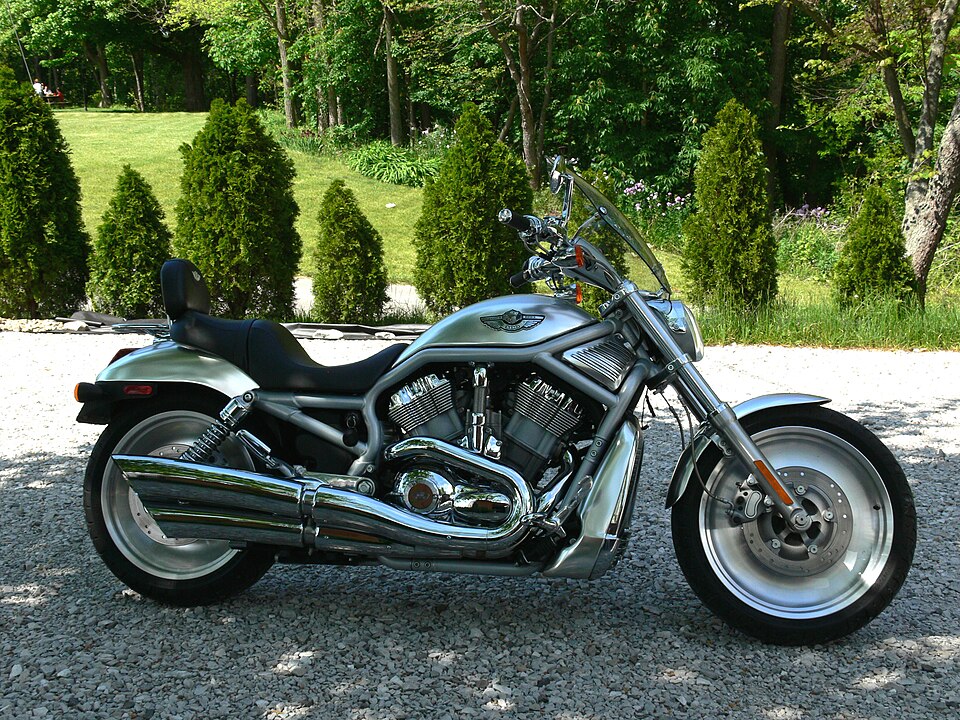
The engineering kept pace, cautiously. The Twin Cam 88 arrived in 1999. The V-Rod, launched for 2002, was the genuine departure: a liquid-cooled, 60-degree, double-overhead-cam 1130cc Revolution engine developed with assistance from Porsche's engineering consultancy, wrapped in a drag-strip-inspired hydroformed frame. It was fast, sophisticated, and it sold moderately at best. Loyal buyers did not want a Harley that revved to nine thousand and sounded like a superbike; the buyers who wanted such a machine did not want it to say Harley-Davidson on the tank. The V-Rod's fifteen-year run was a long, expensive lesson in the limits of brand elasticity.
Competition finally reappeared at home. Polaris launched Victory in 1998 as a credible American alternative, and in 2011 acquired and revived the Indian name — reconstituting, after nearly sixty years, the rivalry that had defined American motorcycling before the war. Polaris shut Victory down in 2017 to concentrate on Indian, which was the correct call: against Harley, a brand with 1901 on its badge was worth more than a brand with 1998 on it.
Buell, MV Agusta, and the trouble with buying a personality
Harley's attempts to reach beyond the cruiser have been, with one recent exception, unhappy.
Buell was the closest to right. Erik Buell, a former Harley engineer and road racer, had been building innovative sportbikes around Harley's Sportster engine since the mid-1980s — machines with the fuel carried in the frame, the oil in the swingarm, a rim-mounted perimeter front brake disc, and a short wheelbase with extreme chassis rigidity. Harley bought 49 per cent in 1993 and effectively all of it by the end of the decade. For fifteen years Buell built genuinely interesting motorcycles, including the 1125R with a liquid-cooled Rotax V-twin. In October 2009, in the depths of the financial crisis and under a new chief executive brought in from outside the industry, Harley shut the whole division down. Erik Buell restarted independently; that venture also eventually failed.
MV Agusta was the clearer mistake. Harley bought the Italian maker of exquisite, expensive, four-cylinder superbikes in 2008 for a sum reported at over $100 million, on the theory that it needed a premium European sports brand. The recession arrived, the strategic rationale evaporated, and in 2010 Harley sold MV Agusta back to the Castiglioni family for a nominal sum, reportedly having to put money in to make the exit happen. It is the standard cautionary example of a brand acquisition made without a plan for what to do the morning after. Harley was later linked with a bid for Ducati when Volkswagen weighed a sale in 2017, an approach that came to nothing — perhaps fortunately, given the MV experience.
The demographic clock
The problem that has shadowed Harley since roughly 2000 is not competition or quality. It is arithmetic.
The buyer who fell in love with the brand in the 1980s and bought his first Softail in the 1990s was in his late thirties then. He is in his seventies now. Across the intervening decades the median age of an American Harley purchaser climbed from the mid-thirties to around fifty, and while the company recruited successfully among women and among riders who came to it later in life, it never solved the fundamental issue: young people were not buying heavyweight cruisers, and heavyweight cruisers were essentially all Harley sold.
The 2008 financial crisis hit precisely the demographic and precisely the discretionary purchase most exposed to it. Sales fell sharply, the financial services arm — which had been highly profitable lending to buyers — became a liability, and the company closed Buell, sold MV Agusta, consolidated plants and renegotiated labour agreements. Recovery was slow and never returned to the 2006 peak. The 2018 imposition of EU retaliatory tariffs, and Harley's announcement that it would shift some European-bound production offshore, produced an unusually public political row that helped nobody.
Successive strategic plans followed — a large product-launch programme in the late 2010s, then a retrenchment under Jochen Zeitz from 2020 that deliberately cut model count and dealer numbers to protect margin and desirability rather than chase volume. The logic was the luxury-goods playbook: fewer units, higher price, tighter distribution. It stabilised profitability; it did not solve the clock.
Pan America and LiveWire: two genuine attempts at a different future
The Pan America 1250, launched in 2021, is the most surprising motorcycle Harley-Davidson has ever built, and the most competent. It is a large adventure-tourer aimed squarely at the segment BMW's GS created, powered by the Revolution Max — a 60-degree, liquid-cooled, double-overhead-cam V-twin with variable valve timing, used as a stressed member of the chassis with no conventional frame downtubes.
Its cleverest feature is Adaptive Ride Height, which lowers the bike automatically as it comes to a stop and raises it again as speed builds — a direct answer to the objection that adventure bikes are too tall for a great many riders. The motorcycling press, which had spent thirty years being polite about Harleys, reviewed the Pan America as a serious machine judged against serious rivals. That the company could build it at all was the point.
The Revolution Max platform also produced the Sportster S and the Nightster, which quietly retired the air-cooled Sportster after more than six decades.
LiveWire took the other route. Shown as a running prototype in 2014 and put into production in 2019, Harley's electric motorcycle was fast, beautifully finished, and expensive. In 2021 the company did something unusual: rather than selling it under the bar-and-shield, it spun LiveWire out as a separate brand with its own identity, and in 2022 took it public in its own right through a special-purpose acquisition company.
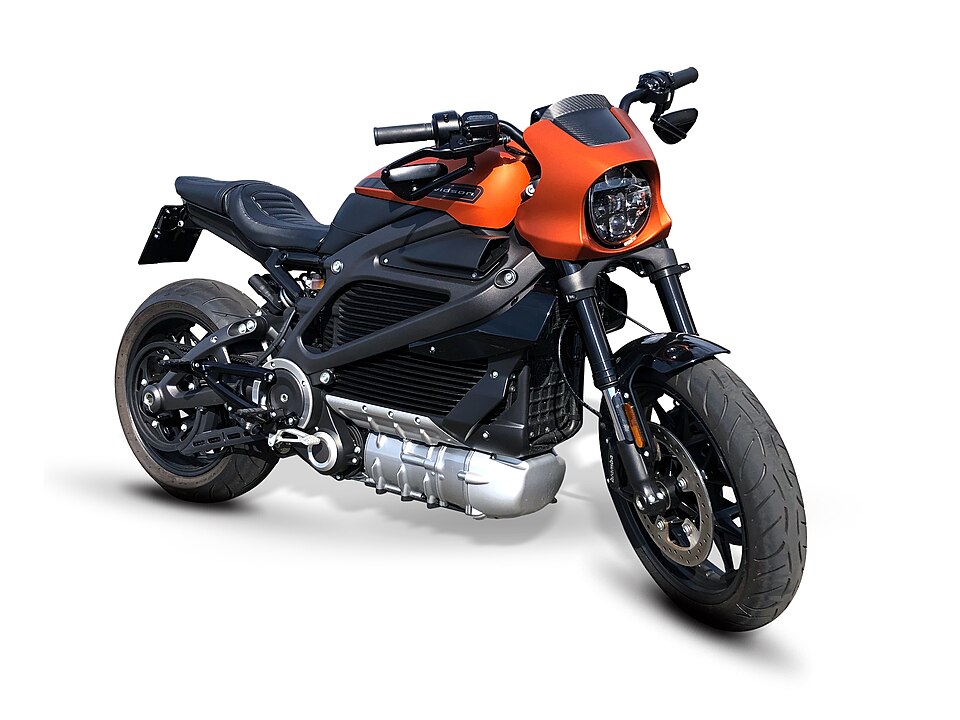
The reasoning is worth sitting with, because it is the whole argument of this article in miniature. Harley-Davidson's brand equity is inseparable from an air-cooled 45-degree V-twin with uneven firing intervals. A silent motorcycle cannot inherit that equity — the thing being inherited is literally a noise. So the company built a new brand to carry the new technology, and kept the bar-and-shield attached to the sound that made it valuable. Whether LiveWire finds a market of its own remains genuinely unresolved; volumes so far have been very small.
What the shield is actually worth
Set aside the motorcycles for a moment and look at the mark itself.
| Era | What the shield signified | How it was monetised |
|---|---|---|
| 1910s–1930s | A guarantee of mechanical reliability | Machine sales, police and military contracts |
| 1940s–1950s | Service and patriotism | Government contracts, dealer network |
| 1960s–1970s | Outlaw counterculture, largely unbidden | Aftermarket parts, an image the factory resisted |
| 1980s–1990s | Membership and belonging | HOG, MotorClothes, licensing, dealer experience |
| 2000s–present | Authenticity and heritage | Licensing, financial services, premium pricing |
Very few industrial trademarks make that journey — from a technical warranty to a cultural affiliation — without being destroyed somewhere along the way. Harley's did, and it did so partly by accident. The company did not create the outlaw image; it spent decades opposing it, then discovered in the 1980s that the safest way to sell to a middle-aged accountant was to sell him a weekend as somebody slightly more dangerous than himself. The bar-and-shield was the passport.
That is also the trap. A trademark that means heritage cannot easily be attached to something new. Every genuinely forward-looking thing Harley-Davidson has done — the V-Rod, Buell, LiveWire, arguably the Pan America — has run into the fact that its own badge argues against it. Meanwhile the things that reinforce the badge are, by definition, the things it has already done.
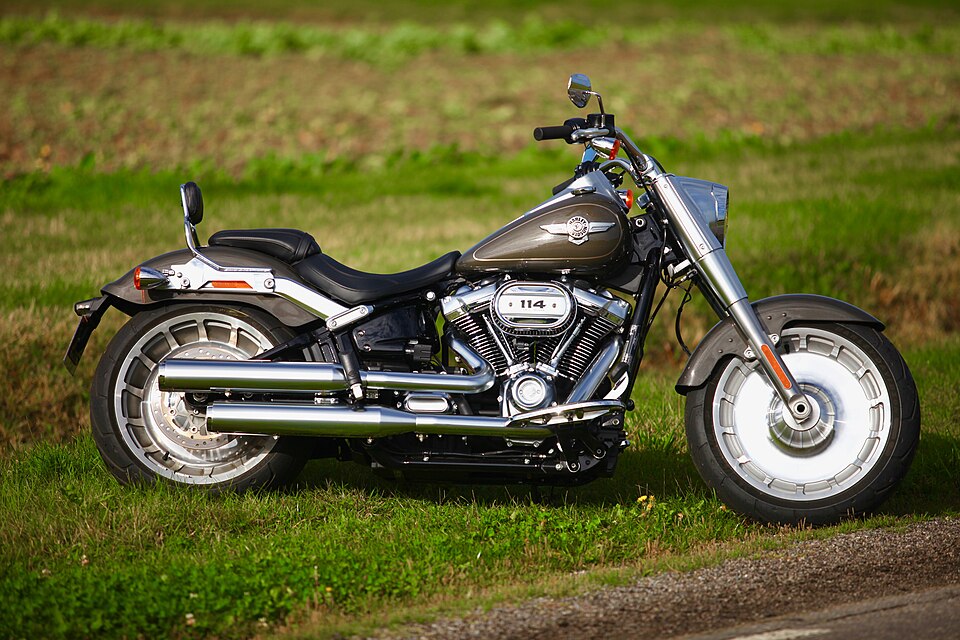
Ride one before you form an opinion
The most common mistake made about Harley-Davidson, in both directions, is treating it as an argument rather than a machine. Enthusiasts of European and Japanese motorcycles dismiss it on specification sheets; the faithful defend it on identity. Both are talking about the logo rather than the motorcycle.
So do the empirical thing. Find a dealer demo day and take out something current — a Low Rider ST, a Road Glide, a Pan America. Note what the engine actually does below 3,000 rpm, which is where a big V-twin lives and where a specification sheet tells you nothing. Then, if you can, find someone with a Shovelhead or a well-sorted Panhead and listen to how much of the modern machine is still audibly the 1936 engine.
And when you next see a bar-and-shield on a jacket, a coffee mug, or the tank of a machine parked outside a diner, consider that you are looking at a piece of graphic design from 1910 that has outlived the shed it was drawn in, two world wars, the Depression that killed every rival but one, a conglomerate that nearly ruined it, and the arrival of the electric motorcycle. Almost nothing else in the vehicle world has managed that. The question the next twenty years will settle is whether a mark that draws its power from the past can be made to point at anything else.


