
On a January morning in 1938, Bernd Rosemeyer drove a streamlined Auto Union record car down the Frankfurt–Darmstadt autobahn at more than 400 km/h and was killed by a crosswind that caught the body between two stands of trees. The car he was driving carried four interlocking rings on its nose — a badge that was, at the time, barely six years old, and which existed only because four bankrupt Saxon car companies had been shoved into a single holding company by a state bank. That badge is now on roughly two million cars a year. Almost every German marque has a story shaped like this one: a merger, a bankruptcy, a state, and a piece of heraldry that outlived the men who chose it.
Germany's motor industry is unusual in that it contains both the oldest surviving car company on earth and one of the youngest mass-market brands in Europe, and that most of the marques in between died in a twenty-year window either side of the war. What follows is the complete map — the living, the dead, the resurrected and the deeply strange — plus an attempt to explain why German badges look the way they do and why German cars feel the way they do.
Zwickau, Chemnitz and the Merger That Made the Four Rings
The four rings are not a design flourish. They are a corporate diagram.
In June 1932, at the bottom of the Depression, the Saxon State Bank engineered the amalgamation of four car and motorcycle makers clustered around Chemnitz and Zwickau: Audi, DKW, Horch and Wanderer. The new company was called Auto Union AG, and the interlocking rings — one per constituent firm — were adopted as its mark. Each brand kept its own badge on its own cars and was assigned a market segment, which is more or less exactly how Volkswagen Group would later run Škoda, SEAT, VW, Audi, Bentley and Porsche. Auto Union invented the modern platform-sharing conglomerate before anyone had a name for it.
Horch was the senior partner and the luxury arm. August Horch founded it in Cologne in 1899 and moved production to Zwickau in 1904, building large, expensively engineered cars with straight-eights and later V8s. Horch's own badge used the family name in Gothic script and, in some periods, a stylised crown-and-shield device befitting a marque that sold to industrialists and ministries.
DKW was the volume brand and the one that actually paid the bills. It was founded by Jørgen Skafte Rasmussen, a Dane who had settled in Zschopau, and the initials began life as Dampf-Kraft-Wagen — steam-powered car — from an early and unsuccessful steam project. When the company pivoted to tiny two-stroke engines it retroactively rebranded the letters as Das Kleine Wunder, the little wonder. By the early 1930s DKW was among the largest motorcycle manufacturers in the world, and its front-wheel-drive, two-stroke, plywood-bodied small cars were the entry point into motoring for a generation of Germans.
Wanderer, based in Chemnitz, had begun with bicycles and made typewriters and machine tools alongside cars. It sat in the middle of the range — solid six-cylinder saloons for doctors and lawyers. Ferdinand Porsche's design bureau developed engines for Wanderer in the early 1930s, one of several threads connecting the Auto Union story to the man who would later shape Volkswagen and Porsche.
The fourth ring, Audi, is the strangest of all, because it exists because of a lawsuit. August Horch fell out with his own supervisory board and left the company he had founded in 1909. He immediately set up a rival firm in Zwickau using his own name, and was promptly sued by the board of the old one for trademark infringement — he lost. Needing a name that wasn't "Horch" but meant the same thing, the story goes that a Latin-schooled boy in the room pointed out that horch is the German imperative "listen", and the Latin imperative is audi. The company was registered under the new name in 1910.
Mercedes-Benz: A Star for Land, Water and Air
Two companies invented the car more or less simultaneously and about a hundred kilometres apart. Karl Benz patented his Patent-Motorwagen in Mannheim in 1886. Gottlieb Daimler and Wilhelm Maybach were building high-speed petrol engines in Cannstatt at the same time. They never met, and their firms competed bitterly for forty years before merging in 1926.
The Mercedes name came from a customer. Emil Jellinek was an Austrian businessman and consul based in Nice who sold Daimler cars to the Riviera set and raced them under the pseudonym "Mercédès", his daughter's name. In 1900 he ordered a batch of cars on the condition that Daimler build them to his specification — long, low, with a honeycomb radiator and a wide track — and that they be sold under that name. The Mercedes 35 PS of 1901 is widely considered the first recognisably modern motor car, and the name stuck to the product so firmly that Daimler-Motoren-Gesellschaft eventually adopted it.
The three-pointed star was registered in 1909. Daimler's sons recalled their father marking the location of his house on a postcard with a star and writing that one day a star would shine over his works. The three points were given the meaning of motorisation on land, on water and in the air — not marketing hindsight, but an accurate description of a company that built car engines, marine engines and aero engines. A circle was added around it in the 1910s. When Daimler and Benz merged, the star was set inside the laurel wreath that Benz & Cie had used, and that combined mark — star plus wreath — remains the corporate logo, with the plain star in a ring used on the cars themselves.
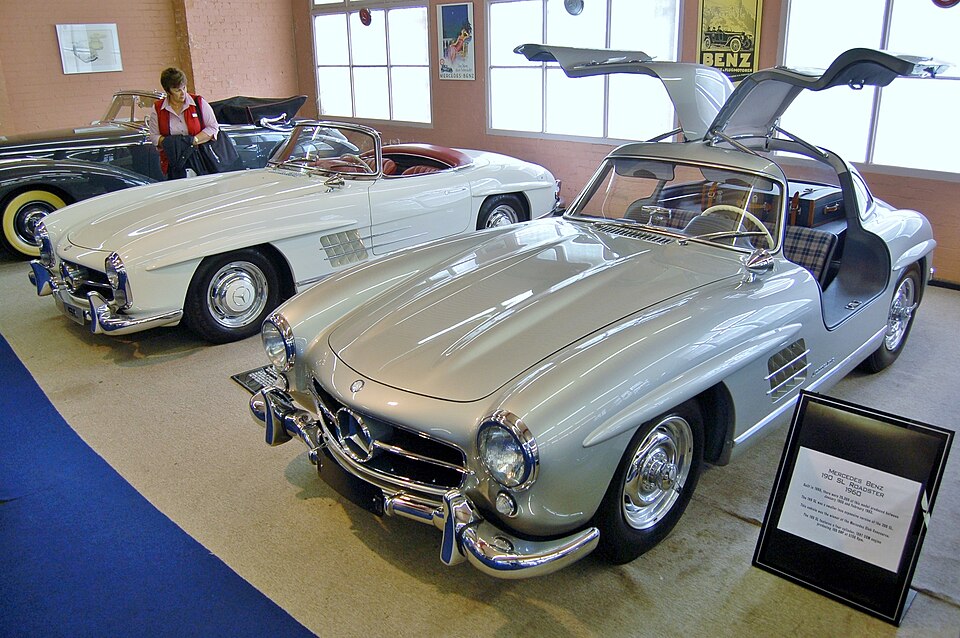
The engineering identity followed the badge. The 300 SL of 1954 introduced mechanical direct fuel injection to a production car; the "Ponton" and "Fintail" saloons of the 1950s and 60s pioneered the crumple zone under Béla Barényi's patents; the W126 S-Class of 1979 industrialised the driver's airbag and ABS in Europe. Mercedes' cultural position is that of the establishment default — the taxi, the ministerial car, the thing that is still running at 600,000 km.
BMW: Bavarian Quarters and the Propeller That Came Later
Bayerische Motoren Werke was formed in Munich in 1917 out of the wreckage of Rapp Motorenwerke, an aero-engine maker. The roundel was registered that year, and it kept Rapp's circular black outer ring with the company initials. The blue and white quarters inside are the colours of the Free State of Bavaria, taken from the Wittelsbach lozenge — but reversed in order, because trademark law of the period forbade the use of state coats of arms in commercial marks. The workaround has been the badge for over a century.
The propeller reading came a decade later. A 1929 BMW advertisement showed the roundel superimposed on a spinning aircraft propeller, and the image was so good that it became the official origin story for the next seventy years. BMW itself now acknowledges the Bavarian-colours explanation as the real one, and treats the propeller as a very successful piece of interwar advertising.
BMW's first car was not its own design: the Dixi 3/15, built at Eisenach in Thuringia under licence from Austin, acquired in 1928. The company's own identity arrived with the 303 in 1933, which introduced the twin kidney grille that has been on every BMW since, and reached its prewar peak with the 328 sports car. After 1945 the Eisenach plant was on the wrong side of the line and continued building BMW-derived cars as EMW; Munich made pots, pans and motorcycles before returning to cars.
The company nearly disappeared. By 1959 BMW was losing money on the enormous 502 V8 and the tiny Isetta bubble car with nothing in between, and a takeover by Daimler-Benz was tabled at the shareholders' meeting. Small shareholders and dealers blocked it, and Herbert Quandt took a controlling stake instead. The car that justified the rescue was the "Neue Klasse" 1500 of 1962 — a compact, four-cylinder, sporting saloon that essentially invented the segment BMW has occupied ever since.
Audi: A Latin Imperative and a Slogan Borrowed from NSU
Postwar, the Auto Union brands were all in Soviet-occupied Saxony and were expropriated. The company was refounded in Ingolstadt, Bavaria, in 1949 — which is why a firm born in Zwickau is now headquartered in a Bavarian market town — and initially built DKW two-strokes. Daimler-Benz took control in the late 1950s, could not make it work, and sold Auto Union to Volkswagen in the mid-1960s.
Volkswagen's interest was capacity, not brands. But the Ingolstadt engineers had developed a four-stroke engine under Daimler ownership, and when the resulting car appeared in 1965 it needed a name that wasn't DKW, whose reputation was tied to smoky two-strokes. The dormant Audi name was revived for the F103, sold by its horsepower rating as the Audi 72. In 1969 Auto Union merged with NSU to form Audi NSU Auto Union AG, dropping to the simple Audi AG in 1985.
Vorsprung durch Technik — progress, or advantage, through technology — came from NSU rather than Audi, and was inherited in the merger. Audi began using it in the early 1970s, and it entered the English-speaking world untranslated in British advertising in the 1980s, which is why millions of people who speak no German can say it.
The engineering that made the slogan credible was the 1980 Quattro: permanent four-wheel drive with a centre differential, developed after chassis engineers noticed that a Volkswagen Iltis military vehicle was faster than an Audi on snow. It rewrote rallying within two seasons and made all-wheel drive a luxury-car expectation.
Volkswagen: The Most Politically Complicated Roundel in Europe
The Volkswagen was a state project. Ferdinand Porsche's design bureau developed it from 1934 under a commission from the Nazi government; the factory and its purpose-built town were established in 1938 in what is now Wolfsburg, and the car was marketed as the KdF-Wagen through the Strength Through Joy leisure organisation. Almost no civilian ever received one — a savings-stamp scheme took workers' money and the plant switched to military Kübelwagen and Schwimmwagen production.
The company's survival after 1945 is largely down to Major Ivan Hirst, a British Army officer who found the bombed plant, got the presses running and secured an order for British forces vehicles when nobody else believed the design had a future. The Beetle went on to become the longest-running and, for decades, best-selling single car design in history.
The VW roundel — a W stacked under a V inside a circle — is usually credited to Franz Xaver Reimspieß, an engineer in Porsche's office. Its outline has been remarkably stable: the wartime version sat inside a cogwheel and stylised wings, which were quietly dropped; the mark was simplified in 1948, given depth and a blue-and-chrome three-dimensional treatment in 2000, and flattened again in 2019 into a thin, two-dimensional outline built for screens rather than chrome badging. Volkswagen's design language has followed the same logic — the Golf, first drawn by Giorgetto Giugiaro in 1974, established a rectilinear, unfussy, hard-edged idiom that survives eight generations later.
An oddity in the same orbit: smart is neither Volkswagen nor quite conventional. It began as a collaboration between Nicolas Hayek of Swatch and Daimler — the name is sometimes given as an acronym of Swatch, Mercedes and art — producing the City-Coupé in 1998, built in Hambach in French Lorraine at a plant nicknamed Smartville. Its structural idea, the visible Tridion safety cell painted in a contrasting colour, turned a crash structure into the brand's entire graphic identity. Today smart is a 50/50 joint venture between Mercedes-Benz and Geely, designed in Europe and built in China as an electric-only marque.
Porsche: Stuttgart's Horse Inside Württemberg's Antlers
The Porsche crest is the most literal piece of heraldry in the car industry. In the centre is the rearing black horse of Stuttgart, taken from the city's arms — the name Stuttgart derives from Stuotgarten, a stud farm. Around it sits the arms of the former state of Württemberg-Hohenzollern: three stylised antlers and red-and-black stripes. The design was commissioned in the early 1950s, reportedly after Porsche's American importer Max Hoffman told Ferry Porsche the cars needed a proper badge, and it has been through only gentle refinements since.
Porsche the company began in 1948 in Gmünd, Austria, with the aluminium-bodied 356, built on Volkswagen mechanicals — a lineage that is not incidental but foundational, since Porsche's office had designed the Beetle in the first place. The 911 arrived in 1963 as the 901, renamed after Peugeot asserted a right to three-digit names with a central zero in France. Sixty years of rear-engined, air-then-water-cooled iteration later, the 911 remains the industry's most extreme example of evolutionary rather than revolutionary design.
Opel: Sewing Machines, Bicycles, and a Lightning Bolt
Adam Opel started making sewing machines in Rüsselsheim in 1862 and added bicycles in the 1880s; the company became one of the largest cycle makers in the world. He died in 1895, four years before his sons put the firm into cars by acquiring the Lutzmann design. Opel introduced moving-assembly-line production to Germany in the 1920s and was bought by General Motors around 1929–31, becoming Europe's most thoroughly Americanised German brand — and remaining GM's European mass-market arm until it was sold to PSA in 2017, arriving in Stellantis with the subsequent merger.
The Blitz logo comes from a truck. Opel's 1930 light lorry was named the Blitz — lightning — and the horizontal lightning-bolt-through-a-circle badge that everyone recognises was introduced in the 1960s, replacing a series of oval and airship-like devices. It has been redrawn repeatedly, most recently as a flat, thin-line mark integrated into the full-width black "Vizor" front panel that now defines the brand's face.
Maybach: Zeppelin Engines and Two Overlapping Ms
Wilhelm Maybach was Gottlieb Daimler's chief engineer and arguably the more brilliant of the pair — the honeycomb radiator and the spray-nozzle carburettor are his. He left Daimler and, with his son Karl, set up in Friedrichshafen on Lake Constance building engines for Count Zeppelin's airships. Cars followed from 1921, and by the 1930s the Maybach Zeppelin, with a 8-litre V12 and a gearbox of baroque complexity, was among the most expensive vehicles in Europe.
The badge — two interlocking Ms inside a triangle, for Maybach Motorenbau — was revived when Daimler relaunched the marque in 2002 with the 57 and 62. It was a commercial failure against Rolls-Royce and Bentley and was wound up in 2012. Mercedes then did the sensible thing and brought the name back as Mercedes-Maybach, a top trim tier on the S-Class and GLS rather than a standalone brand, which has been far more successful.
The Tuners Who Became Manufacturers
Germany has a legal category that most countries lack in practice: a workshop can be recognised as a Fahrzeughersteller, a vehicle manufacturer in its own right, with its own type approval and VIN. That status is why the following are brands rather than accessory shops.
AMG was founded in 1967 by Hans Werner Aufrecht and Erhard Melcher, two former Daimler engineers; the letters are their initials plus Großaspach, Aufrecht's birthplace. The firm's arrival was announced by the 300 SEL 6.8 that finished second in class at Spa in 1971, a two-tonne red saloon that the French press nicknamed the Red Pig. Daimler took a majority stake in 1999 and full ownership in 2005. The "one man, one engine" signature plate on each hand-assembled Affalterbach V8 is a piece of manufacturing theatre that also happens to be true.
Alpina of Buchloe is the strangest of them, because it started as a typewriter company. Burkard Bovensiepen began selling twin-Weber carburettor kits for the BMW 1500 in the mid-1960s, and BMW's own board was impressed enough to honour warranties on cars fitted with them. Alpina was recognised as a manufacturer in 1983 and built its own line of B-series cars — softer, torque-rich, long-geared alternatives to M cars, with the distinctive multi-spoke wheels and gold decals. In a neat closing of the circle, BMW acquired the Alpina brand outright, taking it over from the start of 2026; the Bovensiepen family retains the Buchloe business under its own name.
Brabus, in Bottrop, was founded in 1977 by Bodo Buschmann and Klaus Brackmann — the name is a contraction of their surnames. It specialises almost exclusively in Mercedes, and in a particular register of excess: 800-plus-horsepower twin-turbo V8s, ostrich-leather interiors, and G-Wagens with portal axles. It is now the world's largest independent tuner by revenue.
Ruf Automobile of Pfaffenhausen started as a village garage founded by Alois Ruf Sr. in 1939 and became a recognised manufacturer in the early 1980s under his son. Its moment came in 1987, when Road & Track gathered the world's fastest cars at Nardò and the Ruf CTR — a yellow, twin-turbocharged, narrow-bodied 911 nicknamed the Yellowbird — recorded a little over 340 km/h and beat everything present. A grainy onboard film of Stefan Roser drifting the same car around the Nürburgring became one of the founding documents of car-video culture.
Techart, founded in Leonberg in 1987, occupies the more restrained end of Porsche modification: aerodynamics, chassis and interior work with an OEM-adjacent finish, and its own type approval for complete conversions.
Mansory, based in the Bavarian village of Brand, is the maximalist. Founded by Kourosh Mansory in the late 1980s, it works in carbon fibre across Rolls-Royce, Bentley, Ferrari and Mercedes, and has become a genuine cultural signifier — usually shorthand for a particular register of Gulf-and-Instagram taste. Whatever one thinks of the results, the carbon work is technically serious.
The Small-Volume Sports Car Makers
Isdera — Ingenieurbüro für Styling, Design und Racing — was founded by Eberhard Schulz, who had worked on the mid-engined Mercedes CW311 concept and effectively continued the idea under his own name from 1982. The Imperator 108i and later Commendatore 112i were gullwing, mid-engined, Mercedes-V8-powered cars with a periscope-style roof-mounted rear-view mirror. Production totalled a few dozen cars over two decades, and there was no showroom: you visited the workshop.
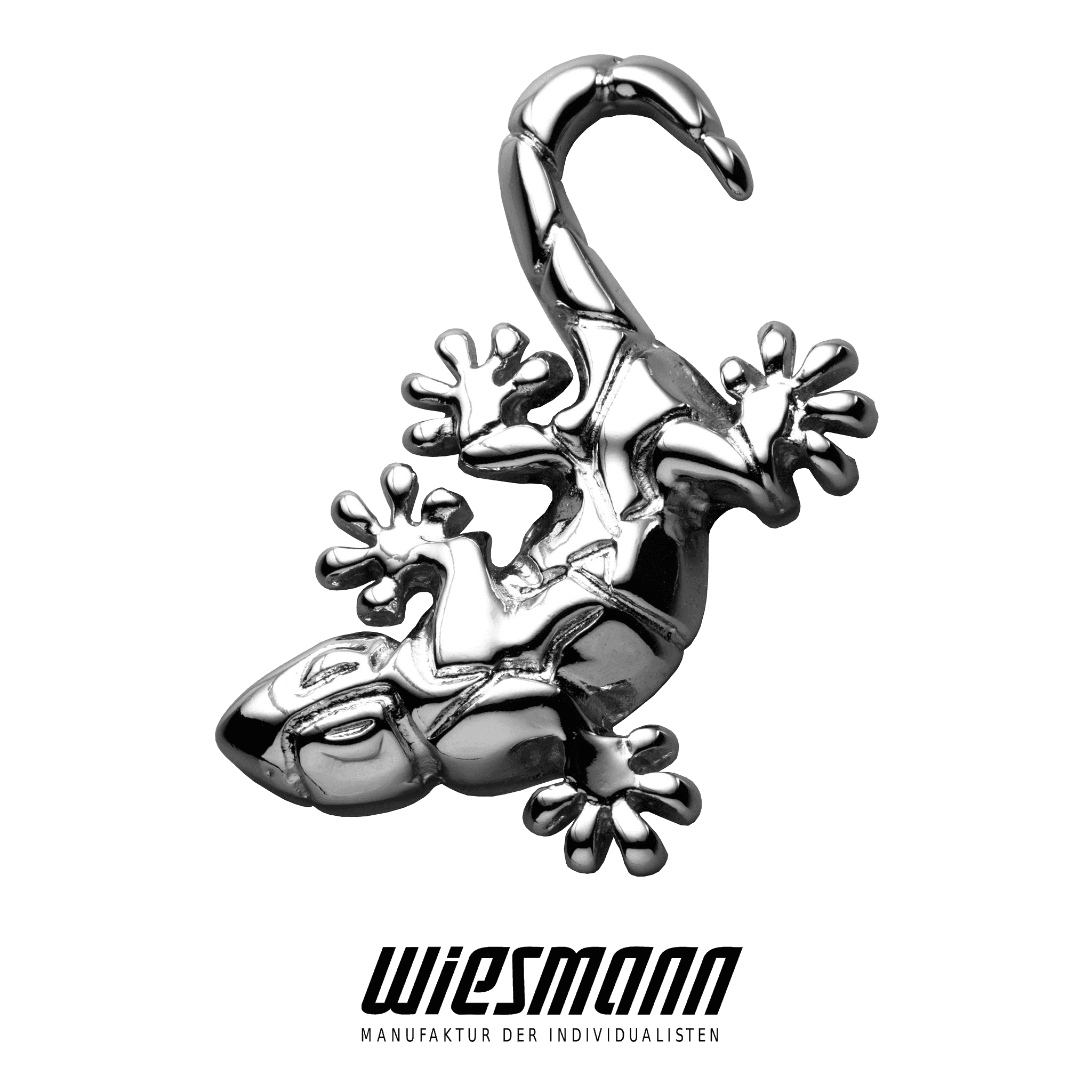
Wiesmann was started in Dülmen in 1988 by brothers Martin and Friedhelm Wiesmann, building retro-styled roadsters and coupés on BMW running gear. Their badge is a gecko, on the logic that the cars stick to the road like one, and the factory itself was built in the shape of a gecko. The company went insolvent in 2014 and has since been relaunched around a new electric model programme.
Artega, from Delbrück in Westphalia, launched the GT in 2009 — a compact mid-engined coupé using Volkswagen's VR6, with bodywork by Henrik Fisker. It was well reviewed and arrived directly into the financial crisis; the company failed in 2012 and the name resurfaced attached to small electric projects.
Gumpert was founded in Altenburg by Roland Gumpert, formerly head of Audi Sport during the Quattro rally years. The Apollo of 2005 was uncompromisingly a race car with plates — flat underbody, huge downforce, twin-turbo Audi V8. Gumpert went insolvent in 2013 and the assets were bought by an investor group that continued as Apollo Automobil, producing the Intensa Emozione. Gumpert himself moved on to methanol fuel-cell projects.
Behind the Wall: The Cars of the DDR

East German car making was organised under IFA, the Industrieverband Fahrzeugbau, which coordinated every vehicle plant in the republic. Its output is often treated as a joke, but the engineering constraints were real: no hard currency for steel, no access to Western components, and production targets set by plan rather than demand.
The Trabant was built at Zwickau — the old Horch and Audi works, renamed VEB Sachsenring — from 1957. The definitive P601 ran from 1964 to 1990 essentially unchanged: a 594 cc two-cylinder, two-stroke engine of about 26 hp, front-wheel drive, and body panels made of Duroplast, a phenolic resin reinforced with cotton waste from Soviet textile mills. Duroplast doesn't rust and is startlingly tough, but it cannot be recycled easily, which made scrapping hundreds of thousands of Trabants after 1990 an environmental problem. Waiting lists ran to a decade or more. A final version with a Volkswagen Polo four-stroke engine was built in 1990–91 and nobody wanted it.
The Wartburg, named for the castle above Eisenach, was the DDR's step up — built in the former BMW plant. The 353, exported as the Knight, used a 992 cc three-cylinder two-stroke and a body with a genuinely spacious cabin and a huge boot. Like the Trabant, it received a Volkswagen four-stroke in its final years and was discontinued in 1991.
Around them sat a full ecosystem. Barkas built the B1000 van in Karl-Marx-Stadt, a forward-control two-stroke box that served as ambulance, police van and delivery vehicle across the Eastern Bloc. Robur in Zittau made light trucks and buses. Simson of Suhl produced the S50 and S51 mopeds and the Schwalbe scooter, machines with a devoted following in eastern Germany to this day. And Melkus, run by racing driver Heinz Melkus in Dresden, hand-built the RS1000 from 1969 — a gullwing, mid-engined coupé using a tuned Wartburg two-stroke, and the only genuine sports car the DDR ever produced.
The Lost Names of the West
Not all the dead brands are eastern. West Germany lost several of its most interesting companies during the boom, not the bust.
Borgward is the great what-if. Carl F. W. Borgward built a Bremen group that at its peak ran four marques — Borgward, Hansa, Goliath and Lloyd — and was for a time the third-largest car maker in West Germany. The Isabella of 1954 was a genuinely lovely mid-size car; Goliath's GP700 of 1952 was among the first production petrol cars with direct fuel injection; Lloyd's LP300 had a plywood-and-fabric body that earned it the nickname Leukoplastbomber, the sticking-plaster bomber. The group collapsed in 1961 in a liquidity crisis whose handling by the state of Bremen has been argued about ever since, since the assets reportedly covered the debts. Chinese-backed attempts to revive the name in the 2010s produced SUVs for the Chinese market and then faded.
Glas, of Dingolfing in Lower Bavaria, began with agricultural machinery and made the Goggomobil microcar. Hans Glas was a real innovator: the Glas 1004 of 1962 introduced the first mass-produced toothed-belt overhead camshaft drive, now universal. The company overreached with the Frua-bodied 2600 V8 — inevitably nicknamed the Glaserati — and was bought by BMW in 1966, largely for its factory. That factory is today BMW's largest plant.
NSU of Neckarsulm went from knitting machines to bicycles to motorcycles, and in the 1950s was the largest motorcycle manufacturer in the world. It built the rear-engined Prinz, then made the boldest technical bet of any German company: the Wankel rotary. The NSU Spider of 1964 was the first rotary-engined production car, and the Ro 80 of 1967 — a low-drag, front-drive saloon that looked a decade ahead of everything — won European Car of the Year. Rotor tip seal failures generated warranty claims that broke the company, and NSU was absorbed into Auto Union in 1969. Ro 80 owners famously greeted each other on the road by holding up fingers to indicate how many engines they'd been through.
| Marque | Home town | Status |
|---|---|---|
| Mercedes-Benz | Stuttgart | Active |
| BMW | Munich | Active |
| Audi | Ingolstadt | Active |
| Volkswagen | Wolfsburg | Active |
| Porsche | Stuttgart-Zuffenhausen | Active |
| Opel | Rüsselsheim | Active (Stellantis) |
| Maybach | Friedrichshafen | Active as Mercedes sub-brand |
| Alpina | Buchloe | Brand now owned by BMW |
| Horch / Wanderer / DKW | Saxony | Dormant (VW Group heritage) |
| Borgward / Lloyd / Goliath | Bremen | Defunct |
| Glas | Dingolfing | Defunct (absorbed by BMW) |
| NSU | Neckarsulm | Defunct (absorbed by Audi) |
| Trabant / Wartburg / Barkas | DDR | Defunct 1990–91 |
Trucks, Buses and Machines That Work
MAN — Maschinenfabrik Augsburg-Nürnberg — is where the diesel engine was actually built. Rudolf Diesel developed his compression-ignition engine at the Augsburg works through the 1890s, and MAN went on to build the first direct-injection diesel truck in the mid-1920s. Its badge, an unusual and rather beautiful device, incorporates the lion of the Duchy of Brunswick, inherited from the Büssing truck business MAN absorbed in 1971. MAN is now part of Traton, Volkswagen Group's commercial vehicle arm.
Setra buses come from Kässbohrer in Ulm, and the name is a contraction of selbsttragend — self-supporting. The 1951 S8 was the first German bus with integral, chassis-less monocoque construction, which is now how essentially every coach in the world is built. Setra is today part of Daimler Buses.
Neoplan, founded by Gottlob Auwärter in Stuttgart, was the design-led alternative: the Skyliner of 1967 was the first modern double-deck touring coach, and the four-axle, 18-metre Jumbocruiser of the 1970s remains the largest bus ever series-produced. MAN acquired it in 2001.
The Unimog — Universal-Motor-Gerät, universal motorised implement — was conceived in the immediate postwar years as a farm machine that could plough at walking pace and drive to market at 50 km/h. Portal axles for ground clearance, a flexible ladder frame that twists deliberately, and power take-offs front and rear made it the tool-carrier of choice for every fire brigade, forestry service and expedition since. Mercedes-Benz has built it at Gaggenau since the early 1950s.
Multicar, from Waltershausen in Thuringia, is the DDR's most successful surviving industrial product: a tiny articulated municipal truck, still made under the Hako umbrella, still sweeping streets across Europe.
Two Wheels and the Component Makers
BMW Motorrad predates BMW's cars. The R32 of 1923, designed by Max Friz, established the flat-twin boxer engine mounted transversely with shaft drive — a layout BMW still sells today, over a century later, which may be the longest continuously produced engine architecture in vehicle history.
Metzeler began as a Munich rubber works in 1863 and became one of Europe's defining motorcycle tyre brands; it has been part of Pirelli since the mid-1980s but retains its own development identity and its elephant mascot. Sachs of Schweinfurt — originally Fichtel & Sachs — built the world on small components: the torpedo coaster brake hub that put brakes in millions of bicycles, then mopeds, small two-strokes, clutches and dampers. Its chassis division was absorbed by ZF, and Sachs shock absorbers are underneath a very large share of European cars.
Why German Design Looks German
The visual argument starts at the Bauhaus, founded in Weimar in 1919 and shut down under political pressure in 1933. Its doctrine — that form should follow function, that ornament is dishonest, that industrial production is a legitimate medium — did not directly touch prewar car design, which was still coachbuilt and decorative. It arrived in the car industry second-hand, through the Hochschule für Gestaltung Ulm, the postwar design school that ran from 1953 to 1968 and whose systematic, grid-based, anti-expressive approach shaped Braun under Dieter Rams and, through Braun, an entire German notion of what a well-made object looks like.
You can see the result most clearly in the difference between a 1974 Golf and a 1974 Fiat or Renault of the same size. The Golf is orthogonal, unornamented, and organised around legibility: a flat instrument binnacle, unambiguous controls, panel gaps treated as a design element rather than a defect to hide. Audi's later "form follows function" era under Peter Schreyer and then Walter de'Silva was an explicit reference to this lineage, and Volkswagen's interiors of the 1990s and 2000s — dark, matte, damped, with a single knurled knob doing one job — are Ulm doctrine applied to a dashboard.
German badges obey the same discipline. Compare the Mercedes star, the BMW roundel, the Audi rings and the VW monogram with the Italian or American equivalents. Each German mark is monochrome or two-tone, geometrically constructible, and reads at any size — they were designed to survive being stamped in metal, cast in plastic, embroidered, and now rendered at 24 pixels on a phone. The Alfa Romeo biscione and the Abarth scorpion are pictures; the German marks are diagrams.
The Autobahn Effect on Chassis Engineering
The other formative force is a road. The first purpose-built limited-access motorway opened between Cologne and Bonn in 1932, and the network expanded enormously in the following decade. Crucially, large parts of it still have no general speed limit — only an advisory Richtgeschwindigkeit of 130 km/h introduced in the late 1970s.
Design a car for a market where a family saloon might genuinely cruise at 200 km/h for an hour and a series of consequences follow that competitors in speed-limited markets can simply ignore. Straight-line stability at high speed requires particular suspension geometry, generous castor, and aerodynamic balance front to rear — not just a low drag coefficient but low lift at both axles. Damping has to be tuned for repeated high-frequency inputs at speed rather than for low-speed ride comfort, which is a large part of why German cars have historically felt firm and slightly aloof at 50 km/h and then come alive at 160.
Then there is heat. Sustained maximum-speed running is brutally hard on cooling, oil temperature, transmission fluid and brakes. German manufacturers standardised on larger radiators, oil coolers, aggressive brake cooling ducts and high-temperature pad compounds long before their competitors, and on tyres rated V, W and Y — ratings that exist mostly because of this one country's roads. It is also why German brake pads famously produce so much dust: they are formulated for fade resistance, not for keeping wheels clean.
The cultural output is a specific idea of quality: not softness, not drama, but composure. The claim implicitly made by a German car is that nothing about it will change if you drive it very fast for a very long time.
Heraldry on the Hood
Finally, look at how much regional identity is encoded in these badges — far more than in any other national industry.
Bavaria contributes the blue and white lozenges of the Wittelsbachs to BMW's roundel. Stuttgart contributes its rearing stud-farm horse to Porsche, and the surrounding antlers and stripes are the arms of Württemberg. Bremen's red and white sit behind Borgward's rhombus. The lion in MAN's badge belongs to Brunswick. Saxony's four bankrupt firms are literally counted out in Audi's rings. Even Opel's lightning bolt began as the name of a truck built in a Hessian town on the Main.
This is not sentimentality. German industry organised itself around cities and states long before it organised itself around a nation — the country only unified in 1871, and its car industry grew up in a federal structure where Munich, Stuttgart, Wolfsburg, Rüsselsheim and Zwickau were genuine rivals with their own banks, their own unions and their own pride. The badges record a geography of competition, and they still do: ask anyone in Stuttgart what they think of Munich.
Read the Badge Backwards
Next time you are stuck in traffic, try reading the marques around you as documents rather than logos. The rings on the car ahead are a bank's 1932 restructuring plan. The roundel beside you is a trademark lawyer's workaround for a state coat of arms. The star in front is a note a dead engineer once wrote on a postcard to his wife. The gecko you almost never see is a joke about grip.
Then go and find the ones that are missing. There are still Isabellas at German shows, still Ro 80s being kept alive by a small and stubborn club, still Trabants running on premix in Zwickau, where the same plant now builds Volkswagen's electric cars on the site where August Horch first set up shop in 1904. The complete list of German car brands is longer than the four you can name from a motorway — and most of the interesting ones are the dead ones.


