
In the summer of 1945, the enormous factory on the Mittellandkanal at Fallersleben was a shell. Allied bombers had opened its roof in a dozen places, the machine tools that survived were slated to be shipped out as reparations, and nobody in the occupying British administration particularly wanted the place. A REME officer named Ivan Hirst — a major, in his late twenties, a Manchester watchmaker's son by background — looked at a dusty, rear-engined saloon that the German workers had cleaned up and presented to him, and decided it might be worth building a few. He had it painted khaki and sent it up the chain of command. The British Army needed light transport. That was the entire commercial case.
Roughly seventy-five years later, the company that grew out of that decision sold vehicles under a dozen badges on four continents, owned Bentley and Lamborghini and Ducati, controlled Porsche, and built more cars in a year than any manufacturer on earth except Toyota. Almost none of it was planned. Volkswagen's history is a chain of accidents, rescues and near-death experiences strung between two extraordinary products: the car everyone knows as the Beetle, and the car that had to replace it.

The Brief: A Car the Average German Could Actually Buy
Germany in the early 1930s was, by the standards of industrialised Europe, badly motorised. Britain and France had far more cars per head; the United States had an order of magnitude more. German cars were well engineered and expensive, built in small numbers by firms who saw the automobile as a luxury good. There had been attempts at a genuine Volkswagen — a "people's car" — before the Nazi party ever used the phrase. Hanomag, Adler and others had all tried small, cheap cars in the 1920s, and none had cracked the price problem.
What changed was political will. The new regime treated mass motorisation as a showpiece policy alongside the Autobahn programme, and in 1934 the German motor industry association handed a development contract to a Stuttgart consultancy run by Ferdinand Porsche. Porsche had left Austro-Daimler and then Steyr, and had set up his own design bureau in 1931 with his son Ferry and son-in-law Anton Piëch orbiting the business. He had been sketching small rear-engined cars for years — for Zündapp and for NSU — and had a fully formed idea of what such a car needed to be.
The brief was brutally specific about price and duty cycle. The car had to carry two adults and three children, cruise at motorway speeds all day without breaking, be air-cooled so it could not freeze in an unheated yard, be simple enough for a village mechanic, and sell for under a thousand Reichsmarks. That last figure was the hard one, and arguably was never honestly met.
Ferdinand Porsche's Answer
Porsche's solution was coherent to the point of stubbornness. A flat platform chassis with a central backbone tunnel. Torsion bar springing front and rear — compact, cheap, and Porsche's own patented enthusiasm. Trailing arms at the front, swing axles at the rear. And hung out behind the rear axle, a horizontally opposed four-cylinder engine, air-cooled, driving forward through the gearbox to the rear wheels.
Putting the engine over the driven wheels gave traction on bad roads and removed the propshaft, the radiator, the water pump and the hoses. It also gave the car its defining dynamic vice: a rearward weight bias combined with swing-axle geometry that would tuck a wheel under and snap the tail loose if a driver lifted off mid-corner. Generations of owners learned to live with it.
The body was shaped by aerodynamic thinking that was in the air across central Europe at the time — Paul Jaray's patents, Hans Ledwinka's Tatras, Josef Ganz's advocacy. The resemblance between Porsche's car and the Tatra V570 and T97 was close enough that Tatra sued; the litigation was interrupted by the German annexation of Czechoslovakia and settled long afterwards, in the 1960s, with Volkswagen paying up.
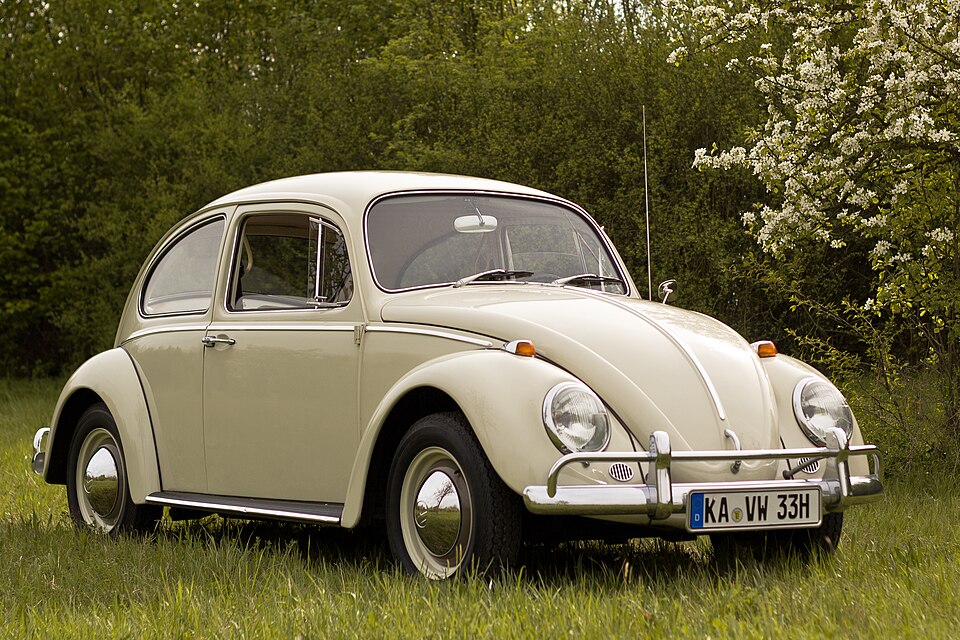
Prototypes ran from 1936. The V3 series, then the thirty-car VW30 fleet tested by SS drivers over hundreds of thousands of kilometres, then the VW38 — the pre-production series that finally fixed the shape most people picture: the split rear window, the running boards, the humped bonnet, the little cable-operated semaphore indicators.
A Factory, a New Town, and a Savings Scheme That Delivered Nothing
The car was launched as the KdF-Wagen, after Kraft durch Freude — "Strength Through Joy", the regime's leisure organisation. The cornerstone of a purpose-built plant was laid in May 1938 on flat farmland beside the canal, next to a village and a castle called Wolfsburg. An entire town was constructed for the workforce, initially named Stadt des KdF-Wagens.
Ordinary Germans could buy the car through a stamp-saving scheme: fill a book with weekly instalments and eventually take delivery. Several hundred thousand people paid in. Essentially none of them received a car. The money went into the state's coffers, the factory turned to war production within a year of opening, and the savers' claims became a long-running legal grievance that Volkswagen eventually settled after the war with a discount scheme rather than cars.
Wartime output was military. The Type 82 Kübelwagen — a flat-panelled, reduction-geared field car on Beetle mechanicals — became the Wehrmacht's jeep equivalent, and the amphibious Type 166 Schwimmwagen, with a swing-down propeller off the crankshaft, became one of the most-produced amphibious vehicles ever built. The plant used forced and slave labour on a large scale, a fact the company has since documented publicly and at length rather than buried; Volkswagen's own historical commission and its contributions to compensation funds in the late 1990s were among the more honest corporate reckonings in German industry.
Major Hirst, and the Company Nobody Wanted
When British forces took the area in 1945 the factory fell inside their zone. The obvious fates were demolition or dismantling. Instead the Royal Electrical and Mechanical Engineers set up a vehicle workshop there, and Ivan Hirst — working under Colonel Charles Radclyffe — pushed the case for building the saloon rather than merely repairing captured trucks.
An order came through for 20,000 cars for the occupation authorities and the German postal and police services. Production restarted in fits and starts in late 1945, with a few hundred cars trickling out of a building that still had holes in the roof and shortages of everything from tyres to sheet steel. The town was renamed Wolfsburg. Hirst re-established a supplier network, got a rudimentary dealer and service system running, and — crucially — kept the plant out of the reparations queue by demonstrating it was doing useful work.
The British then tried to give the company away. Delegations from the British motor industry inspected it; the consensus was that the car was noisy, ugly, and commercially hopeless, and that the plant was not worth the trouble of moving. Ford's American management looked at it too and passed. Every one of those judgements was defensible in 1946 and catastrophic in hindsight.
Nordhoff: One Model, Improved Forever
On 1 January 1948, Heinrich Nordhoff took over as general director. He was an ex-Opel man, which meant he had absorbed General Motors production methods second-hand, and he ran Volkswagen until his death in 1968.
Nordhoff's strategy was almost monastic. One car. No annual restyling, no model-year theatre, no diversification for its own sake. Instead, thousands of running improvements, each quietly folded into production: better synchromesh, a bigger engine, hydraulic brakes, a one-piece rear window replacing the split screen in 1953 and then the oval giving way to a larger rectangle in 1957, 12-volt electrics, a fuel gauge instead of a reserve tap.
The commercial genius of this was parts. A 1965 Beetle and a 1955 Beetle shared enormous amounts of hardware, which meant a dealer in a small town anywhere in the world could stock a modest inventory and fix anything that rolled in. Volkswagen built its export business on service quality before it built it on the product, and that sequencing mattered enormously in the United States.
In 1949 ownership of the company passed from British trusteeship to the West German federal government and the state of Lower Saxony. When Volkswagen was partly privatised in 1960, a special statute — the Volkswagen Act — capped voting rights and preserved Lower Saxony's blocking stake, a peculiarity that still shapes the group's governance and has been litigated repeatedly in Europe.
The Improbable Conquest of America
The first Beetle reached New York in 1949, brought over by the Dutch importer Ben Pon, and the trip was a commercial failure — the car was odd-looking, tiny by American standards, and carried unmistakable political baggage. Pon reportedly sold the car to cover his hotel bill and went home.
What changed the picture was a slow build of a genuine service network, run from 1955 by Volkswagen of America, and a product that fitted a niche Detroit had abandoned. American cars in the 1950s were getting longer, heavier and more chrome-laden every year. The Beetle was cheap to buy, cheap to run, easy to park, absurdly durable, and — because of the air-cooling — impossible to boil in Arizona or freeze in Minnesota.
It also had an unusual demographic pull. It was bought by students, academics, artists and second-car families, precisely the people least interested in the annual American styling cycle. Owning one was a statement of not caring about the statement other cars made. By the early 1960s Volkswagen was comfortably the biggest-selling imported brand in the United States, at a time when "imported car" mostly meant a rounding error.
"Think Small": The Advertising That Made a Cheap Car Cool
In 1959 Volkswagen's US account went to Doyle Dane Bernbach, a New York agency built around Bill Bernbach's conviction that advertising should respect the reader. The team that took the account — art director Helmut Krone and copywriter Julian Koenig among them — produced what is routinely cited as the most influential ad campaign of the twentieth century.
The famous 1959 press ad placed a small photograph of the car high in a vast field of white space under the headline "Think Small." Another, in 1960, showed an apparently perfect Beetle under the single word "Lemon" — the copy then explained that the car had been rejected at final inspection over a blemished glovebox chrome strip, and that this was why yours would be fine.
The tone was the innovation. Where Detroit shouted about power and newness, DDB was dry, self-deprecating and factual, and it treated the car's oddities as virtues to be discussed openly rather than embarrassments to be styled around. Ads addressed the car's slowness, its shape, its lack of change. In doing so they made buying one an act of intelligence rather than of thrift.
The commercial effect is easy to state: the campaign turned an economy car into an identity. The cultural effect was larger. It taught a generation of agencies that irony sells, and it is the direct ancestor of most modern advertising that assumes its audience is smarter than the product.







The Badge Itself
The circular VW monogram — a W nested under a V inside a ring — dates to the late 1930s and is generally credited to Franz Xaver Reimspiess, an engineer in Porsche's office. Its wartime form was surrounded by a stylised cog and, in some applications, wing-like flanges; the post-war company stripped that away immediately and never brought it back.
What followed was one of the most disciplined logo lineages in the industry. The mark has been simplified, thinned, thickened, given a blue field, rendered in chrome-effect three dimensions around the turn of the millennium, and then flattened again in 2019 for a world of small screens and back-lit signage — but the V-over-W in a circle has never once been redrawn into something unrecognisable. Very few manufacturers have held a single idea that steadily for eighty-odd years.
The Type 2: A Sketch That Became a Subculture
Ben Pon returns to the story in a better light. Visiting Wolfsburg in 1947 he saw a flat-bed parts mover the factory had cobbled together on Beetle running gear, and sketched a simple idea in a notebook: a box on the same platform, driver at the very front, engine at the very back, load in the middle.
Volkswagen took it seriously, stiffened the platform into a unitary body, and put the Type 2 Transporter into production in 1950. It came as a panel van, a pickup, a windowed Kombi, and the multi-window Samba microbus with a folding canvas roof. From 1956 it had its own factory at Hannover.
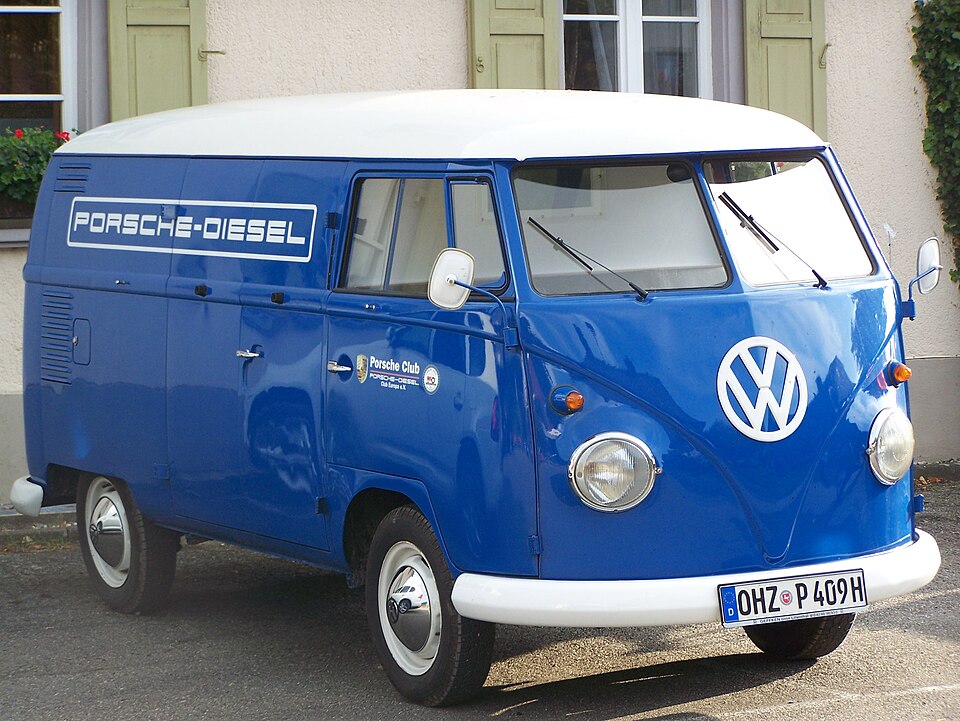
Its second life was accidental. The Transporter was cheap, slow, endlessly repairable and had a flat floor big enough to sleep on — and the German coachbuilder Westfalia was converting them into campers from the early 1950s. By the mid-1960s the split-screen bus had become the default vehicle of the American counterculture, painted, decorated and driven to festivals, in the same period during which Volkswagen was quietly the most conservative manufacturer in Europe.
The company did not create that association and for years did not know what to do with it. It has spent much of the last three decades monetising it.
Filling the Range, Slowly
Under Nordhoff, Volkswagen expanded with great caution and always from the same mechanical set. The Karmann Ghia of 1955 was a Beetle in a beautiful Italian suit — body design from Ghia in Turin, construction by Karmann of Osnabrück — offering roughly zero extra performance and selling superbly on looks alone.
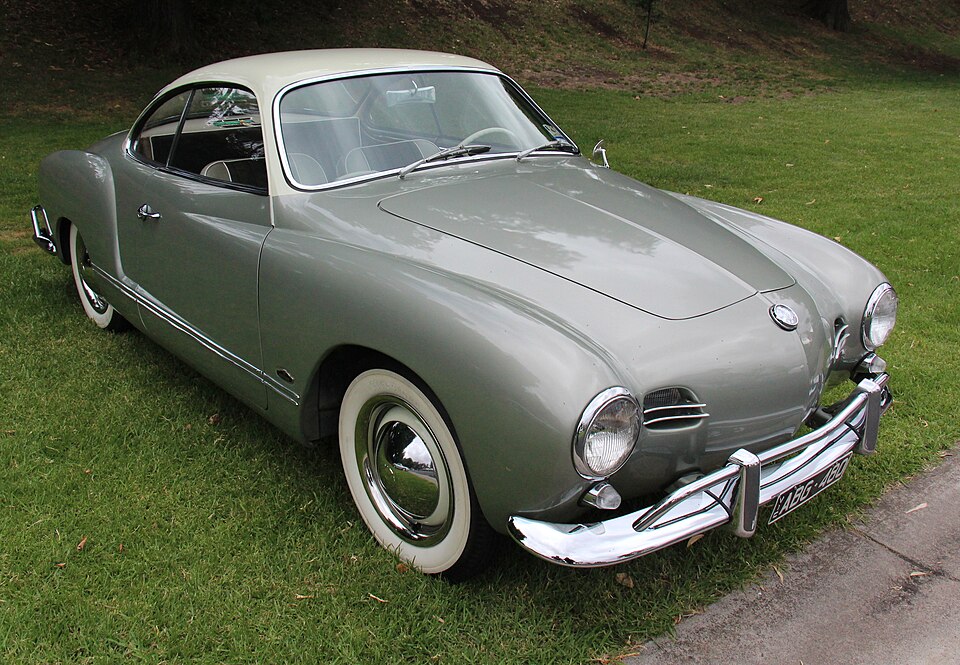
The Type 3 of 1961 (the 1500/1600 notchback, Variant estate and later fastback) introduced a "pancake" version of the flat-four lying flat under a boot floor, giving luggage space at both ends, and in 1968 became one of the first mass-produced cars sold with electronic fuel injection. The Type 4, the 411 of 1968, went larger still.
Meanwhile the Beetle itself kept evolving. Engines grew from under a litre to 1.2, 1.3, 1.5 and 1.6 litres. In 1967 the headlamps stood upright and the electrics went to twelve volts in most markets. The 1302 of 1970 and the 1303 of 1972 replaced the front torsion beam with MacPherson struts and added a curved windscreen and a much larger front boot — genuine engineering effort spent on an eighteen-year-old design.
In February 1972 the Beetle passed the Ford Model T's production total, becoming the most-built single car design in history. It was, in retrospect, the exact moment the strategy stopped working.
The Crisis: When the World Stopped Wanting a Beetle
By the early 1970s the Beetle was obsolete in every way that mattered. Buyers in Europe were moving to front-wheel-drive hatchbacks with water-cooled engines: the Mini had shown the packaging, the Autobianchi Primula and Renault 16 had shown the hatchback, the Fiat 127 and Renault 5 were selling in enormous numbers. Coming safety and emissions legislation, particularly in the United States, was extremely unfriendly to a rear-engined car with the fuel tank ahead of the driver's knees and no meaningful way to clean up an air-cooled engine.
Volkswagen had almost nothing else. Its attempts at replacement had been strategically confused: the EA266, a mid-engined water-cooled saloon developed by Porsche under Ferdinand Piëch, was technically interesting and a servicing nightmare, and it was cancelled. Development money had been spread thin. Sales fell, losses arrived, and by 1974 the company that had been the symbol of the West German economic miracle was in serious financial trouble.
The rescue came from a different direction entirely — from a company Volkswagen had bought almost as an afterthought.
Audi: The Acquisition That Saved the Buyer
Volkswagen acquired Auto Union from Daimler-Benz in stages between 1964 and 1966, largely to get the Ingolstadt factory's capacity for building more Beetles. Auto Union — the four rings representing Audi, DKW, Horch and Wanderer, merged in 1932 — came with a small engineering team and a legacy of two-stroke DKWs that Volkswagen had no interest in.
That team, led by Ludwig Kraus, developed a modern four-cylinder engine and then, famously, a whole car in semi-secret: the front-wheel-drive, water-cooled Audi 100 of 1968, which Nordhoff had not authorised and which turned out to be exactly what the group needed. In 1969 Volkswagen merged Auto Union with NSU, the Neckarsulm firm that had just launched the rotary-engined Ro 80.
By the early 1970s, then, Volkswagen owned in-house expertise in precisely the layout its own brand lacked. The first fruit was the K70, an NSU design launched under the VW badge in 1970 — the first water-cooled, front-engined, front-wheel-drive Volkswagen. It sold poorly. The next attempts did not.
Giugiaro's Golf, 1974
The Passat arrived in 1973, essentially a fastback reworking of the Audi 80. The Scirocco coupé came in early 1974 as a deliberate warm-up act for the shared platform. And in May 1974, Volkswagen launched the car that saved it.
The Golf was styled by Giorgetto Giugiaro at Italdesign, and it is the purest example of his folded-paper period: crisp surfaces, a strong C-pillar, a big glasshouse, and not a single decorative flourish. Underneath was everything the Beetle was not — a transverse water-cooled engine driving the front wheels, a hatchback, MacPherson struts at the front and a beam axle behind, and packaging efficiency that made the car feel a class bigger than its footprint.
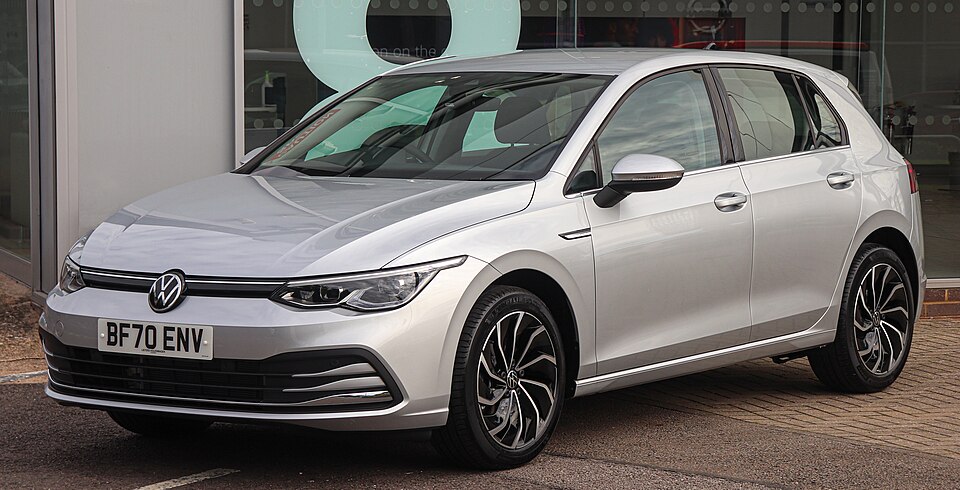
It was rational rather than charming, and it sold enormously. The Golf hit its first million within about two and a half years. The Polo followed in 1975, a rebadged and simplified relative of the Audi 50, and the modern Volkswagen range — small hatch, medium hatch, family car, all sharing engines and parts across brands — was in place within about two years of near-bankruptcy.
In the United States the Golf was called the Rabbit, and from 1978 it was assembled at Westmoreland, Pennsylvania, in Volkswagen's first American plant. The Westmoreland cars were softened and decontented for local taste, sold moderately, and the plant closed in 1988 — an early lesson that the group's European product does not automatically translate.
The GTI Invents a Category
The Golf's most consequential derivative began as an unofficial project. A small group inside Volkswagen — engineers and press staff working around the edges of the official programme — built a Golf with the fuel-injected 1.6-litre engine from the Audi 80 GTE, stiffer springs, a front anti-roll bar, ventilated front discs and modest visual signals: red trim around the grille, black wheel-arch extensions, tartan seats, and a gearknob shaped like a golf ball.
Shown at the Frankfurt show in 1975 and in production from 1976, the Golf GTI made around 110 PS in a car weighing appreciably less than 900 kg. Internal projections were for a run in the low thousands. It sold in the hundreds of thousands.
What the GTI actually invented was not a fast small car — Mini Coopers and Alpine-tuned Renaults had existed for years — but the idea that the standard family hatchback could be turned into a genuinely quick car with no loss of practicality, no exotic parts, and dealer servicing. Every hot hatch since is a variation on that formula, and the badge has now run continuously through eight generations of Golf.
Assembling a Group
Volkswagen's transformation from a single-brand carmaker into a multi-brand group is largely a story of buying troubled companies with good names and pushing group platforms through them.
SEAT came first. The Spanish state manufacturer had built Fiats under licence for decades, and after the relationship with Fiat broke down Volkswagen signed a co-operation deal in 1982 and took control from 1986. Repositioned as the group's sporting Latin brand, it later spun off Cupra as a performance marque in its own right.
Škoda followed after the Velvet Revolution. Volkswagen bought into the Czech firm in 1991 and moved to full ownership over the following decade. Škoda in 1990 made rear-engined cars of doubtful quality and carried a punchline reputation in western Europe; two decades later it was building some of the most quietly competent value cars sold anywhere, on the same architecture as the Golf. It is probably the single most successful brand turnaround in the modern industry.
Then came the trophy year. In 1998, under chairman Ferdinand Piëch — Ferdinand Porsche's grandson, an engineer of famous ruthlessness who had come up through Audi's quattro and five-cylinder programmes — Volkswagen bought three of the great names in one extraordinary burst.
The Rolls-Royce and Bentley affair became an industry legend. Volkswagen outbid BMW for Vickers' Rolls-Royce Motors, acquiring the Crewe factory, the Bentley marque, the Spirit of Ecstasy and the radiator shape — only to discover that the Rolls-Royce name and badge were licensed separately by Rolls-Royce plc, the aero-engine company, which sold the rights to BMW. Volkswagen had bought the factory; BMW had bought the name. The two settled on a transition ending in 2003, after which BMW built Rolls-Royce at Goodwood and Volkswagen kept Crewe and Bentley. Bentley then received the Continental GT, and volumes went from the hundreds into the tens of thousands.
Lamborghini was acquired the same year and placed under Audi, which imposed build quality and electrical architecture that the Sant'Agata firm had never previously enjoyed, then delivered the Gallardo and the Urus and turned a chronically loss-making specialist into a serious profit centre.
Bugatti was a name rather than a company — Piëch bought the rights and then commissioned an engineering statement with no commercial logic whatsoever. The Veyron 16.4 of 2005 used a quad-turbocharged 8.0-litre W16 making 1,001 PS, ten radiators, and a top speed over 400 km/h. It reportedly lost a great deal of money on every car and was never meant to do otherwise; it was a demonstration that the group could out-engineer anyone. The Chiron followed in 2016, and in 2021 Bugatti was folded into a joint venture with Rimac, majority-owned by the Croatian electric hypercar firm with Porsche holding the balance.
Ducati arrived in 2012, bought via Audi and Lamborghini — desmodromic valve gear, trellis frames, and a MotoGP programme joining a car group for reasons that were part strategic and part Piëch enjoying himself. Commercial vehicles came too: majority stakes in Scania and MAN, later consolidated with Navistar into the Traton truck group.
Porsche and Volkswagen: The Circle Closes, Violently
The strangest chapter is the reunion of the two firms Ferdinand Porsche's work created.
From 2005 the Porsche sports car company — far smaller than Volkswagen but extremely profitable — began accumulating Volkswagen shares, ultimately pursuing outright control using cash-settled options. In October 2008 the disclosure of how much of the float Porsche had effectively locked up triggered a short squeeze so severe that Volkswagen briefly became, on paper, the most valuable company in the world.
Then the financial crisis closed the credit markets, and the hunter ran out of money. Porsche's automotive business was folded into Volkswagen instead: the group took 49.9% in 2009 and completed the integration in 2012. The holding company Porsche SE remains the largest voting shareholder in Volkswagen AG, with Lower Saxony holding its statutory blocking stake and Qatar's sovereign fund a further chunk. Porsche AG was partially floated in 2022 while remaining under group control.
The net result is a structure in which the Porsche and Piëch families control the group that owns the sports car firm that tried to buy it — an arrangement that makes sense only as history.
The New Beetle and the Business of Memory
By the 1990s, Volkswagen's American operation was struggling and its brand equity was almost entirely historical. The response, shown as Concept One at the Detroit show in 1994 and put into production as the New Beetle in 1998, was to sell the memory directly.
Designed in Volkswagen's California studio by a team including J Mays and Freeman Thomas, it took the original's three-arc silhouette and rendered it in modern proportions on the front-wheel-drive Golf Mk4 platform. Mechanically it had nothing whatever in common with a Beetle — engine in the front, water-cooled, driven wheels at the wrong end — but it had the shape, an enormous dashboard, and a bud vase.
It sold strongly at launch, particularly to buyers who had never owned the original, and then faded as retro cooled. A second attempt, simply called the Beetle, arrived in 2011 with a flatter roofline and more aggressive stance intended to broaden its appeal beyond the first car's largely female customer base. It never repeated the launch success.
Dieselgate
On 18 September 2015, the US Environmental Protection Agency issued a notice of violation stating that Volkswagen had installed software in its 2.0-litre TDI diesel engines that detected when a car was undergoing an official emissions test and switched the engine into a clean-running mode, then reverted to a dirtier, more powerful and more economical calibration on the road.
The scale was extraordinary. Volkswagen acknowledged that around eleven million vehicles worldwide carried affected software, with roughly half a million in the United States, spanning Volkswagen, Audi, Škoda and SEAT models over several years. Real-world nitrogen oxide output on some affected cars was many times the legal limit.
Chief executive Martin Winterkorn resigned within days and was later charged in both Germany and the United States; several engineers and managers were prosecuted, with some receiving custodial sentences. The direct financial cost — buybacks, fixes, fines, settlements and legal expenses — ran well beyond €30 billion, making it one of the most expensive corporate scandals ever recorded.
The deeper damage was strategic. Volkswagen had bet its entire environmental positioning on diesel, particularly in Europe, where it had spent two decades persuading buyers that a turbodiesel was the responsible choice. That argument died in a single news cycle, and it took the European diesel market with it. Diesel's share of new car sales in Europe fell by more than half over the following years.
Forced Into the Future: MEB and the ID. Family
Having destroyed its own bridge technology, Volkswagen did the only thing available: it committed to electrification faster and harder than any legacy manufacturer of comparable size.
The key decision was not a car but an architecture. The MEB platform — Modularer E-Antriebs-Baukasten — was designed from scratch for battery-electric vehicles: a flat battery in the floor between the axles, a rear-mounted motor as standard with the option of a second motor at the front, short overhangs, and a wheelbase-to-length ratio no combustion car could match. Crucially it was built to be shared, across Volkswagen, Škoda, SEAT/Cupra, Audi and outside licensees.
The ID.3 hatchback entered production at Zwickau — a plant converted wholly from combustion to electric — and reached customers in 2020, deliberately positioned as the third historic inflection point after the Beetle and the Golf. The ID.4 crossover followed as the global volume play, built in Germany, China and Tennessee.
The transition has not been smooth. Software has been the recurring failure: the group's in-house software unit, Cariad, ran badly late, delayed products across Audi, Porsche and Bentley, and contributed directly to a chief executive being removed in 2022. Volkswagen ultimately went outside for help, taking a substantial stake in the American EV startup Rivian for a joint software and electrical-architecture venture, and deepening its partnerships in China, where local brands had moved faster than anyone in Wolfsburg had modelled.
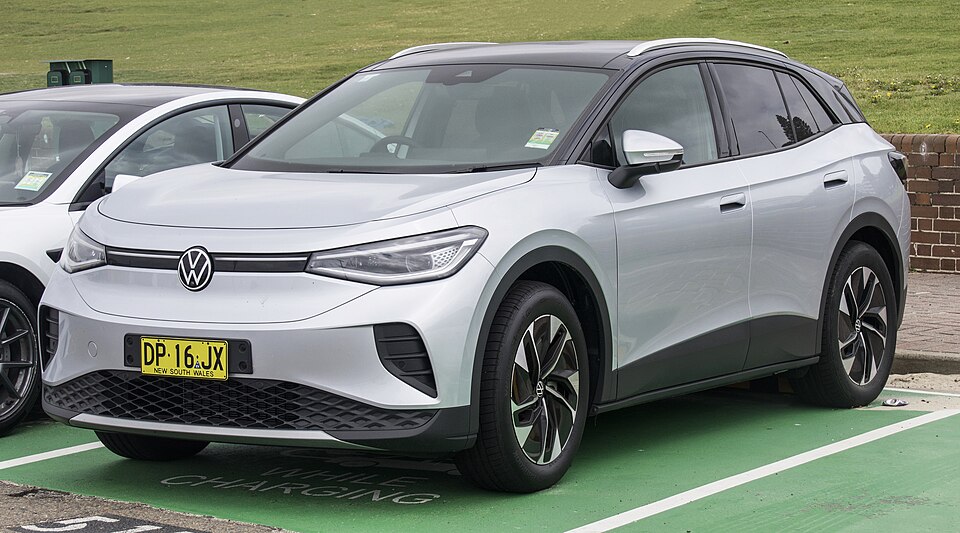
The Bus Comes Back
The most emotionally effective product of the electric era is the one that reaches furthest back. The ID. Buzz was shown as a concept in 2017 and reached production in 2022, and it is the first vehicle since the original for which the rear-motor, rear-drive layout genuinely makes packaging sense: no engine, no transmission tunnel, a completely flat floor, and a driver sitting far forward over a short nose.
Visually it is unembarrassed about what it is doing — two-tone paint, a huge VW roundel on the nose, a V-shaped feature line on the front panel that is a direct quotation from the 1950 Transporter. A long-wheelbase version reached North America in 2024, where the original bus's cultural weight is heaviest.
Whether it is a good business is a separate question from whether it is a good idea. It arrived expensive. But it is the clearest demonstration of the group's most durable asset: a back catalogue that people feel something about.
The Last Beetle
Production of the original Type 1 outlasted its replacement's replacement's replacement. German assembly of the saloon ended in 1978, though cabriolets continued at Karmann into 1980. Brazilian production ran for decades, paused, and was restarted in the 1990s by presidential request. Mexican production at Puebla continued right through, supplying a car that served as Mexico City's taxi fleet in vast numbers — the vocho, usually painted green and white with the front passenger seat removed.
The last Mexican-built Type 1 came off the line at Puebla in July 2003, with total production of the original design past twenty-one million — a figure no single car design has approached before or since.
The modern Beetle's own ending came at the same plant. On 10 July 2019, the final car — a Denim Blue Final Edition coupé — was built at Puebla and sent to a museum rather than a customer. Volkswagen marked it, reasonably enough, as the close of a story that had run since 1938.
The Group at a Glance
| Brand | Joined the group | Role today |
|---|---|---|
| Volkswagen | Founded 1937 | Core volume brand, MEB electric range |
| Audi | 1964–66 (Auto Union) | Premium; brought front-drive water-cooled expertise |
| SEAT / Cupra | 1986 | Spanish volume and performance |
| Škoda | 1991 (full control later) | Value engineering, huge European growth |
| Bentley | 1998 | Luxury grand touring, Crewe |
| Lamborghini | 1998 (via Audi) | Super sports, Sant'Agata |
| Bugatti | 1998 (JV with Rimac 2021) | Hypercar halo |
| Ducati | 2012 (via Audi) | Motorcycles |
| Porsche | 2009–12 | Sports cars; partially refloated 2022 |
Where to Look Next
If you want to understand this company through objects rather than narrative, three are worth seeking out in person.
Find a pre-1953 split-window Beetle and put your head inside it. The thing that startles is not how crude it is but how finished it is — how completely the 1938 design already resolved its own problems, and how little the following forty years actually needed to change.
Then find a Mk1 Golf GTI, ideally an early one on steel wheels. It weighs less than almost anything sold new today, the steering talks constantly, and it makes the case that the entire subsequent history of the fast hatchback has been an exercise in adding mass to something that was already right.
Then look at an ID. Buzz from the rear three-quarter and ask yourself an uncomfortable question: how much of what you feel about Volkswagen is engineering, and how much is a shape that a Dutch importer sketched in a notebook in 1947? The company has spent eighty years alternating between those two answers, and it has never quite decided which one it is selling.


