
In the summer of 1958, two Toyopet Crowns were unloaded at the port of Los Angeles. They were sturdy, carefully assembled little sedans built for Japanese roads that were mostly gravel, and on an American freeway they were a disaster — the engine screamed, the car wallowed, and owners complained the thing simply could not hold 60 mph without threatening to shake itself apart. Toyota pulled the Crown from the US market within a few years and went home to think. Twenty-five years later, the same company would be teaching General Motors how to build cars at a shared factory in Fremont, California.
That arc — humiliation, obsessive study, then quiet dominance — is the story of the entire Japanese motor industry. What follows is a guide to every marque that matters: the nine surviving carmakers, the luxury brands invented specifically to sell to Americans, the bubble-era sub-brands that vanished almost without trace, the tuning houses that became manufacturers in their own right, the truck builders, and the four motorcycle companies that flattened the British industry in about a decade.
Before the war: three names and a lot of licensed engineering
Japan's first series-produced car was the Mitsubishi Model A of 1917, a hand-built copy of a Fiat design of which only around twenty-two were completed. It was a commercial failure. So was almost everything else attempted before 1930. Ford and General Motors both set up assembly plants in Japan in the 1920s and comprehensively outsold the locals until the militarist government legislated them out of the market in the mid-1930s.
The three seeds that mattered were planted quietly. Masujiro Hashimoto's Kaishinsha built a car in 1914 called the DAT, an acronym of the surnames of his three financial backers — Den, Aoyama and Takeuchi. A small follow-up model in 1931 was named "Datson", the son of DAT, quickly respelled Datsun because son in Japanese suggests loss. In 1933 the holding company Nihon Sangyo — abbreviated on the Tokyo stock exchange as Ni-San — took control, and Nissan Motor Company was born.
Meanwhile Sakichi Toyoda's automatic loom business in Aichi Prefecture was generating enough cash that his son Kiichiro could indulge an obsession with engines. The Toyoda Automatic Loom Works built its first passenger prototype in 1935 and the Model AA in 1936, then spun the operation off as Toyota Motor Company in August 1937. The name change from Toyoda to Toyota was partly a matter of the family name being separated from the business, and partly because the katakana spelling of Toyota takes eight strokes — eight being an auspicious number.

The third seed was Hiroshima's Toyo Cork Kogyo, founded in 1920 to make cork products, which pivoted to machine tools, then in 1931 to a three-wheeled truck called the Mazda-Go. The name honoured founder Jujiro Matsuda and, the company has always maintained, Ahura Mazda, the Zoroastrian god of light.
The licence decade: how Japan learned to build cars
Japan's industry emerged from the war with bombed factories and no modern designs. The government's answer, from 1952, was to let manufacturers licence European cars and build them locally, absorbing the engineering along the way. Nissan built the Austin A40 and A50 under licence from the British Motor Corporation. Isuzu built the Hillman Minx for Rootes. Hino assembled the Renault 4CV. Mitsubishi took a Willys licence and built Jeeps.
Every one of those agreements expired around 1960, and every one of the licensees emerged with its own design capability. This is the single most important structural fact about the Japanese industry: it was explicitly, systematically taught by its future victims. Nissan's engineers learned British suspension and body engineering on Austins and immediately applied it to the Bluebird. Isuzu learned Rootes' production methods and went its own way with diesels.
By the mid-1960s the Ministry of International Trade and Industry (MITI) was worried enough about the coming liberalisation of imports that it tried to force consolidation into two or three national champions. The bill never passed, and the reason it matters is Honda: Soichiro Honda, then making only motorcycles, rushed a truck and a tiny roadster to market in 1963 partly to establish himself as a carmaker before any such law could lock him out.
Toyota: the loom company that rewrote manufacturing
Toyota's advantage was never a single brilliant car. It was the Toyota Production System, developed largely by Taiichi Ohno through the 1950s and 60s out of two ideas inherited from the loom business: jidoka, machines that stop themselves the moment something goes wrong, and just-in-time, parts arriving exactly when needed rather than piling up as inventory. The kanban card system that scheduled it was reportedly inspired by American supermarket restocking.
The products followed. The Land Cruiser began in 1951 as a Jeep-like military prototype and became, by the 1960s, Toyota's first genuine global export success — sold in Australia, Africa and the Middle East on the strength of not breaking. The Corolla arrived in 1966 and became the best-selling nameplate in automotive history.
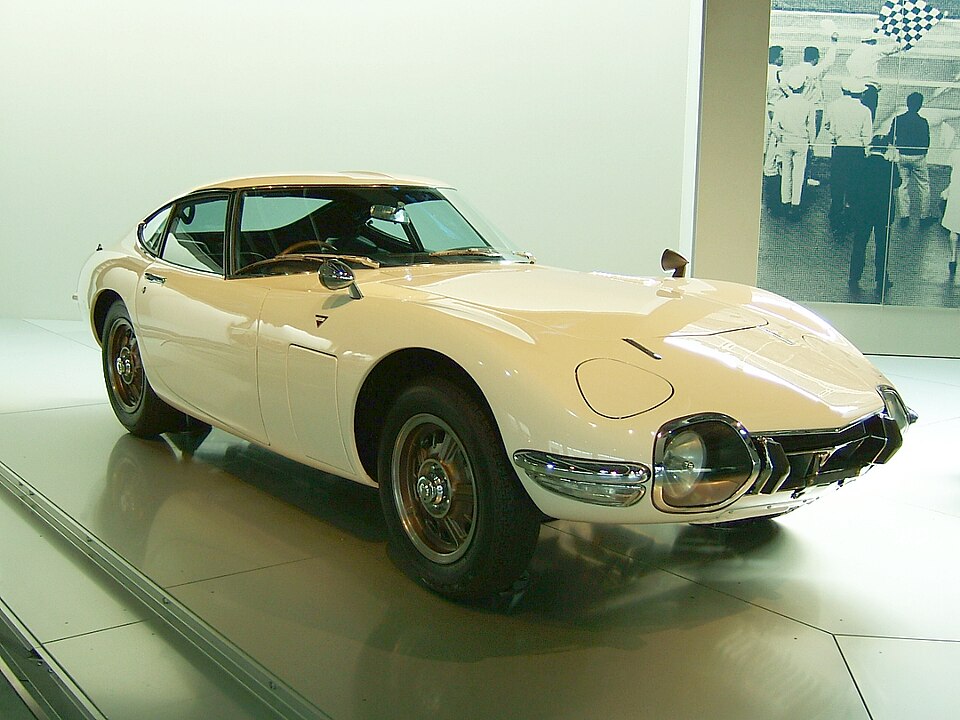
Toyota also proved it could build something beautiful. The 2000GT of 1967, developed with Yamaha, had a Yamaha-tuned twin-cam straight-six, a hand-formed aluminium body and a price that made it a loss-maker; only around 337 were built. A pair of open-topped specials made for You Only Live Twice put it in front of a global audience. It ended the assumption that Japan built appliances and nothing else.
The company's other pivot came in 1997 with the first Prius, a hybrid sold at a loss into a market that had not asked for it. Two decades later the hybrid patent portfolio and manufacturing base it created would be worth more to Toyota than almost anything else it owned.
Nissan: two names, a merger, and a rival tradition
Nissan spent thirty years with a split identity. Domestically it was Nissan; abroad, until the early 1980s, almost everything wore a Datsun badge. The badge change, phased in from 1981 and completed by around 1986, was one of the most expensive brand decisions in the industry, throwing away exactly the name that Americans had learned to trust. Datsun was briefly revived from 2013 for low-cost emerging-market cars, then quietly retired again.
The great Datsun era was defined by two cars. The 510 Bluebird of 1968 wrapped independent rear suspension and an overhead-cam engine in a plain three-box body and got called the poor man's BMW, entirely fairly. Then came the S30 — Fairlady Z at home, 240Z abroad — in 1969.
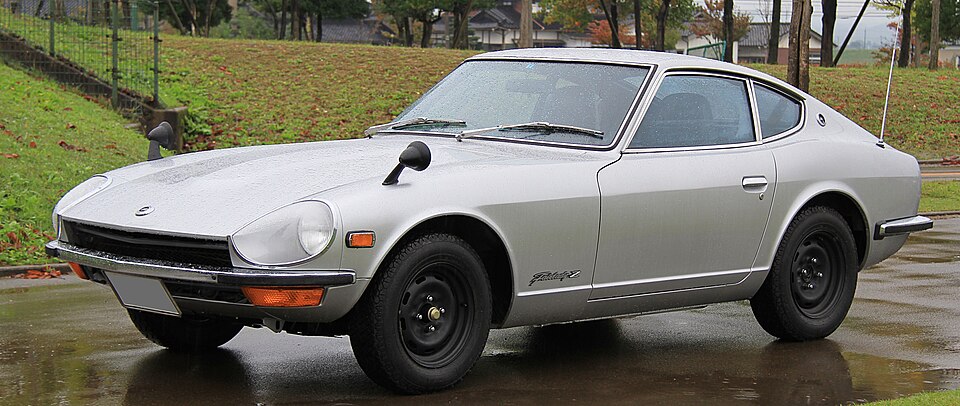
The Z was a long-bonneted straight-six coupe with a price close to a well-equipped family sedan, and it destroyed the British sports car business in America almost single-handedly. It did not leak, it started, and it cost less than an E-Type by an order of magnitude.
Nissan's engineering culture, though, owed a great deal to a company it swallowed. Prince Motor Company descended from the wartime Tachikawa aircraft works, built the Skyline and the Gloria, and ran a serious racing programme with the R380 prototype. When Prince merged into Nissan in 1966 — a merger MITI encouraged — Nissan acquired the Skyline nameplate, the Musashino engineers and an internal culture that treated racing as legitimate work. Everything good about the GT-R traces to that transaction.
Honda: engines first, permission never
Honda is the outlier in every respect. Soichiro Honda was a mechanic and racer from Hamamatsu with no time for ministries, and his business partner Takeo Fujisawa handled the money and the dealer network. The company started in 1948 bolting surplus engines to bicycles, and by 1958 had the Super Cub — a step-through with an enclosed drivetrain, an automatic clutch and a design brief that it should be ridable one-handed by a soba delivery man. It is the best-selling motor vehicle of any kind ever made.
Honda entered Formula One in 1964 with its own chassis and engine, and won at Mexico City in 1965 with Richie Ginther, less than two years after building its first car. Then came the technical coup that made its reputation in America: the CVCC engine of the early 1970s, a stratified-charge design with a small pre-chamber that let the 1975 Civic meet US Clean Air Act standards without a catalytic converter, at a moment when Detroit was insisting compliance was impossible.
The Accord followed in 1976, and in 1982 Honda became the first Japanese company to build cars in the United States, at Marysville, Ohio. Then, in 1990, the NSX.
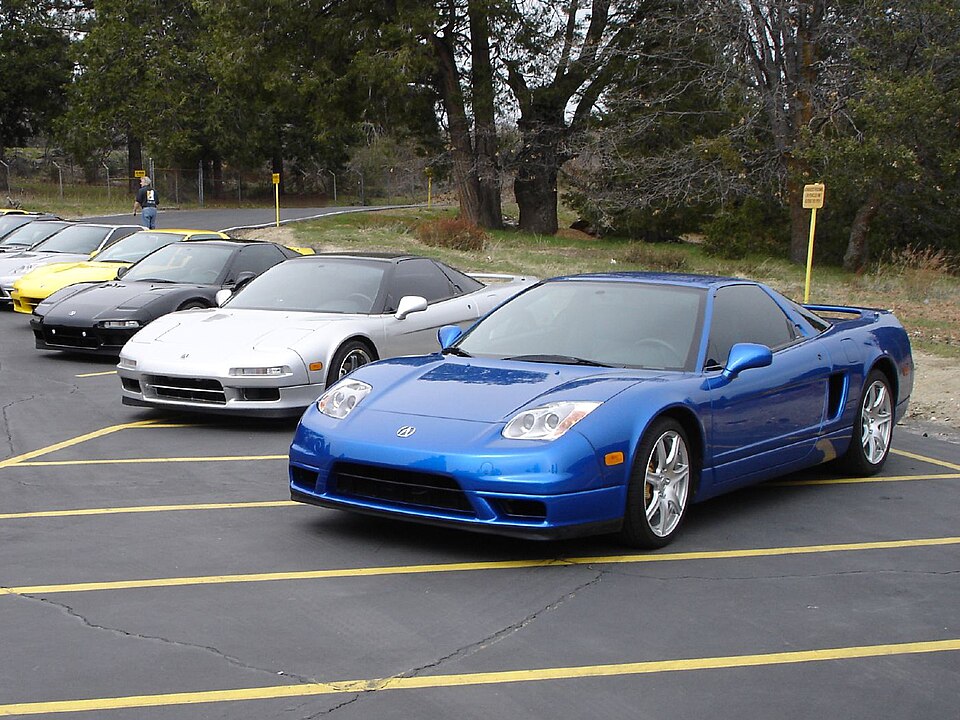
The NSX had an all-aluminium monocoque — a world first for a production car — a titanium-conrod V6 with VTEC variable valve timing, and a development programme that included feedback from Ayrton Senna at Suzuka. Its real achievement was proving a mid-engined supercar could have decent visibility, working air conditioning and a service interval. Ferrari's response over the following decade was, essentially, to copy that.
Mazda: cork, rotaries and a beautiful obsession
No Japanese company has taken more risks per unit of size than Mazda. Its logo history alone reads like a company that never quite settled.









Mazda licensed the Wankel rotary from NSU in 1961 and put roughly fifty engineers on solving the problem that had defeated Germany: chatter marks, the scoring left on the rotor housing by the apex seals, known internally as the devil's fingernail marks. Kenichi Yamamoto's team worked through seal materials until carbon-aluminium seals held, and the Cosmo Sport 110S went on sale in 1967 — the first practical twin-rotor production car.
Rotaries were smooth, compact and revved beautifully; they also drank fuel, which nearly killed the company in the 1973 oil crisis. Mazda survived on bank support from Sumitomo and on the willingness of Hiroshima's suppliers to wait. It kept going, put rotaries in the RX-7 from 1978, and in 1991 won Le Mans outright with the four-rotor 787B — the only rotary victory in the race's history, and the only Japanese one until Toyota's in 2018.
Its other masterpiece needed no exotic engineering at all.
The MX-5 Miata, launched at the 1989 Chicago Auto Show, was proposed by American journalist-turned-product-planner Bob Hall and engineered under Toshihiko Hirai around a principle called jinba ittai, horse and rider as one. It was a lightweight front-engined roadster in the Lotus Elan tradition, built with Japanese reliability, and it has outsold every other two-seat sports car ever made.
Subaru: aircraft engineers who refused to build a normal car
Subaru is the automotive remnant of Nakajima Aircraft, Japan's largest wartime aeroplane manufacturer, which was broken into a dozen pieces by the occupation authorities. Five of those pieces recombined in 1953 as Fuji Heavy Industries. Kenji Kita named the new car brand Subaru, the Japanese name for the Pleiades star cluster — six stars, for the six companies bound into one, which is exactly what the badge shows.
The Subaru 360 of 1958 was a monocoque kei car so light it fell below American safety regulation thresholds when Malcolm Bricklin later imported it. But the defining decision came with the Subaru 1000 of 1966: a flat-four boxer engine driving the front wheels. The layout's symmetry made it straightforward to run a driveshaft straight back, and in 1972 the Leone estate became Japan's first mass-produced four-wheel-drive passenger car — sold initially to Tohoku Electric Power linemen who needed to reach substations in snow.
That combination — boxer, symmetrical all-wheel drive — became the entire brand identity. It took Subaru to three consecutive World Rally Championship manufacturers' titles in the mid-1990s and Colin McRae's drivers' title in 1995, and gave the Impreza WRX a following that had nothing to do with the company's original customers.
Mitsubishi: the three diamonds
Mitsubishi is not a car company that grew a conglomerate; it is a conglomerate that happens to include a car company. Yataro Iwasaki founded the shipping business in 1870, and the three-diamond mark combines his family's three-stacked-rhombus crest with the three-oak-leaf crest of the Tosa clan that gave him his start.
Mitsubishi Motors was only spun out as a separate company in 1970, immediately taking a 15 percent investment from Chrysler that put Colt-badged Mitsubishis in Dodge showrooms. Its high points are real: the Pajero, launched in 1982, won the Dakar Rally more times than any other vehicle; the Lancer Evolution fought Subaru through the 1990s rally era and produced one of the great four-cylinder engines in the 4G63; and the Galant VR-4 pioneered the four-wheel-drive turbo saloon.
Its low points are equally real. A defect cover-up exposed in 2000, and again in 2004, cost the company enormous trust at home. A fuel-economy testing scandal in 2016 finished the job, and Nissan bought a controlling 34 percent stake in the aftermath.
Suzuki and Daihatsu: masters of the small
Both companies started as something else. Michio Suzuki founded a loom works in Hamamatsu in 1909; Daihatsu began in 1907 as Hatsudoki Seizo, an engine maker founded by academics from Osaka University, its name a contraction of Osaka and hatsudoki (engine).
Suzuki's Suzulight of 1955 was one of the first true kei cars and, remarkably, front-wheel drive with rack-and-pinion steering. The Jimny arrived in 1970 as a kei-class off-roader that could go places a Land Cruiser could not fit. The Alto of 1979 made cheap motoring genuinely national. But Suzuki's masterstroke was geographic: a joint venture with the Indian government signed in the early 1980s produced the Maruti 800, and for decades afterwards Suzuki has held a share of the Indian market that no foreign manufacturer has come close to matching anywhere. It left the American car market in 2012 without much noticing the loss.
Daihatsu took the other route — into Toyota's arms. Toyota took a stake in 1967 and full ownership in 2016, and Daihatsu became the group's small-car specialist, engineering kei models and cheap compacts for emerging markets.
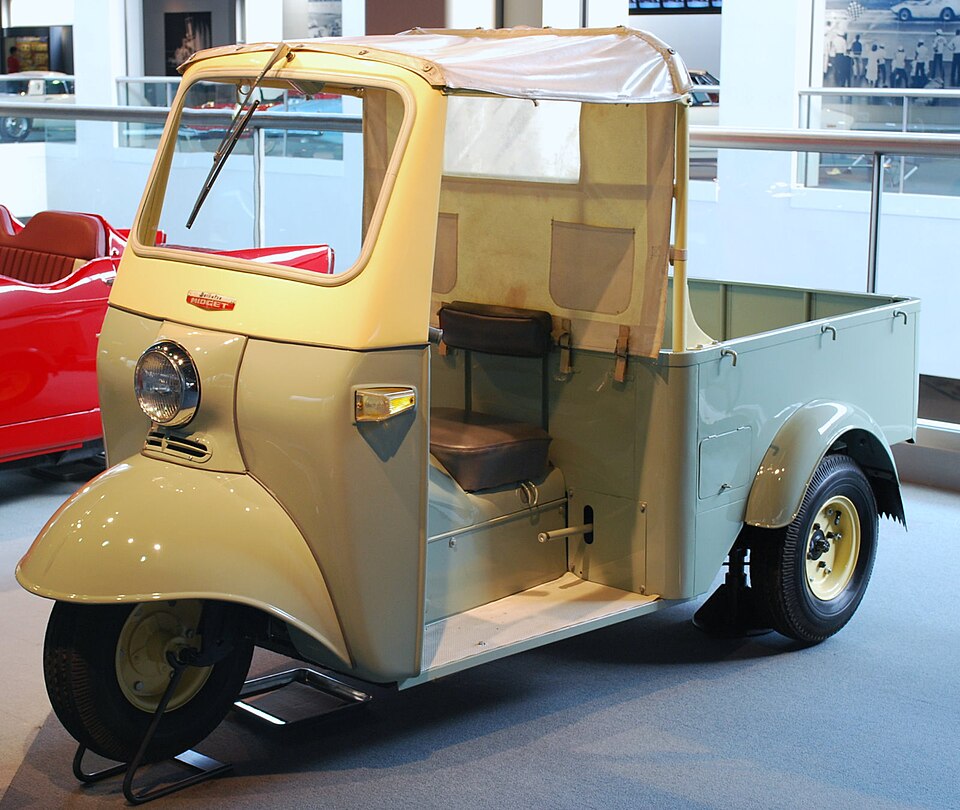
The Midget three-wheeler of 1957, a single-seat cab on a scooter chassis, is the purest expression of what these firms did: motorise a country that could not yet afford cars. Daihatsu's modern reputation took a severe hit in 2023, when an internal investigation found that safety certification test data had been manipulated across a wide range of models, halting shipments.
Isuzu: the diesel specialist that walked away from cars
Isuzu's lineage runs back to Tokyo Ishikawajima Shipbuilding, which built Wolseleys under licence from 1922. The Isuzu name — after the river beside the Ise Grand Shrine — was adopted in the 1930s.

For a while Isuzu made genuinely stylish cars: the 117 Coupe and the Piazza were both Giugiaro designs, and the Bellett GT was an early Japanese sports saloon. But Isuzu's real competence was diesel engines, and it sold them to everyone — including General Motors, which took a stake in 1971 and used Isuzu engineering under Chevrolet, Opel and Holden badges for decades. Isuzu withdrew from the US passenger market entirely in 2009 and now builds trucks and the D-Max pickup, plus, since 2021, UD Trucks.
Kei cars: the regulation that shaped a design language
In 1949 the Japanese government created a legal class of kei jidosha — light vehicles — with tiny displacement limits, cheap tax and cheap insurance, intended to get a broke country moving. The limits ratcheted upward over the decades: 360cc in the mid-1950s, 550cc in 1976, and 660cc since 1990, alongside a maximum length of 3.4 metres and width of 1.48 metres, and a voluntary output ceiling of 64 hp. Kei cars wear yellow plates, and in much of the country they are exempt from the shako shomeisho rule requiring proof of an off-street parking space.
Those numbers did more to shape Japanese car design than any stylist. They forced engineers to be ruthless about packaging, which is why Japanese cars of every size tend to have more interior room than their footprint suggests, and why the tall-box shape now common worldwide was normal in Japan decades earlier. They also produced some of the most charming vehicles ever made — the Honda N360, the mid-engined Autozam AZ-1 with gullwing doors, the Suzuki Cappuccino, the Daihatsu Copen.
Lexus, Acura, Infiniti: three brands invented for one market
In 1981 Japan agreed to voluntary export restraints limiting the number of cars shipped to the United States. The logic that followed was inescapable: if you can only send a fixed number of cars, send expensive ones. But no American would pay Mercedes money for something with a Toyota badge. Three companies reached the same conclusion within four years of each other, and all three built brands that existed in America years before they existed at home.
Acura went first, opening in March 1986 with the Legend and the Integra. The Legend was co-developed with Austin Rover, which sold its own version as the Rover 800 and, in America, as the ill-starred Sterling — a useful natural experiment in which the identical car with British electrics and assembly was a quality catastrophe while the Honda-built version was not.
Lexus came from a 1983 challenge by chairman Eiji Toyoda: could Toyota build the best car in the world? The answer, after a development programme of extraordinary expense under chief engineer Ichiro Suzuki, was the LS400 of 1989 — a 4.0-litre quad-cam V8 sedan so smooth that the launch advertisement stacked champagne glasses on the engine while it revved to redline. Mercedes and BMW both cut US prices in response.
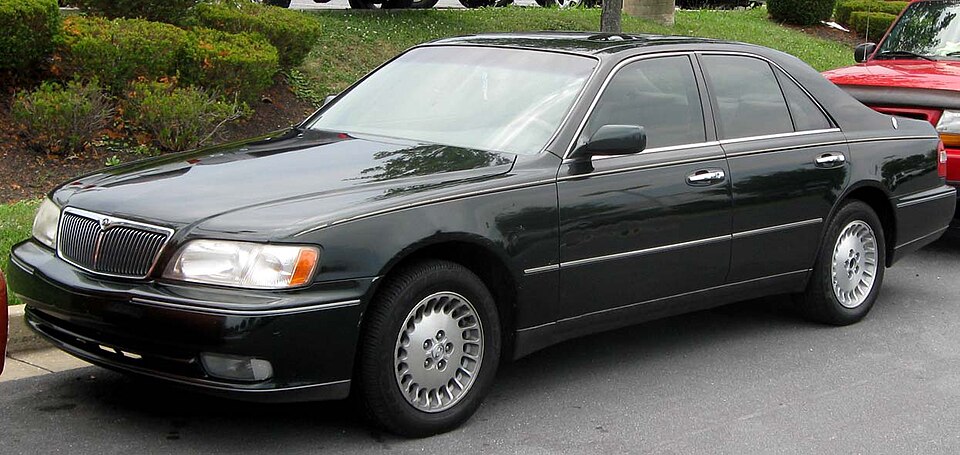
Infiniti launched in November 1989 with the Q45, technically the most interesting of the three: a 4.5-litre V8, active suspension available, and a deliberate refusal to fit a conventional grille — just a cloisonné badge on a body-coloured panel. Its launch campaign showed rocks, trees and water rather than the car, which became a case study in how not to introduce a product.
Lexus did not go on sale in Japan until 2005; Infiniti did not appear there until well into the 2010s. Acura still does not exist in Japan at all. They were, and largely remain, export instruments.
| Brand | Launched in US | Launch flagship | Sold in Japan |
|---|---|---|---|
| Acura | March 1986 | Legend | Never |
| Lexus | September 1989 | LS400 | From 2005 |
| Infiniti | November 1989 | Q45 | From the 2010s |
The bubble-era channel brands: Japan's forgotten marques
Japanese manufacturers historically sold through parallel dealer chains, each carrying different models — a system that let a company court multiple customer types without confusing any of them. Toyota ran five: Toyota Store, Toyopet Store, Corolla Store, Auto Store (later Netz) and Vista Store, only consolidating them in 2020. Nissan had Nissan Store, Motor Store, Cherry Store, Prince Store and Bluebird Store. Honda ran Primo, Clio and Verno.

During the late-1980s asset bubble, when it seemed the Japanese market would expand forever, Mazda decided to do all of this at once. Between roughly 1989 and 1992 it created five sales channels, several with their own marque identity, their own badges and their own model ranges.

Autozam handled kei cars and the smallest models, including the astonishing AZ-1. Eunos was the upmarket sporting channel, selling the Eunos Roadster — the MX-5's home-market name — plus the Eunos Cosmo, the only production car ever sold with a three-rotor engine. Ẽfini took the RX-7 and larger saloons. The core Mazda channel continued, and Autorama sold rebadged Fords.
Then the bubble burst. Mazda had built a distribution network sized for a market that evaporated, with development costs for badge-engineered variants nobody wanted. Losses were severe enough that Ford, already a shareholder since 1979, raised its stake to a controlling 33.4 percent in 1996 and installed the first non-Japanese president of a Japanese automaker.
The saddest casualty was Amati, Mazda's planned American luxury brand, meant to fight Lexus and Infiniti with a V12 flagship. Dealers were signed and cars were engineered before the plan was cancelled in 1992. The Amati 500 became the Eunos 800 and Mazda Millenia, and the badge became a collector's curiosity.
Performance sub-brands: from back-street tuners to factory divisions
Japan's tuning scene grew up in a regulatory environment that made modification legally awkward and therefore serious. The result is an unusually well-defined hierarchy of brands.
The in-house divisions came first. TRD (Toyota Racing Development) was established in the mid-1970s to handle motorsport and factory-approved parts; it has since been absorbed into the broader Gazoo Racing identity, which began as an online used-car venture named after gazou (image), became Akio Toyoda's Nürburgring endurance project, and was consolidated in 2017 into the GR brand that gave us the GR Yaris — a homologation special with a bespoke three-cylinder engine and a body shell shared with nothing.

Nismo was formed in 1984 by merging Nissan's Oppama and Omori competition works. It ran the Group A Skylines and Group C prototypes, and its road-car high point is the R34 GT-R Z-tune of 2005: a rebuilt 2.8-litre engine, roughly 500 PS, and only about nineteen cars built. STI — Subaru Tecnica International — was founded in 1988 and produced the 22B, a widened two-door Impreza built in a run of 400 that sold out in Japan in under two days.
Mugen ("without limit") was founded in 1973 by Hirotoshi Honda, Soichiro's son, and Masao Kimura — a deliberately independent company that nonetheless built Honda's Formula One engines in the 1990s, winning grands prix with Ligier and Jordan under the Mugen-Honda name. Autech is Nissan's in-house specialist-vehicle arm, responsible for the Zagato-bodied Autech Stelvio AZ1, a small run of extremely strange coupes built at the peak of bubble-era confidence.
Among the independents, HKS was founded in 1973 by Hiroyuki Hasegawa and Goichi Kitagawa with backing from Sigma Automotive — the three initials — and effectively invented the Japanese aftermarket turbo business. Impul was founded by racing driver Kazuyoshi Hoshino in 1980 and remains a Super GT team as well as a wheel and tuning brand. Spoon Sports, founded in 1988 by Tatsuru Ichishima, works on Hondas exclusively and in one colour scheme. Tommykaira, founded in Kyoto in 1986 by Yoshikazu Tomita and Kikuo Kaira, went far enough to be registered as a manufacturer in its own right and build the ZZ roadster.
And then there is Mitsuoka, which is not a tuner at all but Japan's smallest recognised automaker, granted manufacturer status in the mid-1990s. It takes ordinary Japanese cars and re-bodies them as pastiches: the Viewt turns a Nissan Micra into a miniature Jaguar Mk2, the Rock Star turns an MX-5 into a C2 Corvette, and the Orochi was an original design that looked like a catfish and is genuinely unforgettable.
The Skyline GT-R and the 280 PS handshake
The GT-R badge arrived in 1969 on the PGC10 Skyline — the boxy "Hakosuka" — carrying the S20, a 2.0-litre twin-cam straight-six derived directly from Prince's R380 racing engine. It won almost everything it entered in Japanese touring car racing. Its successor, the 1973 "Kenmeri" GT-R, arrived just as the oil crisis and new emissions rules hit; fewer than 200 were built before it was cancelled, and the badge disappeared for sixteen years.
It returned in 1989 with the R32, engineered specifically to win Group A: the RB26DETT twin-turbo straight-six and the ATTESA E-TS all-wheel-drive system, which normally sent power rearward and shuffled torque forward only when sensors demanded it. It won every race of the Japanese Touring Car Championship it contested over four seasons, and after it demolished the field at Bathurst, the Australian press christened it Godzilla.
Officially, the R32 GT-R made 280 PS. So did the Supra Turbo, the RX-7, the Lancer Evolution and the Impreza WRX STI. This was the gentlemen's agreement: an industry-wide understanding, in force from around 1989, that no Japanese manufacturer would advertise more than 280 PS in a domestic-market car, alongside a related convention limiting speedometer-governed top speed to 180 km/h. Nobody enforced it and nobody believed it — independent testing routinely found cars comfortably above the figure — but every brochure obeyed. The agreement finally broke in the mid-2000s when Honda published 300 PS for the Legend, and the numbers game resumed immediately.
The cars of that capped era are now the most valuable Japanese vehicles ever made. The fourth-generation Supra's 2JZ-GTE, a cast-iron-block straight-six engineered with enormous margin, became the most famous tuning engine in the world precisely because the factory had been forced to understate it.
Hino, UD and Fuso: the commercial vehicle triangle
Japan's truck industry is a story of three names that all ended up partly foreign-owned.
Hino descends from Tokyo Gas and Electric, built Renault 4CVs under licence in the 1950s, and made a rear-engined saloon called the Contessa styled by Michelotti before Toyota took control in 1967 and steered it exclusively toward trucks and buses. UD Trucks was Nissan Diesel; the initials come from the Uniflow-scavenging Diesel engine of the 1950s, later retrofitted with the marketing gloss "Ultimate Dependability". Volvo bought it in 2007 and sold it to Isuzu in 2021. Mitsubishi Fuso took its name from a mythical Chinese tree in the 1930s, was spun out of Mitsubishi Motors in 2003, and passed under Daimler control the same year.
Hino's own emissions and fuel-economy data falsification scandal, revealed in 2022, was severe enough to push it toward a combination with Mitsubishi Fuso — an arrangement bringing Toyota and Daimler Truck together as shareholders in a merged Japanese truck maker.
The four that took the motorcycle world
Japan's conquest of motorcycling was faster and more complete than its conquest of cars. In 1959, Britain and Italy made the world's motorcycles. By 1975, Japan made them.
Honda's Super Cub did the volume, helped in America by a 1963 campaign built around the line "You meet the nicest people on a Honda", which repositioned motorcycling away from outlaw imagery. Then the CB750 of 1969 delivered a mass-produced transverse inline-four with a front disc brake at a price that undercut everything comparable, and effectively created the superbike.
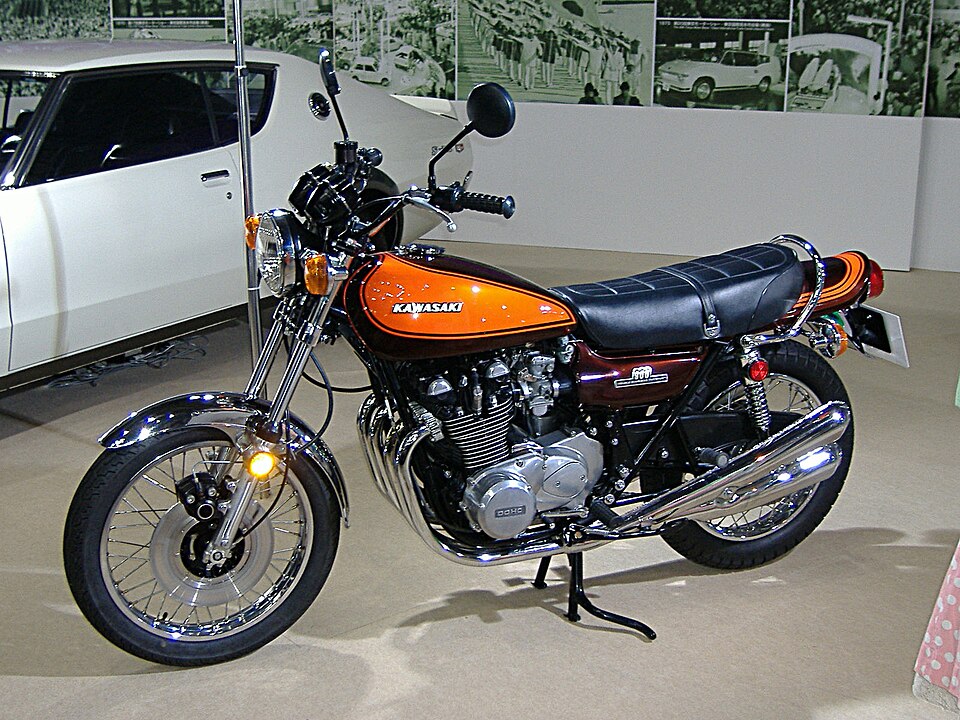
Yamaha came from Nippon Gakki, a piano and organ maker — which is why the badge is three interlocking tuning forks — and built its first motorcycle, the YA-1 "Red Dragonfly", in 1955. Kawasaki came from heavy industry and aircraft, and behaved accordingly: the 500cc Mach III triple of 1969 was violently fast and famously unstable, and the Z1 of 1972 answered the CB750 with a 903cc twin-cam four.
Suzuki delivered the GSX-R750 in 1985, an aluminium-framed racer with lights that reset expectations for what a road bike should weigh, and then the Hayabusa in 1999, whose top speed of roughly 312 km/h prompted the manufacturers to agree an electronic limit around 300 km/h — another gentlemen's agreement, and this one still holding.
How the reliability reputation was actually earned
The reliability story is not a national character trait; it is a documented management transfer. In 1950 the Japanese Union of Scientists and Engineers invited the American statistician W. Edwards Deming to lecture on statistical process control to Japanese executives. Deming's argument — that quality is designed into a process rather than inspected at the end, and that reducing variation reduces cost — was ignored in the United States and adopted wholesale in Japan. The Deming Prize was established in 1951 and became the most prestigious industrial award in the country.
Layered on top came company-specific practice: total quality control across the whole organisation rather than a quality department; kaizen, continuous incremental improvement suggested by line workers; poka-yoke, error-proofing fixtures that make incorrect assembly physically impossible; and the andon cord that lets any worker halt the line.
The competitive consequence appeared in the 1980s, when American owners began reporting defect rates for Japanese cars a fraction of domestic equivalents. The reputational lead built in that decade has proved remarkably durable — Toyota and Lexus still top most long-term dependability surveys — and it is the single asset that Japanese manufacturers have most consistently monetised.
The electric problem
The irony of the current moment is that Japan built the first mass-market electric car and then stalled. The Nissan Leaf arrived in December 2010, years before anyone else offered an affordable EV, and Nissan failed to build on it — the second generation arrived late and the company's early lead evaporated.
Toyota's position was strategic rather than accidental. Having invested more than anyone in hybrids, and having bet on hydrogen fuel cells with the Mirai from 2014, it argued publicly for years that a mixed powertrain portfolio served global emissions better than an all-electric mandate. That position was ridiculed while Chinese and American EV sales climbed; it looks less foolish now that EV growth has slowed in several markets, but it left Toyota with a thin battery-electric line-up. The bZ4X launch in 2022 was undermined by a recall over wheel fasteners, and the company's much-promised solid-state batteries remain a late-decade prospect.
Honda's response has been the 0 Series programme and a series of partnerships, including a joint venture with Sony. Nissan and Honda opened merger talks at the end of 2024 that collapsed within two months, an episode that revealed how much pressure both companies feel. Meanwhile Chinese manufacturers have begun targeting the one segment Japan considered impregnable — BYD has announced a kei-class electric car designed specifically for the Japanese market.
Whether Japan's incumbents recover the initiative will depend on the thing they have always been best at: not inventing the category, but arriving second with a version that works, costs less and does not break. That is precisely what happened to the British sports car in 1970 and the British motorcycle in 1972. It is worth asking whether a company can execute that playbook when it is the one being played against.
Where to see it for yourself
If any of this makes you want to look rather than read, the artefacts are more accessible than you would expect. The Toyota Automobile Museum in Nagakute holds the loom-works prototypes alongside a 2000GT. Mazda runs factory and museum tours in Hiroshima where the 787B and the rotary development engines sit within sight of the line. Honda's collection at Motegi keeps the RA272 that won in Mexico in running order.
And the cheapest version costs nothing: find a kei car in a car park and look at how much room its designers extracted from 3.4 metres. Every constraint in this article is visible in that one shape.


