
On 29 April 2004, a gold Alero rolled off the line in Lansing, Michigan, and America's oldest car brand stopped existing. Oldsmobile had been building cars since 1897 — before the Wright brothers flew, before Henry Ford incorporated anything, before the word "automobile" had settled into English. It took roughly four years of managed decline to switch it off, and the assembly workers signed the last car's headliner like a yearbook.
That is what the death of a car brand actually looks like. Not a crash, but a slow administrative subtraction: a product plan that stops getting funded, a dealer network that stops getting visits, a badge that quietly becomes a trim level. America has killed more car marques than most countries have ever created, and the causes repeat with almost unnerving regularity.
The arithmetic that kills a car brand
Building cars is one of the most capital-hungry businesses humans have invented. A single new platform demands tooling, crash certification, emissions homologation and a supplier base willing to quote for volumes it believes are real. Those costs are effectively fixed. They do not care whether you sell 40,000 cars or 400,000.
This is why the American industry has consolidated relentlessly for a century. In the 1910s there were hundreds of manufacturers; by 1960 there were effectively four. Everything that follows is a variation on the same problem: a brand that cannot spread fixed costs over enough units, or a brand inside a conglomerate that cannot justify its own existence next to a sibling selling the same car.
The second failure mode is the sneaky one. Scale kills independents. Brand overlap kills subsidiaries. And distribution — the franchise dealer network, protected by state law, expensive to build and legally painful to dismantle — turns both problems into something you cannot fix quickly.
General Motors built a ladder, then fell off it
Alfred Sloan's great organisational insight in the 1920s was the price ladder: Chevrolet, Pontiac, Oldsmobile, Buick, Cadillac, each a rung, each with a distinct customer and a distinct rung above to aspire to. A car for every purse and purpose. It worked spectacularly for four decades.
It stopped working when GM began sharing platforms to save money. Once an Oldsmobile Cutlass Ciera, a Buick Century, a Pontiac 6000 and a Chevrolet Celebrity were the same A-body car with different grilles, the ladder collapsed into a single crowded step. GM had five brands charging different prices for what customers could plainly see was the same vehicle — and it had five sets of dealers, five advertising budgets and five sets of franchise agreements to pay for the privilege.
By 2009, when GM entered Chapter 11 bankruptcy with government financing, the restructuring plan required exactly the amputation the company had avoided for twenty years.
LaSalle: the first one GM deliberately killed
Long before the modern cull, GM ran an experiment in "companion makes" — junior brands slotted beneath the established ones. Pontiac was Oakland's companion. Marquette was Buick's. Viking was Oldsmobile's. And LaSalle was Cadillac's.
LaSalle matters out of proportion to its sales because the 1927 model was the first production car styled by Harley Earl, whom GM hired to run its new Art and Colour Section. It established that a car's shape was a designed object rather than an engineering by-product, and it made Earl the most powerful stylist in the industry.
LaSalle died in 1940 for the reason that would later kill Pontiac and Mercury: Cadillac's own entry-level Series 61 had crept down into LaSalle's price territory. When your parent brand can cover your ground with more prestige, you are no longer a rung. You are a redundancy.
Oldsmobile: killed by its own customers getting old




Ransom E. Olds built his first production cars in Lansing at the end of the 1890s, and the Curved Dash Oldsmobile of the early 1900s was arguably the first American car made in genuine series production. Oldsmobile spent the next half-century as GM's engineering brand: the Hydra-Matic of 1940 was the first mass-produced fully automatic transmission, and the Rocket V8 of 1949 helped invent the American performance car.
Through the 1970s it was enormous. The Cutlass was for several years the best-selling nameplate in the United States, and Oldsmobile regularly outsold every division except Chevrolet and Ford. Then came the damage.
The diesel V8 of the late 1970s — a petrol V8 architecture converted to diesel without adequate head bolts or fuel-water separation — was a reliability catastrophe that soured a generation on diesel passenger cars in America and specifically on Oldsmobile. Around the same time, GM's platform-sharing dissolved the brand's engineering identity. An Oldsmobile stopped being an Oldsmobile-engineered car and became a badge on corporate hardware.
The 1990s response — the Aurora, the Intrigue, the Alero, a new logo, a repositioning against European sport sedans — was actually a reasonable product plan. It was simply about fifteen years too late and aimed at buyers who had already bought Acuras. Meanwhile the loyal Oldsmobile customer had an average age creeping steadily upward, which is a demographic problem no advertising budget solves. GM announced the wind-down in December 2000 and finished the job in spring 2004.
Pontiac: the excitement division that ran out of excitement
Pontiac began in 1926 as Oakland's cheap companion and had eaten its parent by 1931 — the only companion make to outlive the brand it was meant to support. Its second life began in the late 1950s when Semon "Bunkie" Knudsen, John DeLorean and Pete Estes turned a dowdy make into GM's performance arm: wide-track chassis, the split grille, Super Duty engines, and in 1964 the GTO, which effectively invented the muscle car by dropping a big engine into an intermediate body against corporate policy.
That identity — "We Build Excitement" — was real and it was valuable. It was also the first thing to go when the corporation needed cost savings. By the 1980s Pontiac was selling front-wheel-drive Grand Ams and a Fiero that was launched as a commuter car to get around internal objections to a second sports car, then engineered into a proper mid-engined machine just as it was cancelled.
The late run was a study in confusion: the Aztek in 2001, a crossover with genuinely sensible packaging and a face that became industry shorthand for design-by-committee; the Vibe, a Toyota Matrix; the GTO, an imported Holden Monaro with none of the visual drama the name demanded; the G8, a genuinely excellent Australian rear-drive sedan that arrived in 2008, exactly as fuel prices spiked and the credit markets froze.
Pontiac was announced for closure in April 2009 during GM's collapse. Production ended that year; the franchise agreements ran out in October 2010. It was killed not because it was bad but because GM could not afford five ways of selling the same car.
Saturn: a different kind of car company, starved of cars
Saturn was founded in 1985 as something close to a separate company — its own subsidiary, its own labour agreement with the UAW, its own greenfield plant in Spring Hill, Tennessee. The idea was to build a small car that could beat Honda and Toyota on their own ground, and to sell it in a way that Americans did not hate.
The retail half worked brilliantly. No-haggle fixed pricing, salaried staff instead of commission sharks, dent-resistant polymer body panels, and a customer culture so unusual that thousands of owners drove to Tennessee for factory "homecoming" reunions. Saturn built customer loyalty scores that embarrassed the rest of GM.
The product half never got funded. The original S-Series arrived for 1991 and then sat, barely changed, for most of the decade while GM spent its development money elsewhere. When replacements finally came, they were rebadged corporate and European hardware — the Ion, the Vue, the Opel-derived Aura and Astra, the Sky roadster. Good cars, several of them. But by then Saturn was no longer a different kind of car company; it was another GM channel with a distinctive dealer body, which is exactly the thing the 2009 restructuring existed to eliminate.
A deal to sell Saturn to Roger Penske collapsed in September 2009 when Penske could not secure a long-term supply of cars to sell after the GM contract expired — the clearest possible demonstration that a retail brand without a factory is not a car company. Saturn closed in 2010.
Hummer: killed by a fuel price, resurrected as a trim badge

Hummer was a civilian conversion of AM General's military HMMWV, put on sale in the early 1990s largely because Arnold Schwarzenegger asked for one. GM bought the brand rights in 1999 and did the obvious thing: made it much less military and much more profitable.
The H2 of 2002 was a Tahoe underneath, the H3 of 2005 was a Colorado pickup underneath, and both sold in numbers a genuine Humvee never could. Then petrol went from roughly two dollars a gallon to roughly four in 2008, the housing market took the buyers with it, and Hummer became the single most legible symbol of everything the industry was about to be punished for.
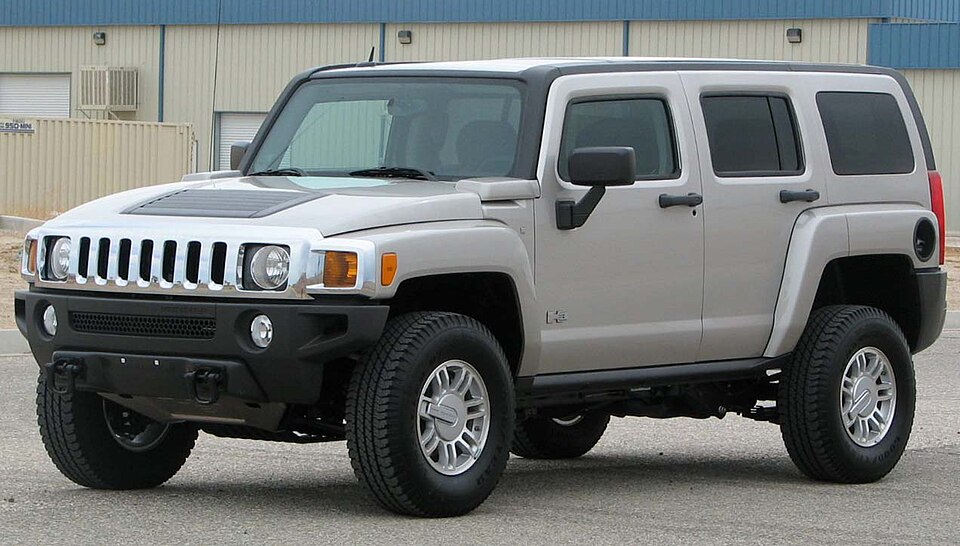
GM tried to sell the brand to Sichuan Tengzhong; Chinese regulators declined to approve it and the deal died in early 2010. The brand was wound up with the rest of the cull. In 2020 GM brought the name back as the GMC Hummer EV — a 9,000-pound electric pickup — which is the neatest available proof that what died was the division, not the name. Names are cheap. Dealer networks and product programmes are not.
Geo: a badge that was never really a brand

Geo existed from 1989 to 1997 to solve a specific problem: Chevrolet dealers needed small, efficient, cheap cars, and Chevrolet could not build them profitably in America. So GM assembled a brand out of other people's engineering — the Metro was a Suzuki, the Prizm a Toyota Corolla from the NUMMI joint venture in Fremont, the Storm an Isuzu, the Tracker a Suzuki again.
It worked, in that the cars sold. It failed as a brand because it had no engineering identity of its own to defend, and because the marketing effort required to establish a new marque was hard to justify for products that could simply wear a bowtie. Geo was folded back into Chevrolet for 1998, the cars continuing unchanged with different badges — a brand death with no funeral, because there was no body.
Chrysler's amputations
Chrysler has always been the most financially fragile of the Detroit three, and it shows in the brand count. It has entered near-death twice — the 1979 federal loan guarantees, the 2009 bankruptcy — and each crisis cost it marques.
Plymouth (1928–2001)


Walter Chrysler launched Plymouth in 1928 to give his company a fighter in the low-price field against Ford and Chevrolet, and for decades it was the volume engine of the corporation. It also had genuinely great moments: the Barracuda arrived in 1964, the Road Runner in 1968 turned a cartoon licence into an honest cheap muscle car, and the winged Superbird of 1970 was one of the most extreme production cars America has ever homologated.
Plymouth's most important contribution was the 1984 minivan — the Voyager, alongside Dodge's Caravan, a package that reshaped the American family car for twenty years and arguably saved Chrysler.
That is precisely the problem. Every Plymouth had a Dodge twin. When Chrysler needed to cut costs in the late 1990s, Plymouth was carrying almost no unique product: a Neon that was also a Dodge, a Voyager that was also a Caravan, a Breeze that was also a Cirrus. Only the Prowler, the retro hot-rod of 1997, was distinctly its own thing, and it sold in tiny numbers. DaimlerChrysler announced the end in 1999 and closed the brand in 2001.
DeSoto (1928–1961)

DeSoto was launched the same year as Plymouth to occupy the space between Dodge and Chrysler, and it spent thirty years being squeezed from both sides. Its best era was the mid-1950s, when Virgil Exner's "Forward Look" gave it tailfins, glass and a genuine sense of occasion.
Then three things happened at once. Exner's 1957 cars, though visually stunning, had serious build and rust problems that damaged the whole corporation's reputation. The 1958 recession hit mid-price makes hardest. And Chrysler itself pushed Dodge upmarket while pulling Chrysler-branded cars down, closing the gap DeSoto lived in. The brand was terminated in late 1960, weeks into the 1961 model year — one of the abrupter deaths in the industry, with dealers learning their franchise was worthless almost overnight.
Eagle and Imperial
Eagle was an accident of acquisition. When Chrysler bought AMC in 1987 it wanted Jeep, but it also inherited the Renault-derived Premier sedan and a network of dealers who needed cars. Eagle was invented to hold them: the Premier, the Talon (a Mitsubishi from the Diamond-Star joint venture in Illinois), the Summit, and later the handsome Vision from the LH platform. It had no coherent story, and it was gone by 1998.
Imperial is the odder case — Chrysler's flagship, spun out as a standalone marque from 1955 to 1975 to compete directly with Cadillac and Lincoln, then revived twice as a model name in the 1980s and early 1990s. It never established itself as a separate brand in customers' minds, which is the whole difficulty of creating luxury marques from below.
Ford: one famous catastrophe and two slow suffocations
Edsel (1958–1960)

The Edsel is the most famous product failure in industrial history, and most of what people remember about it is the grille. The vertical "horse collar" was a deliberate attempt to give the brand instant visual identity in an era of horizontal chrome, and it read to many buyers as awkward at best.
The grille was not the problem. The problem was everything else. Ford spent years and an enormous sum developing a new medium-price division to sit between Ford and Mercury, then launched it in September 1957 — directly into a sharp recession that hammered exactly the mid-price segment Edsel was built to occupy. The car itself was largely shared with Ford and Mercury bodies, so it offered no engineering reason to exist. The Teletouch push-button automatic, with its buttons in the steering wheel hub, was clever and unreliable. Early build quality was poor because Edsels were assembled on lines alongside Fords by workers handling two different specifications.
Above all, Ford had to build a dealer network from scratch and did it by recruiting aggressively, which meant a lot of undercapitalised dealers in bad locations selling a car the public had been told to expect miracles from. Ford killed it in November 1959, weeks into the 1960 model year, having lost a sum usually quoted around a quarter of a billion dollars of the era's money.
Mercury (1939–2011)

Edsel Ford created Mercury for the 1939 model year to fill the enormous gap between a Ford and a Lincoln, and for a while it was one of the great American brands — the 1949 Mercury became the definitive lead sled of custom culture, and the 1967 Cougar was a genuinely distinct, better-dressed alternative to the Mustang.
Mercury's slow death is the purest example of the overlap problem. Ford moved upmarket in content and price. Lincoln moved down. The middle collapsed, and Mercury's product line became a set of Fords with different grilles and a slightly softer ride: the Sable was a Taurus, the Milan a Fusion, the Mariner an Escape, the Mountaineer an Explorer. Even the Grand Marquis, a real success with a loyal following, was a Crown Victoria.
By the late 2000s almost every Lincoln-Mercury dealer sold both brands from the same building, so the badge added distribution cost without adding reach. Ford announced the closure in June 2010 and stopped production by the end of that year, redirecting the money into making Lincoln credible — a project still ongoing.
Merkur (1985–1989)
Merkur was Ford's attempt to sell European Fords in America without calling them Fords, on the theory that a German-sounding badge would let Lincoln-Mercury dealers charge BMW-adjacent prices. The XR4Ti was a Sierra XR4i fitted with the American 2.3-litre turbocharged four, and it was a genuinely good driver's car; the Scorpio was a large hatchback saloon with standard anti-lock brakes.
It failed for a stack of small reasons that add up to one large one. Americans could not pronounce it. It was sold by a fraction of Lincoln-Mercury dealers, many of whom had no idea what to do with it. The Deutschmark strengthened against the dollar, destroying the price positioning. And upcoming US passive-restraint and crash requirements would have demanded expensive re-engineering of low-volume imports. Ford withdrew in 1989 rather than pay.
The classical-era independents, killed by the Depression
Before the Second World War, America supported a genuine luxury and near-luxury industry with dozens of independent makers. The 1929 crash and the decade that followed removed almost all of them, because the customers for hand-built 16-cylinder cars were exactly the customers whose wealth evaporated.
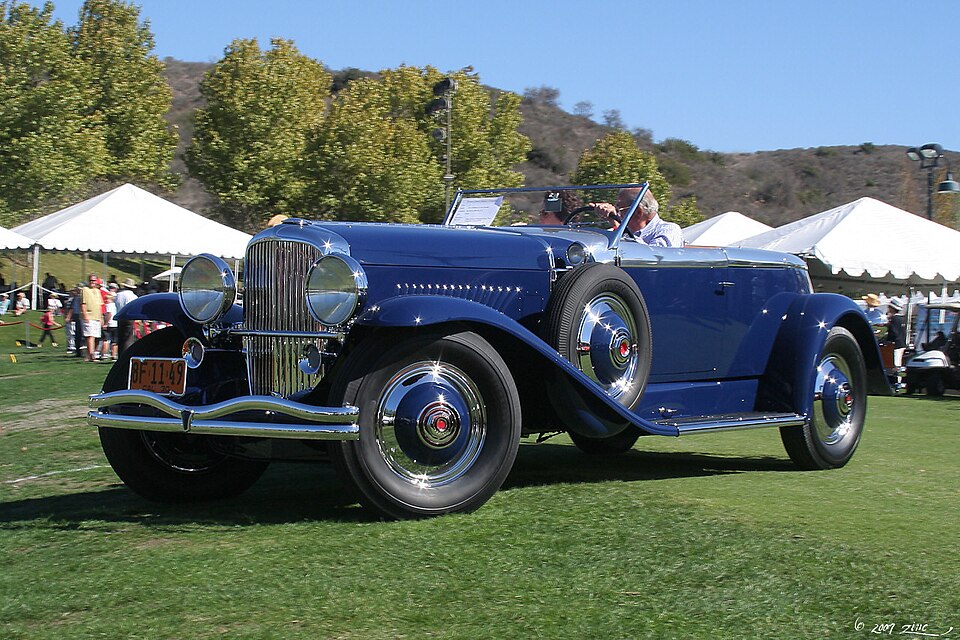
Duesenberg was the summit. Fred and August Duesenberg were racing engineers — a Duesenberg won at Le Mans in 1921 — and after E.L. Cord bought the company, the Model J of 1928 arrived with a twin-cam straight-eight rated at roughly 265 horsepower at a time when a good American car made about 70. Supercharged SJ versions went higher still. You bought a chassis and had a coachbuilder body it. It was the most expensive American car by a wide margin, and there were not enough buyers left after 1929.
Cord was the same empire's technical adventure: the L-29 of 1929 was one of the first American production cars with front-wheel drive, and the 810/812 of 1936, designed by Gordon Buehrig, remains one of the most striking objects the industry has produced — the "coffin nose" with concealed headlamps cranked up by hand.
Auburn, the third pillar of the Auburn-Cord-Duesenberg group, sold style at a mid-range price: the 851 and 852 Speedsters of the mid-1930s, with their boat-tail rears and external exhaust pipes, each came with a certificate confirming the car had exceeded 100 mph. The whole group collapsed in 1937.
Pierce-Arrow of Buffalo, New York, built cars whose headlamps grew out of the front wings — an identifying feature so distinctive it functioned as a logo. Studebaker took control in 1928 and dragged it down when Studebaker itself entered receivership in 1933; Pierce-Arrow struggled on to 1938.
Stutz of Indianapolis made its name at the racetrack and its money with the Bearcat, then in the 1920s pivoted to the "Safety Stutz" with a low chassis, laminated glass and hydraulic brakes. It ended in the mid-1930s. The name was revived in the late 1960s for neoclassical coupes built on GM underpinnings and sold to entertainers, which is a different kind of afterlife.
Franklin of Syracuse built air-cooled engines for three decades on the sound argument that a system with no water cannot freeze or boil. It was expensive to make and increasingly out of step, and the company failed in the early 1930s. Its engine business survived, and — via a helicopter engine — would resurface in the strangest place in this article.
Marmon of Indianapolis has the best single credential in American motoring: the Marmon Wasp, driven by Ray Harroun, won the first Indianapolis 500 in 1911. Its final act was the Marmon Sixteen of 1931, an aluminium V16 that was one of the finest engines of the era and arrived in the worst possible year. Passenger car production ended in 1933; the truck side lived on as Marmon-Herrington.
Hupmobile was a solid Detroit mid-price maker that hired Raymond Loewy for styling in the early 1930s, then made a last desperate move: it bought the body dies for the dead Cord 810 and used them for the Skylark. Building the tooling into a workable production process took too long, and the company stopped in 1940.
Graham-Paige did the same thing with the same dies at the same time — its Hollywood shared the Cord bodywork — after the striking "sharknose" Graham of 1938 failed to find buyers. It stopped making cars around 1940 and its remains went into the creation of Kaiser-Frazer after the war.
Terraplane was Hudson's low-price brand of the 1930s, launched with an aviation theme and christened at a ceremony with famous aviators present. It was fast and light for the money and it sold well, but it was absorbed back into Hudson before the decade was out — another demonstration that sub-brands are much easier to launch than to sustain.
The postwar independents: everything except scale
After 1945 there was a seller's market. Anyone who could build a car could sell it, and the independents enjoyed a few golden years. Then Ford and GM finished retooling, started a price war in the early 1950s, and the independents discovered they could not match Detroit's costs, tooling budgets or dealer counts.


Studebaker of South Bend, Indiana had been building wagons since the 1850s and was the only wagon maker to make the transition to cars successfully. It also had the best design instincts of any independent: the 1947 Starlight coupe with its wraparound rear glass, the beautiful 1953 Starliner, the sensible compact Lark of 1959, and the fibreglass-bodied Avanti of 1962, styled by Raymond Loewy's team in a rented house in Palm Springs in about two weeks.
Design was never the problem. Studebaker's costs per car were higher than the Big Three's, its labour agreements were expensive, and its plant was old. It merged with Packard in 1954 in a combination that helped neither. South Bend closed in December 1963 and the last cars were built in Hamilton, Ontario, in 1966.

Packard was, for the first third of the century, America's pre-eminent luxury make — "Ask the Man Who Owns One" — with a Twin Six V12 as early as 1916 and a reputation that genuinely rivalled Rolls-Royce. Its fatal decision was rational: in 1935 it launched the mid-price One-Twenty to survive the Depression, and it worked. It also meant that by 1945 a Packard was a car a dentist bought, not a car a magnate bought, and Cadillac took the top of the market permanently.
The 1954 merger with Studebaker was meant to create a full-line independent. Instead the combined company had two ageing plants, two dealer networks and no money. Genuine Packards ended in 1956; the 1957–58 cars were rebadged Studebakers that collectors call "Packardbakers", and the badge died with them.
Hudson built the most technically interesting American car of the late 1940s. The "step-down" design of 1948 dropped the floor pan inside the frame rails, giving a very low centre of gravity and outstanding handling. The Hornet, with its big flathead six, dominated early stock car racing — Hudsons won a remarkable share of NASCAR events in the early 1950s. But the step-down's unitised structure was expensive to restyle, and while the Big Three brought out new bodies every couple of years, Hudson could not afford to. It merged with Nash in 1954.

Nash was run by Charles Nash, a former president of General Motors, and it was consistently the most innovative independent: unibody construction on the 600 in 1941, serious aerodynamic work, integrated heating and ventilation, and — most importantly — the Rambler of 1950, which established the American compact car a decade before Detroit took the idea seriously.
The Nash-Hudson merger of 1954 created American Motors, at the time the largest corporate merger in US history. Under George Romney, AMC bet everything on the compact car and, for a few years around 1960, won: the Rambler brand became the third best-selling make in America.

AMC's story afterwards is the independent's dilemma in miniature. It could afford roughly one all-new product at a time. When it spent that money well — the Javelin and AMX, the Hornet, the Jeep acquisition in 1970, the Eagle 4WD wagon of 1980 that essentially invented the crossover — it prospered briefly. When it spent it on the Pacer, it did not. Renault took a controlling interest at the start of the 1980s, Chrysler bought the company in 1987 for Jeep, and the AMC badge disappeared within a year.
Kaiser and Frazer were the great postwar startup: shipbuilder Henry J. Kaiser, who had turned out Liberty ships at extraordinary speed, teamed with veteran car executive Joseph Frazer and took over the vast Willow Run bomber plant. Their first cars in 1947 sold well into the postwar vacuum. But Kaiser had no V8 and no money to develop one, its compact Henry J was too spartan to succeed, and the price war of the early 1950s destroyed its margins. It left the US passenger car market in the mid-1950s, though it continued building cars in Argentina for years.
Willys-Overland of Toledo, Ohio had been the second largest American car producer behind Ford in the late 1910s, then never recovered from the 1920s. Its salvation and its ending were the same vehicle: the Jeep. Willys built the wartime MB and turned it into the civilian CJ, and by the early 1960s the Jeep business so dominated the company that — after Kaiser bought it in 1953 — the corporate name was changed to Kaiser Jeep and the Willys badge simply stopped being used.
Tucker and DeLorean: the startups everybody remembers
Preston Tucker's 1948 sedan is the most famous American car that almost nobody owns: 51 were built. The specification was genuinely radical — a rear-mounted flat-six adapted from a helicopter engine (built by Air-Cooled Motors, the descendant of Franklin), a padded dashboard, a pop-out safety windscreen, and a third central "Cyclops" headlamp that turned with the steering.
Tucker's failure had two causes and people still argue about the ratio. The first is ordinary: he was undercapitalised, his production plans were wildly optimistic, and his fundraising methods — including selling dealer franchises and accessories for cars that did not exist — were legally exposed. The second is the SEC investigation and 1949 fraud indictment, which destroyed what remained of investor confidence. He was acquitted on all counts in early 1950, by which time the company was already gone. Whether he was crushed by Detroit or by his own accounting is a debate that has kept the story alive for seventy-five years.
DeLorean is the same story with better cinema. John Z. DeLorean had run Pontiac during its greatest era and became the youngest division head in GM's history before leaving to build his own car. The DMC-12 had a Giugiaro body in unpainted stainless steel, gullwing doors, a backbone chassis engineered by Lotus under Colin Chapman, and a Peugeot-Renault-Volvo V6 hung out behind the rear axle where it made the car handle exactly as you would expect.
It was built in Dunmurry, outside Belfast, funded heavily by a British government desperate for Northern Irish jobs. Roughly 9,000 cars were built before the company entered receivership in early 1982, undone by a recession, a strong dollar, a car that was slower than it looked and a factory staffed by a workforce with no automotive experience. DeLorean's arrest later that year in a cocaine trafficking sting — he was acquitted on entrapment grounds — turned a business failure into a permanent piece of American folklore, and Back to the Future did the rest.
The EV era repeats the lesson at speed
The 2020s produced a second wave of American brand deaths, and the mechanism was almost identical to Tucker's — with a SPAC merger in place of a stock offering.
Fisker managed it twice. Fisker Automotive's Karma of 2011 was a stunning plug-in hybrid designed by Henrik Fisker himself, built by Valmet in Finland, and troubled by battery recalls, a supplier bankruptcy, and a batch of new cars destroyed by flooding at Port Newark during Hurricane Sandy. The company failed in 2013 and its assets went to a Chinese buyer. Fisker Inc., founded in 2016, contracted Magna Steyr in Austria to build the Ocean SUV — genuinely clever hardware — but shipped it with software so unfinished that basic functions failed, then ran out of cash in 2024 with no service network to support the cars already sold.
Lordstown Motors bought GM's old Lordstown, Ohio plant and promised an in-wheel-motor electric pickup. A short-seller report in 2021 alleged its pre-orders were far less firm than presented; the founder resigned, the plant went to Foxconn, and the company filed for Chapter 11 in 2023 having built a very small number of Endurance trucks.
Nikola promised hydrogen fuel-cell heavy trucks and reached a market capitalisation briefly exceeding Ford's on the strength of them. A 2020 short-seller report demonstrated that a prototype in a promotional video had been rolled down a hill rather than driven. Founder Trevor Milton was convicted of fraud in 2022; the company filed for bankruptcy in 2025, having actually delivered some battery-electric trucks in the meantime — which arguably makes it the most and the least real of the group.

Canoo had the most distinctive product idea of the lot: a slab-sided, cab-forward lifestyle van sold on subscription, plus a delivery van and a genuinely useful pickup concept. It won a contract to supply crew transport vehicles to NASA and an order commitment from a major retailer. It never got production volume, burned through repeated capital raises, and liquidated in early 2025.
The five ways an American car brand dies
| Cause | Mechanism | Examples |
|---|---|---|
| Insufficient scale | Fixed development and tooling costs spread over too few cars | Studebaker, Packard, Hudson, Nash, Kaiser |
| Demand shock | The customer base disappears faster than the product plan can adapt | Duesenberg, Marmon, Pierce-Arrow, Edsel, Hummer |
| Brand overlap | A sibling in the same group covers the same ground more cheaply | LaSalle, Plymouth, DeSoto, Mercury, Pontiac |
| Distribution failure | No dealer network, or a network too small, too weak or too expensive | Merkur, Edsel, Geo, Fisker, Canoo |
| Capital exhaustion | Money runs out before production volume arrives | Tucker, DeLorean, Lordstown, Nikola |
Most dead brands died of at least two of these at once. Edsel had a demand shock and a distribution failure. Pontiac had brand overlap and a demand shock. Fisker managed capital exhaustion and distribution failure in the same eighteen months.
The one pattern worth noticing is that quality of product barely appears. Saturn had the happiest customers in America. The Cord 810 is in museums as industrial art. The Hudson Hornet won races. The Pontiac G8 was praised by everyone who drove it. Being good is not a defence against arithmetic.
Which of today's badges are already ghosts?
The useful thing about this history is that it gives you a checklist to point at the current market. Ask of any badge: does it have unique engineering, or is it a grille on someone else's platform? Does it have a dealer network that other brands do not already cover? Does it have a customer whose average age is falling? And is anyone funding its next product, or only its current one?
Run that test across the brands on sale right now — the luxury sub-brands with one bespoke model, the EV startups with a fifth funding round and no plant, the American marques whose lineup is entirely shared with a sibling — and the shortlist writes itself. Somebody in Lansing signed the headliner of the last Alero in 2004. Somewhere, right now, a badge is being quietly moved from a brand plan into a trim level, and nobody has told the dealers yet.


